How does Kaiyukan rank among the world's aquariums?
There is no official world aquarium ranking, so this page gives the checkable numbers: tank volumes, species counts, visitor milestones and reviews that show where Kaiyukan actually stands.
How does Kaiyukan rank among the world's aquariums?
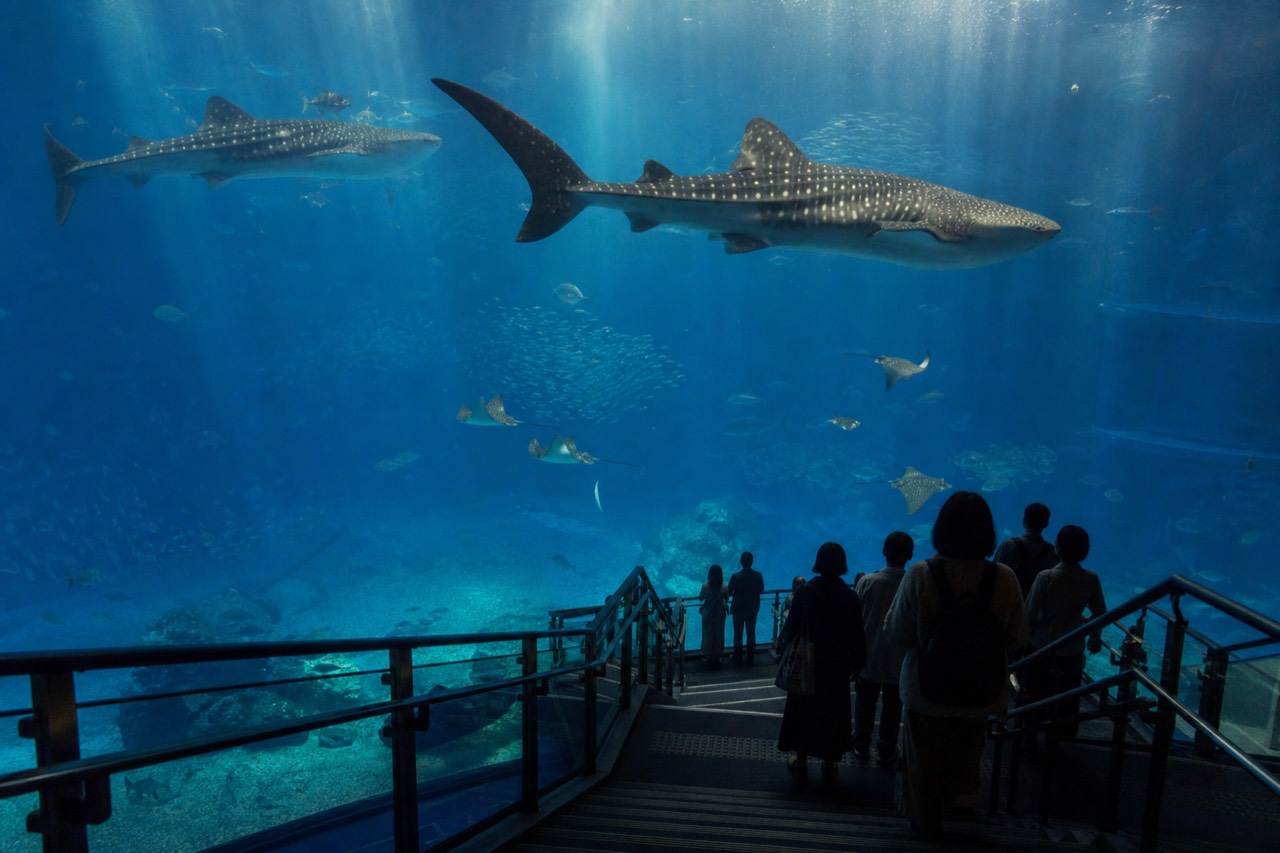
There is no official world ranking of aquariums, and any list claiming to name "the number one aquarium in the world" is an editorial opinion, not a measured result. What can be checked are figures: Kaiyukan holds about 11,000 tons of water in total, keeps about 620 species and about 30,000 animals, and passed 90 million cumulative visitors on 1 October 2025.
Those numbers come from the aquarium itself and from Japan's zoo and aquarium association, and they are the honest basis for any ranking claim. Kaiyukan's own school-visit pages state the total water volume, about 11,000 tons, and the animal counts, about 620 species and 30,000 animals, figures also printed on its introductory pages. Its corporate history, published in full on the official site, documents every visitor milestone from 1 million in 1990 to 90 million in 2025, a paper trail very few aquariums anywhere can match.
Why does this matter for the ranking question? Because almost every "top 10 aquariums in the world" article you will find online was written without consulting any of this. They recycle superlatives, mix up tank volumes, and quietly disagree with each other about which aquarium holds which record. Some put Osaka Aquarium first, some third, some leave it out entirely, and none of them cite a source that could be checked. When a ranking cannot be falsified, it is not a ranking, it is a mood.
The one ranking that does exist in a verifiable form is guest review scores, and there Kaiyukan performs strongly. Its ticket on the live listing carries a 4.8 rating across about 14,894 reviews, one of the largest verified review samples for any aquarium ticket in Japan. That is a large, current sample from paying visitors, which is more than most "world's best" lists can say for themselves.
If you are planning a visit around these figures, the practical takeaway is that Kaiyukan's popularity is real, not just marketing: the crowds that produce 90 million visits also fill the daily time slots, especially the cheap ones.
Is there an official world aquarium ranking?
No. No international body publishes a ranked league table of aquariums, and the two closest organizations, the World Association of Zoos and Aquariums and the Japanese Association of Zoos and Aquariums, publish membership lists rather than rankings. Any "number one aquarium" claim you have read online is a writer's opinion, and Kaiyukan appears at different positions depending on who wrote the list.
The association that actually covers Kaiyukan is the Japanese one. Kaiyukan is listed as a member of the Japanese Association of Zoos and Aquariums, under its English name, Osaka Aquarium KAIYUKAN. JAZA is itself an association member of the World Association of Zoos and Aquariums, but Kaiyukan is not individually listed on WAZA's own member roll, which was checked entry by entry and contains no aquarium by that name. So an accurate sentence is "a member of JAZA", not "a WAZA-accredited aquarium", a distinction most ranking articles never bother to make.
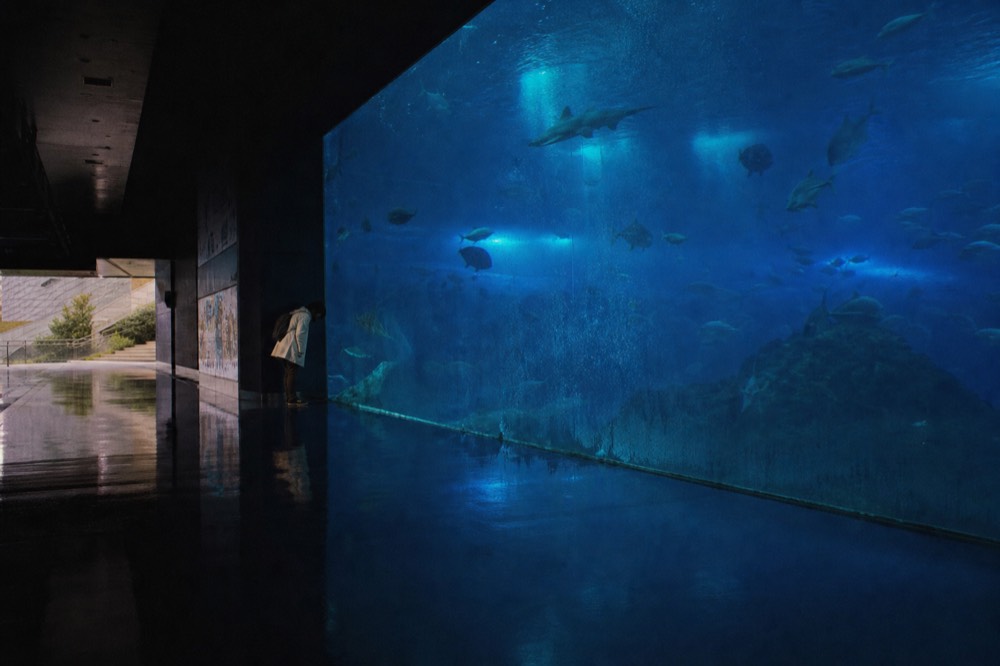
What about the superlatives? Kaiyukan is often described as "one of the world's largest aquariums", a phrase that is defensible but loose. By total water volume, about 11,000 tons, it is enormous by any standard, and its central tank is genuinely exceptional on its own terms. But "largest" depends on the metric: number of animals, floor area, tank volume, or building footprint all give different winners, and several giant aquariums built in the last two decades in China and the Middle East outclass everything in Japan on raw volume. An honest ranking article has to say which yardstick it is using, and most do not.
There is one more institutional distinction worth knowing, because it is often misreported in ranking copy. Kaiyukan was certified a museum-equivalent facility by the Osaka Prefectural Board of Education in July 1994, a formal recognition of its research and educational function that many listicle writers either ignore or inflate into claims of international accreditation. It also runs its own biological research institute, the Osaka Aquarium Biological Research Institute Ibuki Center in Tosashimizu, Kochi, opened in September 1997, which is the facility that collected the ocean sunfish now swimming in the Pacific tank. These are checkable facts about the institution's standing that no popularity ranking captures.
The useful substitute for a world ranking is a like-for-like comparison with aquariums whose own operators publish checkable figures. Within Japan that comparison is easy to make, and later in this article we run it with each venue's own published numbers. Across borders it gets murkier, because non-Japanese aquariums publish their scale in different units, if at all.
How big is Kaiyukan's Pacific Ocean tank compared to other famous tanks?
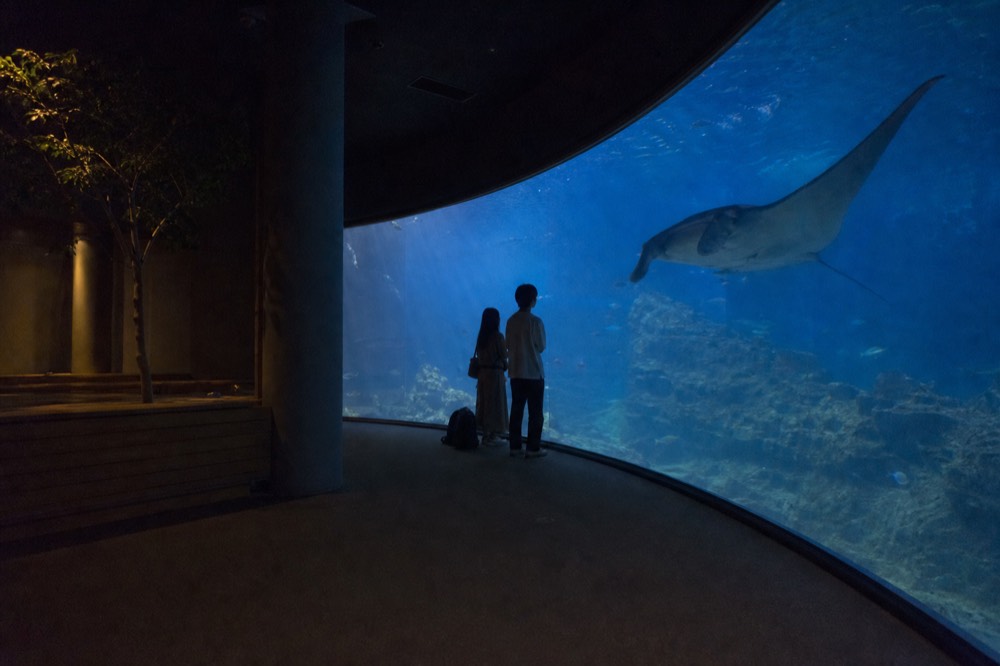
Kaiyukan's central Pacific Ocean tank holds 5,400 tons of water, reaches a maximum length of 34 metres and a depth of 9 metres, and it is the largest tank in Japan by water volume that is openly published by its operator. It is the tank that makes the whole building work: visitors descend from the 8th floor around it, seeing the same water at every depth.
The figures come from two official Kaiyukan sources that agree with each other: the facilities pages and the school-visit pages, which state the tank's maximum length, depth and volume directly. For context inside Japan, the Port of Nagoya Public Aquarium's main pool, which its operator calls the largest pool in Japan, measures 60 metres long by 30 metres wide by 12 metres deep, but Nagoya publishes dimensions rather than a tonnage, so the two tanks cannot be compared on volume alone. Kyoto Aquarium's main tank holds about 500 tons. Sumida Aquarium's penguin pool holds about 350 tons.
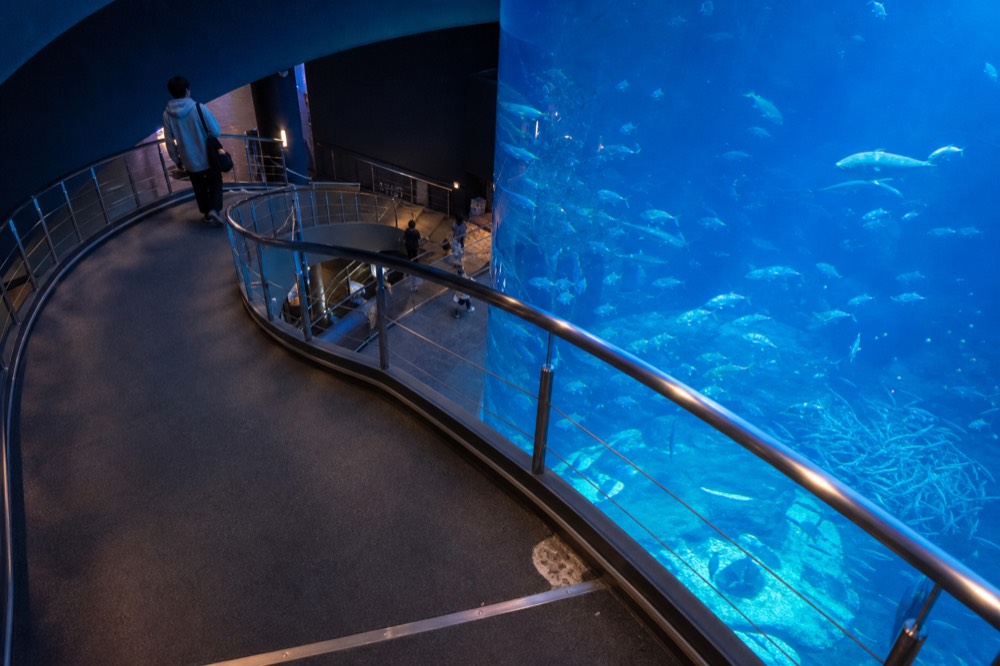
What makes the Pacific tank unusual in world terms is not just size but design. Kaiyukan's building is a spiral: you enter through the Aqua Gate tunnel tank, ride an escalator to the 8th floor, and walk down and around the central tank, floor by floor, viewing the same animals from eight different depths. The aquarium's own description of the structure is a spiral descent from the upper floors. Most large aquariums elsewhere show their signature tank from one or two vantage points.
| Kaiyukan scale figure | Published value | Source type |
|---|---|---|
| Total water volume, all tanks | About 11,000 tons | Operator's school-visit pages |
| Pacific Ocean tank volume | 5,400 tons | Operator |
| Pacific Ocean tank maximum length | 34 m | Operator |
| Pacific Ocean tank depth | 9 m | Operator |
| Species on display | About 620 | Operator |
| Animals on display | About 30,000 | Operator |
| Exhibition tanks | 14 large and small | Operator |
| Building height | 30 m, or 50 m including the glass upper section | Operator |
Set against the other big Japanese tanks, the Pacific tank's position is clearer still. The table below uses only figures each operator publishes itself, which is why some cells show dimensions and others show tonnage: no honest single-unit table across all these venues is possible, and that limitation is itself part of the answer to the ranking question.
| Signature tank | Venue | Published figure |
|---|---|---|
| Pacific Ocean | Kaiyukan, Osaka | 5,400 tons, max length 34 m, depth 9 m |
| Main pool | Port of Nagoya Public Aquarium | 60 m long, 30 m wide, 12 m deep |
| Kyoto Sea | Kyoto Aquarium | About 500 tons of artificial seawater |
| Penguin pool | Sumida Aquarium, Tokyo | About 350 tons |
| Bluefin tuna tank | Tokyo Sea Life Park, Kasai | 2,200 cubic metres |
One more moat fact that ranking lists never mention: Kaiyukan does not use the sea in front of it. The mouth of the Aji River swings too much in salinity and turbidity, so seawater for the tanks is trucked in, about 350 tons per delivery run, according to the aquarium's own facilities team. An aquarium this size that ships in its own ocean is a genuine engineering outlier, and it is a checkable claim from the operator's own blog.
What do visitor numbers say about Kaiyukan's standing?
Kaiyukan passed 90 million cumulative visitors on 1 October 2025, its 12,541st day of operation, and it hit its first million just 40 days after opening in 1990. Very few aquariums anywhere have published, dated attendance milestones covering their entire history, so on the evidence that can actually be verified, Kaiyukan sits in the top tier of visited aquariums in the world.
The full milestone list is on the aquarium's own corporate history page, cross-referenced on the official site: 5 million in 1991, 10 million in 1992, 20 million in 1995, 30 million in 1999, then 40, 50, 60, 70 and 80 million at remarkably steady intervals, and 90 million in 2025. That even spacing matters. It shows sustained demand across three and a half decades, not a single post-opening spike followed by decline, which is the pattern that undresses many "world famous" attractions.
| Milestone | Date reached | Days after opening |
|---|---|---|
| 1 million | 28 August 1990 | 40 |
| 5 million | 7 July 1991 | 353 |
| 10 million | 21 August 1992 | 756 |
| 30 million | 11 June 1999 | 3,193 |
| 80 million | 7 September 2021 | 11,069 |
| 90 million | 1 October 2025 | 12,541 |
The building opened on 20 July 1990 together with the Tempozan Marketplace next door, and turned 36 in 2026. For comparison within Japan, Kyoto Aquarium opened in 2012, Sumida Aquarium in Tokyo in 2012, NIFREL in Suita in 2015, and the Port of Nagoya Public Aquarium in 1992. Kaiyukan is the oldest of that group and still out-draws most of them, which is the strongest available evidence for its staying power.
If those crowds are part of your planning, the practical detail to know is that admission now runs in capped 15-minute time slots, introduced explicitly to control crowding, and same-day re-entry ended in June 2026. A timed e-ticket is how you convert a famously busy aquarium into a calm one, as our Kaiyukan ticket guide explains in detail.
How does Kaiyukan compare with Japan's other big aquariums?
Within Japan the comparison is checkable, and it favours Kaiyukan on scale and species: about 620 species and 30,000 animals against Nagoya's about 500 species and 50,000 animals, Kyoto's about 200 species, and Sumida's per-tank counts. On price, Kaiyukan is the most expensive of the group at ¥2,800 to ¥3,500 for an adult, because it is the only one using demand-based variable pricing.
Every figure in the table below was read from each operator's own site, and notably, none of the other venues uses seasonal or demand-based pricing at all. Their price pages were each checked and contain no variable-pricing wording, so a single adult figure is honest for each of them. Kaiyukan is the outlier: its adult admission moves with a date-by-date price calendar, running ¥2,800 to ¥3,500 on currently bookable dates, with about three quarters of bookable dates at ¥2,800.
| Venue | Adult admission | Opened | Checkable scale |
|---|---|---|---|
| Osaka Aquarium Kaiyukan | ¥2,800 to ¥3,500 by date | 20 July 1990 | About 620 species, 30,000 animals, about 11,000 t total water |
| Port of Nagoya Public Aquarium | ¥2,030 flat | 29 October 1992 | About 500 species, 50,000 animals; main pool 60 m by 30 m by 12 m |
| Sumida Aquarium, Tokyo | ¥2,700 flat | 22 May 2012 | Ogasawara tank about 45 species, 450 fish; penguin pool about 350 t |
| Kyoto Aquarium | ¥2,600 flat | 14 March 2012 | About 200 species, 10,000 animals; main tank about 500 t |
| Tokyo Sea Life Park, Kasai | ¥700 flat | 10 October 1989 | Over 500 species; tuna tank 2,200 cubic metres |
| NIFREL, Suita | ¥2,400 flat | 19 November 2015 | 8 exhibition zones; scale figures not published |
Two honest caveats belong next to that table. First, Nagoya's main pool is described by its own operator as the largest pool in Japan, and its 50,000 animals beat Kaiyukan's 30,000, so Kaiyukan does not sweep every category even at home. Second, Tokyo Sea Life Park charges ¥700 and holds over 500 species, which makes it the value standout of the group; it is a metropolitan-government facility with a public mandate, and comparing its pricing with a private aquarium's is not quite like for like.
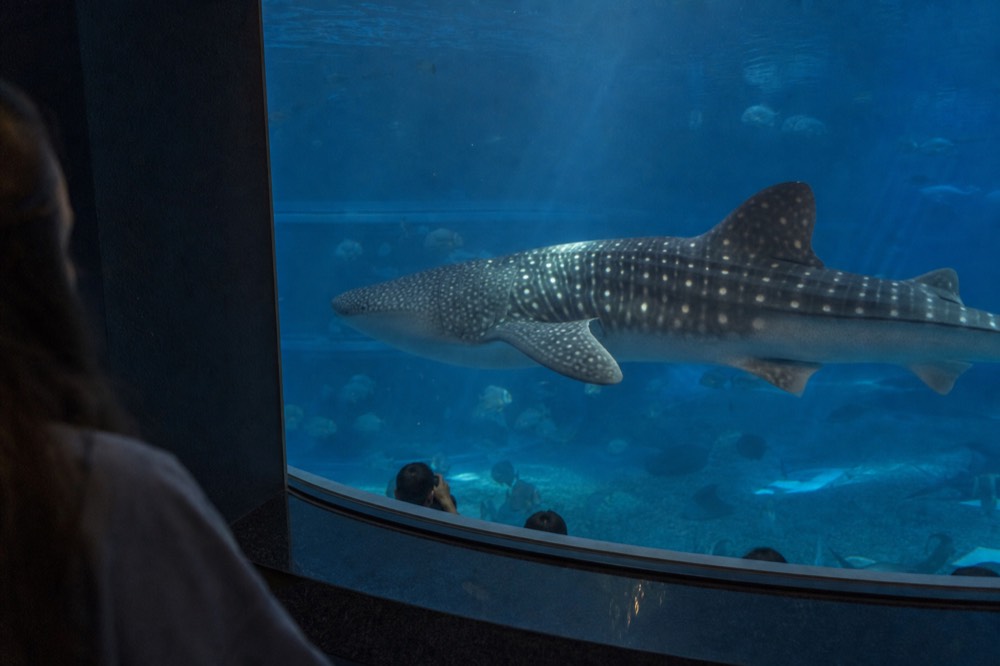
What none of the others has is a whale shark, let alone two. Kaiyukan's Pacific tank held two whale sharks, Kai and Yu, at the aquarium's last published measurement, taken at the end of October 2025, with Yu at 6 m 20 cm and about 1,800 kg. In world terms, whale sharks are the single rarest card a public aquarium can hold, with only a handful of facilities outside Asia ever exhibiting one. For many international visitors that animal alone, covered in more depth in what Kaiyukan is famous for, is the answer to the ranking question regardless of any list.
Kaiyukan also differentiates on exhibit breadth. Its own encyclopedia lists 19 exhibition areas, 18 permanent plus the current temporary show, arranged as 14 large and small tanks recreating 10 world regions, from a Japan Forest on the 7th floor to the Falkland Islands on the 4th. One zone, the Aleutian Islands tank, is currently closed for renovation, so a visitor tallying zones today will count 17 open permanent areas plus the temporary show, a detail no ranking article tracks but which any honest on-the-ground comparison should note.
What do guest reviews say about Kaiyukan's rank?
Kaiyukan's ticket on the live listing is rated 4.8 out of 5 across about 14,894 reviews, and that score is one of the few ranking signals based on a large sample of verified paying visitors rather than a writer's opinion. Among major Japanese aquariums that publish review scores on booking platforms, 4.8 on a sample that size puts Kaiyukan at the top end.
Review-based rankings have their own limits, of course. They measure expectation against experience, not tank volume, and a family with toddlers at an aquarium with a touch pool can rate a smaller venue just as highly. But they are at least transparent: you can see the sample size, read the reviews, and watch the score move. A "top 10 aquariums" listicle shows you none of that.
Kaiyukan's review strength also survives its own popularity, which is the real test. The aquarium operates timed entry in 15-minute slots specifically to control crowding, ended same-day re-entry in June 2026, and still draws enough visitors to reach 90 million. Attractions that rank high on review scores while managing world-scale crowds are rarer than the listicles imply. It is also worth knowing that the aquarium's feeding timetable is published in full by zone, from the 7F penguins at 10:00 and 14:20 to the 4F ringed seals at 10:50 and 15:35, so a well-timed ticket can put you at the glass for the best moments rather than the thickest crowds.
For visitors who want the quiet version of the aquarium, timing matters as much as the ticket: weekday mornings right at opening are the calmest, and the aquarium shifts lighting and music into a moonlit "night" mode from 17:00, covered in our piece on the best time of day to visit Kaiyukan.
So where does Kaiyukan actually stand?
On checkable evidence, Kaiyukan ranks among the world's largest and most-visited aquariums: about 11,000 tons of water, a 5,400-ton central tank, about 620 species including two whale sharks, 90 million visitors since 1990, and a 4.8 review rating across about 14,894 reviews. On pure tank volume it is no longer the biggest on earth, but on combined scale, history and attendance it is in the top tier.
The honest summary is that "rank" depends on the yardstick, and anyone who tells you there is a single answer is guessing. By water volume published by an operator, by the rarity of its whale sharks, by dated attendance records spanning 36 years, and by verified review scores, Kaiyukan belongs in any serious world top tier. By cheapest admission it does not: Tokyo Sea Life Park at ¥700 wins that contest outright, and within its own city NIFREL and Kyoto Aquarium are both cheaper.
That is also why Kaiyukan's variable pricing exists. The aquarium states openly that it sets prices by demand to spread visitors across dates, and on the dates currently bookable, more than three quarters sit at ¥2,800 for an adult, with the rest rising to ¥3,500 on the busiest days. A weekday visit is not just quieter, it is usually the cheapest bookable date, one of the few cases in travel where the best experience and the best price point the same direction.
The six questions below are the ones readers actually ask about Kaiyukan's world standing, and each answer uses only figures the aquarium, its association or its live listing publishes. Taken together they cover the ranking question from every angle: scale, animals, accreditation, price and reviews. If you only remember one point, make it this: no official world ranking exists, so the checkable numbers are the only honest answer.
Common questions about Kaiyukan's world ranking
How does Kaiyukan rank among the world's aquariums?
There is no official world ranking. On verifiable figures, about 11,000 tons of total water volume, a 5,400-ton central tank, about 620 species, 90 million visitors by October 2025 and a 4.8 rating across about 14,894 reviews, Kaiyukan sits in the world's top tier of aquariums by scale, attendance and guest satisfaction.
Is Kaiyukan the number one aquarium in the world?
No ranking authority can award that title, and articles claiming to are unsourced opinions. Kaiyukan is one of the largest and most visited aquariums anywhere, and within Japan it leads on species count and total water volume, but it does not sweep every category even domestically: Nagoya's main pool is larger by dimension and Tokyo Sea Life Park is far cheaper.
Is Kaiyukan the biggest aquarium in Japan?
It is the biggest by the metrics its operator publishes: about 11,000 tons of total water volume and a 5,400-ton central tank. Nagoya's main pool is physically larger in dimensions at 60 by 30 by 12 metres, but its operator publishes no tonnage, so the two cannot be compared on volume. Kaiyukan leads Japan clearly on species, about 620.
How many whale sharks does Kaiyukan have?
Two, named Kai and Yu, at the aquarium's last published measurement taken at the end of October 2025. Kai, male, measured 5 m 30 cm and about 1,100 kg; Yu, female, measured 6 m 20 cm and about 1,800 kg. Kaiyukan occasionally rotates whale sharks, so the count is stated date-scoped.
Is Kaiyukan internationally accredited?
It is a member of the Japanese Association of Zoos and Aquariums, listed under its English name on the association's own member list. It is not individually listed as a member of the World Association of Zoos and Aquariums; JAZA itself holds that association membership, so the link is indirect.
Does Kaiyukan deserve its high review scores?
Its 4.8 rating across about 14,894 reviews is one of the largest verified samples for any aquarium on a booking platform. The score is earned by the spiral layout around the Pacific Ocean tank, the whale sharks, and the breadth of about 620 species, though visitors should book a timed slot, since crowding controls are now strict and re-entry is no longer allowed.