What is Kaiyukan famous for?
Kaiyukan is famous for its 5,400-ton Pacific Ocean tank, its top-down spiral route, its whale sharks Kai and Yu, and a Ring of Fire premise that organises every zone.
What is Kaiyukan famous for?
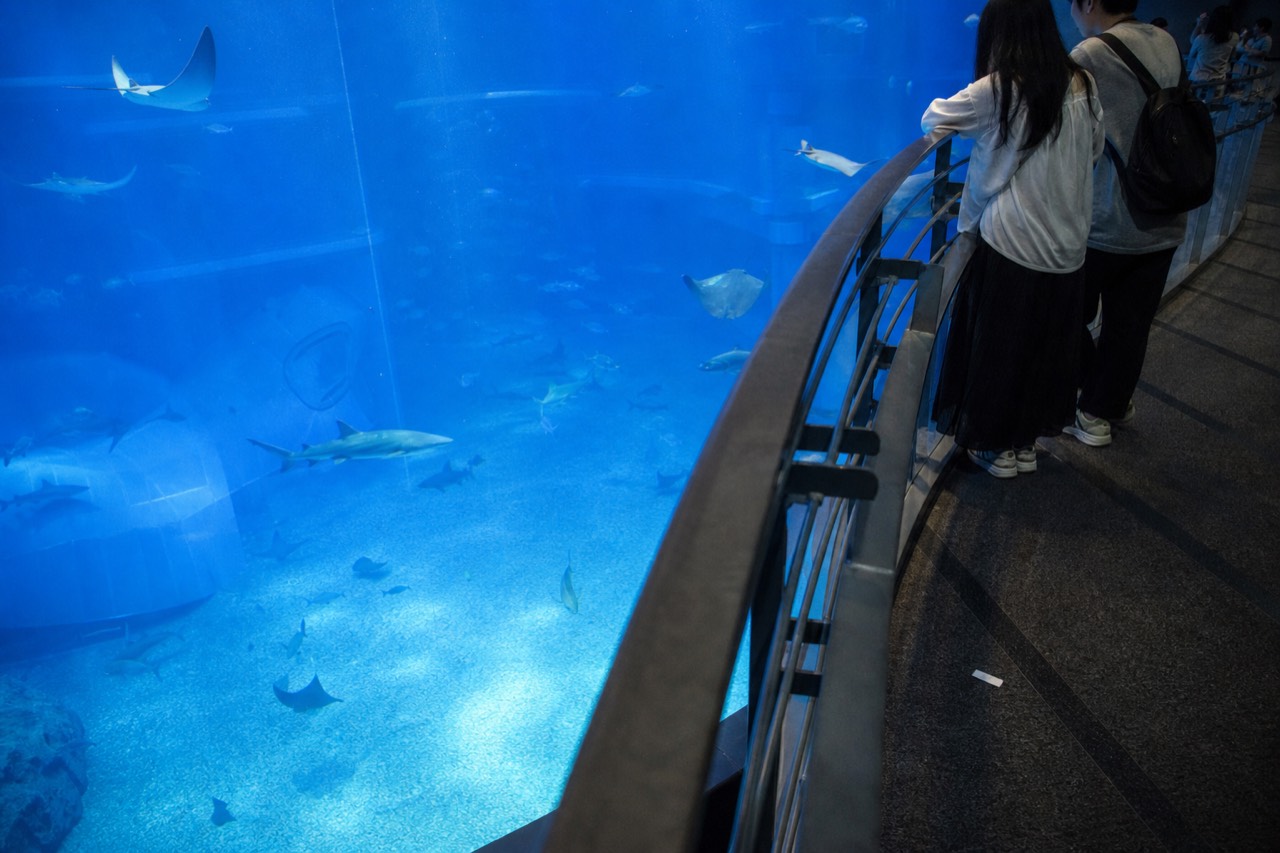
Kaiyukan is famous for three things working together: a 5,400-ton central Pacific Ocean tank, 9 metres deep and 34 metres at maximum length; a top-down spiral route that carries you around that tank from the 8th floor to the 3rd; and the two whale sharks, Kai and Yu, at the centre of it all. Around 620 species and 30,000 animals fill 14 tanks across the building.
Most big aquariums funnel you from tank to tank along a corridor. Kaiyukan, which opened on 20 July 1990 in Osaka's Tempozan Harbor Village, inverts the idea: the building is essentially a ring of habitats around one enormous column of water, and you descend through it like a diver coming up in reverse. The aquarium's own scale figures, published on its school-visit pages, give the total water volume as about 11,000 tons across the whole facility, with the Pacific tank alone holding 5,400 of them.
That tank is the single thing most visitors remember, and it is what put the aquarium on the map: 90 million visitors had passed through by 1 October 2025, a milestone the aquarium itself logged thirty-five years after opening. The Japan National Tourism Organization features it among the country's standout attractions, describing the same spiral descent around the central tank that the aquarium designs its whole route around. The national tourism body's own listing is a good independent read on why the layout matters.
The premise is a second layer of fame. The 14 tanks recreate environments arranged roughly around the Pacific Ring of Fire, from the Japan Forest at the top to the Japan Deep near the bottom, so the route down is also a journey down the volcanic rim and into the ocean itself. For a site dedicated to the attraction, Osaka Aquarium coverage continues across every practical question the visit raises, from tickets to feeding times.
Why is the Pacific Ocean tank such a big deal?
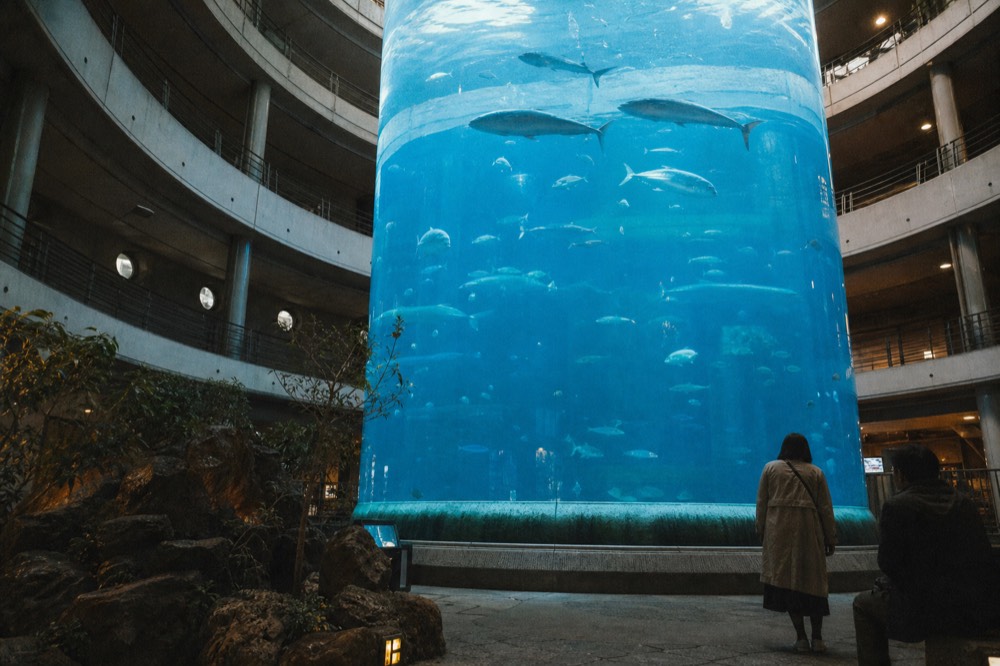
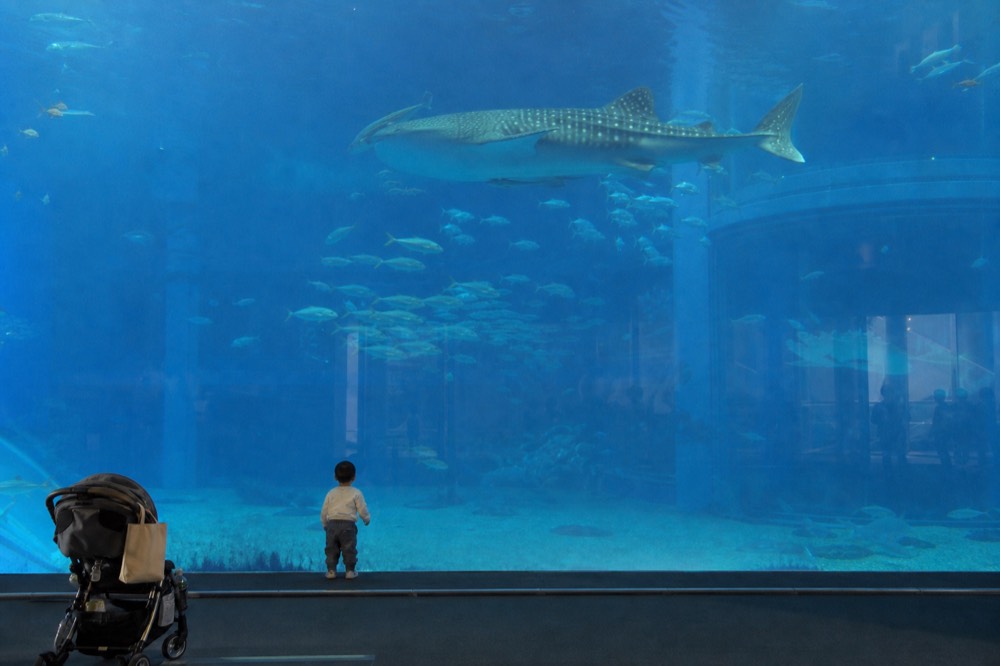
The Pacific Ocean Tank holds 5,400 tons of water, runs 9 metres deep and reaches a maximum length of 34 metres, making it one of the largest single aquarium tanks in the world. It is the heart of the building: every floor of the spiral route looks into it at a different depth, and the two whale sharks live inside it.
Numbers alone undersell the effect. Because the tank sits at the centre of the building and the walkway corkscrews down around it, you meet the same body of water repeatedly: first from the surface on floor 8, where whale sharks feed upside down at the top; then at mid-depth where rays and schooling fish cross; finally at the deep viewing gallery where the water column towers above you. The aquarium describes the experience as feeling like diving down 9 metres, and that is close to what the route achieves without you ever getting wet.
A detail almost nobody mentions: the seawater is not local. The sea immediately in front of the aquarium is the mouth of the Aji River, and its salinity and turbidity swing too much to use. Instead, seawater is collected elsewhere and trucked in, about 300 tons pumped per collection and about 350 tons delivered per run, according to the aquarium's own facilities team. The most famous tank in Osaka is, logistically, a construction project on wheels.
For orientation before you go, our Kaiyukan floors and map guide walks the route floor by floor.
| Pacific Ocean tank figure | Value |
|---|---|
| Water volume | 5,400 tons |
| Depth | 9 metres |
| Maximum length | 34 metres |
| Facility total, all 14 tanks | about 11,000 tons |
| Signature residents | two whale sharks, Kai and Yu |
What is the spiral route, and why does it matter?
The spiral route is Kaiyukan's defining design: an escalator carries you from the entrance to the 8th floor, and you then walk steadily downward around the central Pacific tank, passing 8F, 7F, 6F, 5F, 4F and 3F in order, seeing the same water at every depth before exiting at the Entrance Building 3F.
The aquarium's own wording for the structure is a spiral descent, walking down along the route from the upper floors of the building. In practice this solves the two chronic problems of large aquariums: crowding, because everybody moves the same direction at a natural pace, and narrative, because descending past a tank from surface to seabed mirrors how ocean habitats actually layer. The Monterey Bay zone sits near the top, the Japan Deep near the bottom, and the fall of the building traces the fall of the ocean floor.
Nineteen exhibition areas are listed in the aquarium's own encyclopedia data, 18 permanent plus the current temporary show, arranged across 14 tanks recreating 10 regions. The first thing you meet is the Aqua Gate, a walk-through tunnel tank that opened on 17 April 1998, and it sets the tone: you are inside the water before you have seen a single tank from outside it.
The descent works floor by floor, and the sequence is worth knowing before you arrive, because it tells you where each famous animal lives.
| Floor | What you see |
|---|---|
| 8F | Top of the Pacific Ocean tank, whale shark surface feeding |
| 7F | Japan Forest, Aleutian Islands, Monterey Bay, Gulf of Panama, Antarctica, Tasman Sea |
| 6F | Pacific Ocean mid-depths |
| 5F | Great Barrier Reef, Seto Inland Sea, Coast of Chile, Cook Strait |
| 4F | Arctic Region, Falkland Islands, Japan Deep |
| 3F | Pacific Ocean deep viewing gallery, exit route |
One honest planning note: the route is one-way and there is no going back up. Same-day re-entry ended on 15 June 2026, so once you exit, the visit is over. Budget accordingly, because Kaiyukan itself says a visit runs 90 to 120 minutes. Our page on how long to spend at Kaiyukan breaks that down by travel style.
Kaiyukan itself budgets 90 to 120 minutes, a figure it publishes for school groups, and most independent visitors land in that same window.
What is so special about the whale sharks?
Kaiyukan's two whale sharks, the male Kai and the female Yu, are the aquarium's most famous residents. At the aquarium's last published measurement, taken on 31 October 2025, Kai measured 5 m 30 cm and about 1,100 kg, and Yu measured 6 m 20 cm and about 1,800 kg. Few aquariums anywhere in the world keep the species.
The whale shark is the world's largest fish, capable of over 12 metres, a plankton feeder that in most of the world you only meet by boat. Kaiyukan keeps them in the Pacific tank year-round, and because the spiral route looks into that tank at every depth, you see them from the surface, from the side and from below in a single visit. The official viewing tip is worth knowing: the sharks feed at the surface, upending into a vertical position to suck in food, and the upper floors give the better view of it.
Kai is the newer arrival, having come to the aquarium on 2 October 2024, and by the 2025 measurement had grown 60 cm and about 400 kg since arrival. Yu, at an estimated 18 to 19 years old, is the senior animal. Kaiyukan rotates whale shark individuals back to the sea, so the honest phrasing is two whale sharks at the aquarium's last measurement, not an undated present-tense count.
The Pacific tank has gained other headline residents recently, too. Two sand tiger sharks arrived in May 2025 from the Tokai University Marine Science Museum, the first time the species had been exhibited at Kaiyukan, and a 97 cm male ocean sunfish arrived on 4 July 2025 from the aquarium's own Iburi Center research facility in Kochi. Our dedicated page on the whale sharks at Kaiyukan covers the animals, the feeding positions and the best floors in detail.
What is the Ring of Fire premise?
The Ring of Fire premise is the organising idea behind Kaiyukan's zones: the 14 tanks recreate natural environments arranged around the volcanic Pacific Rim, from the Japan Forest and the Aleutian Islands down through Monterey Bay, the Ecuador Rainforest, Antarctica and the Great Barrier Reef, ending in the Japan Deep.
This is what separates Kaiyukan from a collection of impressive tanks. Each habitat corresponds to a real place on the Pacific's volcanic rim or its ocean floor, and the top-down route doubles as a geographic journey: high-altitude forest at the top, temperate coasts at mid-level, tropical seas and polar waters below, the deep ocean at the bottom. The Great Barrier Reef tank reopened after renovation on 28 November 2024 and is one of the brightest of the mid-route zones.
The zone list, in the aquarium's own English exhibition headings, reads: Japan Forest, Aleutian Islands, Monterey Bay, Gulf of Panama, Ecuador Rainforest, Antarctica, Tasman Sea, Great Barrier Reef, Pacific Ocean, Seto Inland Sea, Seasonal Exhibits, Coast of Chile, Cook Strait, Japan Deep, Aqua Gate, Jellyfish, Arctic Region, Falkland Islands, plus the current temporary show. One honest caveat: the Aleutian Islands tank is closed for renovation, with its animals moving to Aquaworld Ibaraki Oarai Aquarium, so a visit today covers the rest.
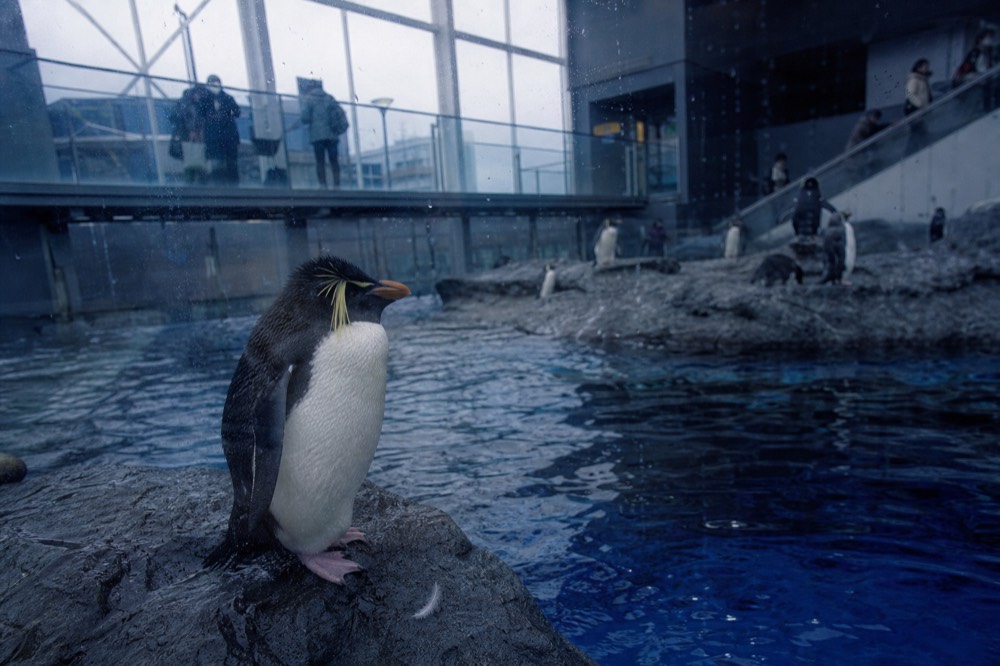
The aquarium publishes a feeding timetable by zone, and it is one of the quiet pleasures of the place. It is a single published timetable with no weekday or weekend variants, and the aquarium's own caveat is that times may be cancelled or changed without notice depending on the animals' condition.
| Floor | Zone | Feeding | Times |
|---|---|---|---|
| 7F | Japan Forest | Otter | 11:30, 13:30, 15:30 |
| 7F | Monterey Bay | Sea lion / seal | 09:50, 13:20, 14:50 |
| 7F | Gulf of Panama | Coati | 11:15, 15:30 |
| 7F | Antarctica | Penguins | 10:00, 14:20 |
| 7F | Tasman Sea | Pacific white-sided dolphin | 11:40, 14:00, 16:30 |
| 6F | Pacific Ocean | Pacific fish | 10:30, 15:00 |
| 4F | Arctic Region | Ringed seal | 10:50, 15:35 |
| 4F | Falkland Islands | Southern rockhopper penguin | 10:50, 15:10 |
How famous is it, in numbers?
Kaiyukan has drawn 90 million visitors since opening on 20 July 1990, reaching that milestone on 1 October 2025, on day 12,541 of operation. It is routinely ranked among Japan's and the world's leading aquariums, and its ticket carries a 4.8 rating across about 14,894 reviews on the operator's live listing.
The visitor-count record is the aquarium's own and it is unambiguous: 1 million within 40 days of opening in 1990, 50 million by day 6,317, and 90 million as of 1 October 2025. Very few attractions anywhere, of any kind, have a per-day throughput like that sustained over three decades.
Against its peers, the honest comparison is that Kaiyukan is the outlier on both scale and pricing. It holds about 620 species and 30,000 animals and about 11,000 tons of water; Tokyo Sea Life Park, the only Tokyo aquarium in its size class, holds over 500 species and charges a flat ¥700. Kyoto Aquarium charges ¥2,600 flat, Port of Nagoya ¥2,030 flat, Sumida ¥2,700 flat. Kaiyukan is the only one of these running demand-based variable pricing, ¥2,800 to ¥3,500 for an adult depending on the date, with 15-minute timed entry slots and a cap on each slot. On the dates currently bookable, more than three quarters sit at ¥2,800 and the rest run up to ¥3,500. The official ticket page sets out the system in the aquarium's own words. Kaiyukan's official ticket information is the source for every price band.
| Aquarium | Adult admission | Opened | Checkable scale |
|---|---|---|---|
| Kaiyukan, Osaka | ¥2,800 to ¥3,500 by date | 20 July 1990 | about 620 species, 30,000 animals, about 11,000 t |
| Tokyo Sea Life Park | ¥700 flat | 10 October 1989 | over 500 species |
| Sumida Aquarium, Tokyo | ¥2,700 flat | 22 May 2012 | Ogasawara tank about 45 species, 450 fish |
| Kyoto Aquarium | ¥2,600 flat | 14 March 2012 | about 200 species, 10,000 animals |
| Port of Nagoya Public Aquarium | ¥2,030 flat | 29 October 1992 | about 500 species, 50,000 animals |
Do you need to plan around the fame?
You do, because the things Kaiyukan is famous for now run on rules that changed in 2026: tickets are sold in 15-minute timed slots with a capped number per slot, same-day re-entry ended on 15 June 2026, and from April 2026 large bags are banned inside, with anything whose three sides total 120 cm or more, or any single side over 70 cm, refused.
The timed-slot system exists precisely to protect the spiral route from the crowding that fame brings. Each slot holds a capped number of visitors, so the descent stays fluid even on busy days; the trade is that you commit to an arrival window when you buy. The aquarium recommends advance purchase of its official e-ticket, and the date and time can be changed later from My Page. Buying from an authorised seller matters here, because the aquarium warns that tickets from anywhere other than its official website and its named partners will not admit you, and that a fake site is actively defrauding overseas visitors.
The bag rule, effective 24 April 2026, is the one that catches travellers with luggage: suitcases and cart-type luggage are not allowed inside at all, and Kaiyukan's advice is to leave oversized bags at your hotel or in the coin lockers at the entrance, in Tempozan Marketplace or under the Ferris wheel. Pets are limited to dogs and cats in a carrier no larger than 50 x 30 x 30 cm.
Crowd timing is the last piece. Weekday mornings right at opening are the quietest periods, and Tuesday and Wednesday are typically the least crowded days. Peak periods to avoid include Golden Week in late April and early May, Obon in mid-August, New Year holidays and Japanese school vacations. If you are combining the visit with the rest of the bay, our Tempozan Ferris Wheel and Harbor Village guide covers the Marketplace, the LEGOLAND Discovery Center and the Santa Maria cruise that all sit within a two-minute walk of the exit.
Visiting with small children is easier than the one-way route suggests: the Maldives Zone has one of Japan's larger touch pools where visitors can touch sharks and rays, and a baby care room with nursing and changing facilities sits on the Entrance Building 2F. Strollers are not rented, but the route mostly uses slopes, and staff provide elevator assistance where stairs or escalators exist. Admission is free for children under 3, and preschoolers aged 3 to 6 pay the lowest tier, from about $4.75 on the live listing.
For the wider context of how the aquarium stacks up nationally, our best aquariums in Japan guide places Kaiyukan alongside its peers, and the aquarium's own beginner's page states the 620-species, 30,000-animal scale verbatim. Kaiyukan's own introduction is the primary source for those figures.
Kaiyukan's fame comes down to a handful of concrete things: the 5,400-ton Pacific tank, the spiral descent, the whale sharks, and a visitor record of 90 million people since 1990. The questions below are the ones readers ask most often about all four.
Common questions about what Kaiyukan is famous for
What is Kaiyukan famous for?
Kaiyukan is famous for its 5,400-ton central Pacific Ocean tank, 9 metres deep and 34 metres at maximum length; the top-down spiral route around it from the 8th floor to the 3rd; its two whale sharks, Kai and Yu; and the Ring of Fire premise that organises the zones around the Pacific Rim.
How many whale sharks does Kaiyukan have?
Two at the aquarium's last published measurement, taken on 31 October 2025: Kai, a male of 5 m 30 cm, and Yu, a female of 6 m 20 cm. Kaiyukan rotates whale shark individuals back to the sea, so the count is stated date-scoped rather than as a permanent number.
How big is the main tank at Kaiyukan?
The Pacific Ocean tank holds 5,400 tons of water, is 9 metres deep, and reaches a maximum length of 34 metres. The whole facility holds about 11,000 tons across 14 tanks, so the Pacific tank alone is roughly half the aquarium's total water.
Why does Kaiyukan make you start at the top?
The building is designed as a spiral descent: an escalator takes you to the 8th floor and you walk down around the central tank, seeing it at every depth. The aquarium describes it as like diving down 9 metres, and the one-way descent is also its crowd-control mechanism.
Is Kaiyukan one of the biggest aquariums in the world?
It is among the largest by tank scale and visitor numbers: about 620 species, 30,000 animals, roughly 11,000 tons of water, and 90 million visitors by October 2025. It is also one of the few aquariums in the world exhibiting whale sharks.
Can you leave Kaiyukan and come back in the same day?
No. Same-day re-entry ended on 15 June 2026 as part of the timed-entry system. Once you exit, the visit is over, so plan meals and the Ferris wheel for after the aquarium rather than in the middle.