Is Kaiyukan the biggest aquarium in the world?
Kaiyukan is often called the world's biggest aquarium, but the honest answer is no. Here are its real size figures, where the claim comes from, and what it actually leads on.
Is Kaiyukan the biggest aquarium in the world?
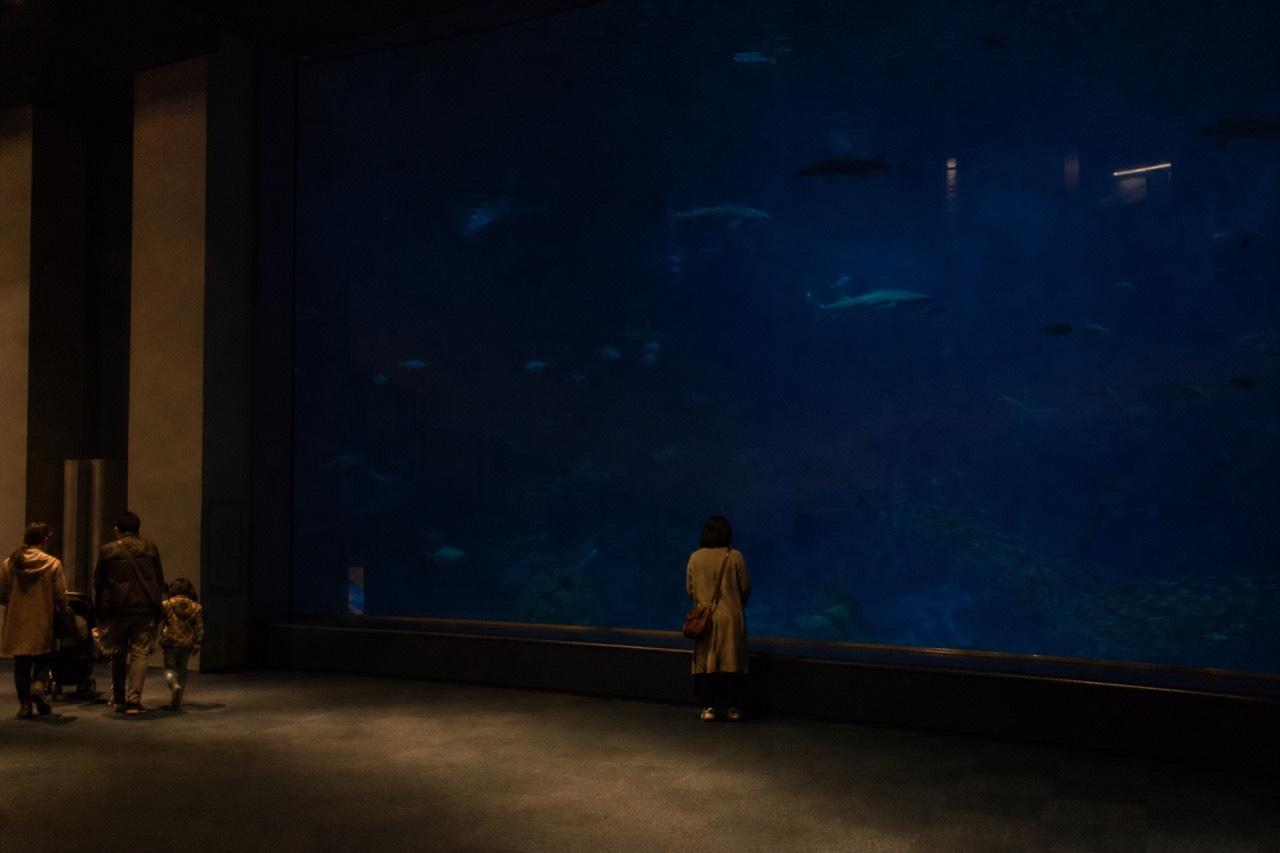
No. Kaiyukan is not the biggest aquarium in the world, and it does not even hold Japan's largest single pool. Its central Pacific Ocean tank holds 5,400 tons of water and runs 34 meters at maximum length, but the Port of Nagoya Public Aquarium's main pool is officially described as Japan's largest at 60 meters long, 30 meters wide and 12 meters deep. Where Kaiyukan genuinely leads is total water volume, about 11,000 tons across 14 tanks.
That distinction matters more than it sounds. The "biggest aquarium in the world" label gets attached to Kaiyukan constantly in travel forums and listicles, usually without any figure attached, and it does the aquarium a disservice. The real story is a building that holds about 620 species and some 30,000 animals in roughly 11,000 tons of water, arranged around one very deep central tank, per the aquarium's own overview page. That is a different kind of achievement than a single record-breaking pool, and it deserves to be described accurately rather than inflated.
This site is dedicated to Osaka Aquarium, so we have gone through the primary sources rather than repeating the folklore. Almost every "biggest" claim collapses the moment you ask which measure is being used. Total water volume is one contest. Largest single tank is another. Most species, most individual animals, most visitors, largest building footprint, largest viewing panel: all separate competitions, all with different winners, and almost none of the listicle writers bother to say which one they mean. Kaiyukan tops some of those lists in some years and never others, and the global record has moved on substantially since 1990 in any case.
There is also a dating problem baked into the myth. When Kaiyukan opened on 20 July 1990, alongside Tempozan Marketplace, it genuinely stood near the front of the pack worldwide, and the superlatives written that year were largely earned. But aquarium construction did not stop in 1990. Enormous purpose-built marine parks have opened across Asia and the Middle East in the decades since, several of them far bigger than anything in Japan. A claim that was defensible in 1990 cannot simply be carried forward 36 years unexamined, yet that is exactly what has happened in guide after guide, forum post after forum post.
If you are planning a visit around the scale of the place, the practical takeaway is simpler than any ranking argument: Kaiyukan budgets 90 to 120 minutes for a visit, entry runs in capped 15-minute timed slots, and tickets come in three age tiers, adult from 16, child from 7 to 15, and young child from 3 to 6, with under 3 entering free. Here are those tiers side by side.
What are Kaiyukan's real size figures?
Kaiyukan's own published numbers are these: about 620 species and 30,000 animals, kept in 14 tanks of varying size recreating 10 regions, with a total water volume of about 11,000 tons. The central Pacific Ocean tank alone holds 5,400 tons, reaches 9 meters deep, and measures 34 meters at maximum length. The building stands 30 meters tall, or 50 meters including the glass upper section.
These figures come from an official page few people quote, Kaiyukan's own school-visit materials at the reason-to-visit page, which states total water volume, tank dimensions and species counts in the aquarium's own words. That page is worth reading carefully because it also clears up a common confusion. Kaiyukan lists 19 exhibition areas in its own encyclopedia data, of which 18 are permanent and one is the current temporary show, while the 14-tank figure counts physical tanks, not themed zones. Two different numbers counting two different things, and mixing them up is how bad statistics get started.
The distinction matters when you are comparing aquariums, too. A facility with one enormous pool and a handful of small satellites can honestly claim both "fewer tanks than Kaiyukan" and "a bigger main tank than Kaiyukan" in the same sentence. Neither statement tells you much about the visit. Kaiyukan's design philosophy was the opposite approach: 14 tanks arranged as a continuous descent through Pacific rim habitats, from a Japanese forest at the top to the Japan Deep near the bottom, so the volume is distributed through an environment rather than concentrated in one showpiece.
| Measure | Kaiyukan's figure | Source type |
|---|---|---|
| Total water volume | about 11,000 tons | Official school-visit page |
| Central Pacific Ocean tank | 5,400 tons, 9 m deep, 34 m maximum length | Official school-visit page |
| Species | about 620 | Official overview page |
| Animals | about 30,000 | Official overview page |
| Tanks | 14, recreating 10 regions | Official school-visit page |
| Exhibition areas | 19 listed (18 permanent plus current temporary show) | Official encyclopedia data |
| Building height | 30 m, or 50 m with the glass upper section | Official school-visit page |
| Opened | 20 July 1990 | Official company history |
One caveat on the central tank: the Pacific tank's width is not published anywhere official. Kaiyukan publishes a maximum length and a depth and never a width, so any article giving you a neat "34 by something" rectangle is inventing the second number. The 34-meter figure is a maximum length, not one side of a rectangle, and we would rather leave a gap than fill it with a guess. This is a recurring theme in aquarium statistics: the numbers that circulate freely online are often the ones nobody ever verified.
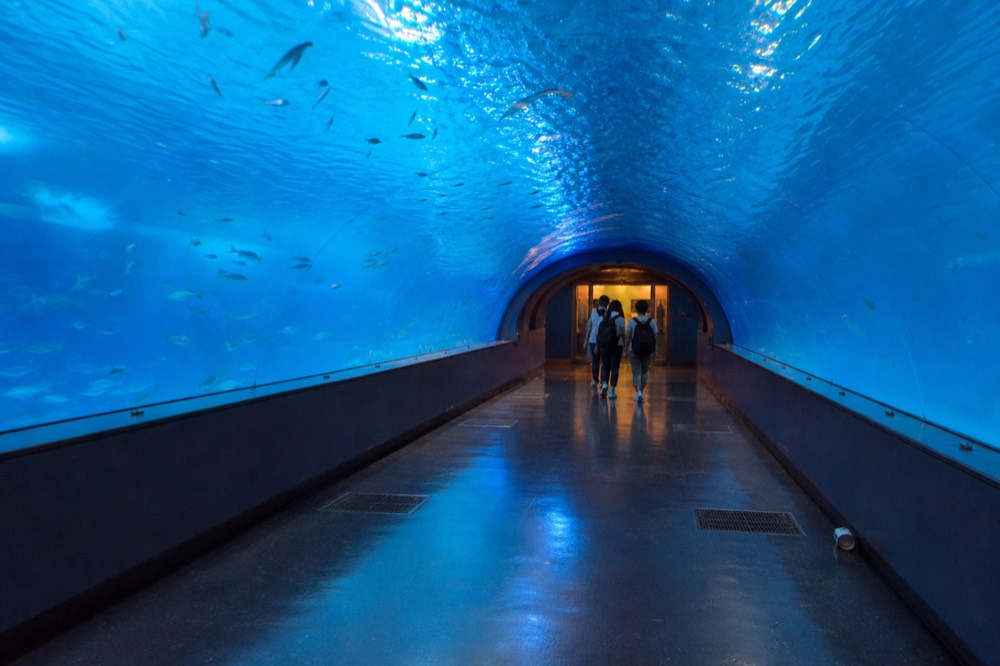
The 5,400-ton Pacific tank is the heart of the visit, and the reason the size debate exists at all. The route starts with the Aqua Gate tunnel tank, opened 17 April 1998, then an escalator ride to the 8th floor, from which you spiral down around that one tank, viewing it at different depths on every level from the 8th to the 3rd. Two whale sharks, Kai and Yu, lived there at Kaiyukan's last official measurement, taken 31 October 2025: Kai, a male at 5.3 meters and an estimated 1,100 kg, and Yu, a female at 6.2 meters and an estimated 1,800 kg. More on them in our whale sharks guide.
There is one size-adjacent fact that almost no visitor ever hears, and it is our favorite thing about the building. The sea directly in front of Kaiyukan is the mouth of the Aji River, whose salinity and turbidity swing too much to use, so the aquarium's seawater is trucked in: about 300 tons pumped per collection and about 350 tons delivered per run, per the aquarium's own facilities team blog. A building holding about 11,000 tons of water on a riverbank, filled by tanker trucks, is a quiet engineering story the "biggest in the world" headlines never touch.
Wondering whether the myth changes the visit? It does not: the tank is genuinely vast, whichever ranking it holds.
Where does the "biggest aquarium" claim come from?
The myth almost certainly comes from Kaiyukan's early years and from visitor numbers, not tank measurements. When it opened on 20 July 1990 it was among the largest aquariums anywhere, and it hit one million visitors in just 40 days, on 28 August 1990. Superlatives from that era were largely earned, then got repeated for decades after other aquariums overtook it in size.
The visitor milestones are genuinely spectacular and all documented in the aquarium's official company history. Ten million visitors by August 1992, day 756 of operation. Twenty million by October 1995. Fifty million by day 6,317, seventy million by day 9,418. The freshest milestone is the best one: Kaiyukan passed 90 million total visitors on 1 October 2025, day 12,541. That cumulative attendance figure is the real world-class statistic, and it is one of the strongest pieces of evidence that the aquarium earned its reputation honestly rather than through marketing.
Think about what that pace means. A million people in forty days, in an era before online booking, social media hype or international travel at today's scale. The aquarium became one of Osaka's defining attractions within its first summer, and a large share of the English-language coverage of Japan in the 1990s passed through Kansai, where Kaiyukan was the shiny new landmark. Guidebooks printed the superlative, travelers repeated it, and by the time bigger aquariums existed elsewhere the phrase had calcified into "fact."
| Milestone | Date | Day of operation |
|---|---|---|
| 1 million visitors | 28 August 1990 | 40 |
| 10 million visitors | 21 August 1992 | 756 |
| 30 million visitors | 11 June 1999 | 3,193 |
| 80 million visitors | 7 September 2021 | 11,069 |
| 90 million visitors | 1 October 2025 | 12,541 |
There is a second, quieter source of the myth: the spiral building itself. Because the route wraps around one 5,400-ton tank from the 8th floor down, the visit feels enormous in a way a flat-floor aquarium never does. Depth, not floor area, is the dominant sensation. A guest who has descended eight floors around a single tank will swear it is the biggest aquarium they have ever seen, and experientially they are right, even if the tape measure disagrees. Perception does an enormous amount of work in this debate, and there is nothing dishonest about the perception; it just is not a measurement.
A third contributor is simple translation drift. Japanese tourism materials have described Kaiyukan with superlative-laden language since 1990, and phrases like "world-class" or "one of the world's largest" compress easily into "the world's largest" when they cross languages and get re-quoted at second and third hand. By the third retelling, the hedge is gone and the claim has hardened. Tracing any specific "biggest aquarium in the world" headline back to a primary source is almost impossible, which itself tells you something: nobody making the claim is standing on a checkable figure.
What the myth never survives is a side-by-side with Japan's other major aquariums, which is exactly what the next section does. And if the scale debate has convinced you to see it yourself, the entry product is the same whichever side you take: timed e-tickets, sold in three age tiers, with the adult tier as the reference price.
How does Kaiyukan compare with Japan's other big aquariums?
Against the four most comparable Japanese aquariums, Kaiyukan has the largest total water volume, about 11,000 tons, and the most species, about 620, but not the largest single pool and not the most animals. The Port of Nagoya Public Aquarium holds about 50,000 animals against Kaiyukan's 30,000, and its main pool is officially Japan's largest. Every one of the others charges a flat adult price; Kaiyukan alone uses a date-based price calendar.
These figures were all read from each operator's own site, and the comparison holds some surprises. Tokyo Sea Life Park, a metropolitan-government facility, charges ¥700 for an adult, roughly a quarter of Kaiyukan's cheapest bookable date, and holds over 500 species. Nagoya's main pool, at 60 by 30 by 12 meters per its own English page, dwarfs any single tank in Osaka in surface terms. Sumida Aquarium, attached to Tokyo Skytree, sits at ¥2,700 flat, right inside Kaiyukan's price range, though it publishes animal counts rather than total water volume. NIFREL in Suita, produced by the same operating company as Kaiyukan, is the family's design-forward sibling at ¥2,400 flat with 8 exhibition zones.
| Aquarium | Adult admission | Opened | Checkable scale |
|---|---|---|---|
| Kaiyukan (Osaka) | ¥2,800 to ¥3,500 by date | 20 July 1990 | about 620 species, 30,000 animals, about 11,000 t total water |
| Port of Nagoya Public Aquarium | ¥2,030 flat | 29 October 1992 (South Building) | about 500 species, 50,000 animals, main pool 60 × 30 × 12 m |
| Kyoto Aquarium | ¥2,600 flat | 14 March 2012 | about 200 species, 10,000 animals, main tank about 500 t |
| Sumida Aquarium (Tokyo) | ¥2,700 flat | 22 May 2012 | Ogasawara tank about 45 species, 450 fish |
| Tokyo Sea Life Park | ¥700 flat | 10 October 1989 | over 500 species, bluefin tuna tank 2,200 m³ |
| NIFREL (Suita, Osaka) | ¥2,400 flat | 19 November 2015 | 8 exhibition zones |
Two honest readings fall out of that table. First, if "biggest" means most animals, Nagoya wins in Japan, comfortably. If it means total water volume or species count, Kaiyukan wins in Japan, on the figures its operators publish. If it means largest single pool, Nagoya wins again. There is no single crown, and anyone telling you otherwise is picking the measure that suits their headline. Second, on price, Kaiyukan is not just the most expensive of the group on a peak date, it is the only one where you cannot name the price without naming the date; we checked every other operator's price page for demand-based pricing language and found none. We break down how that calendar works in the Kaiyukan tickets guide, and the global angle, where Kaiyukan actually ranks internationally, is covered in how Kaiyukan ranks in the world.
The Tokyo comparison deserves a special note because it is the one travelers actually face. There is no single honest "Tokyo aquarium" counterpart, so weigh both. Tokyo Sea Life Park is the scale counterpart: over 500 species against Kaiyukan's 620, and a ¥700 public ticket that makes it the value pick by a mile. Sumida Aquarium is the trip-planning counterpart: same money as a cheap Kaiyukan date, modern, indoors, attached to a tower you were probably visiting anyway. Neither matches Kaiyukan on total water volume or on whale sharks, and saying that plainly is more useful than pretending a winner exists.
For the record on the world stage: this site's verified research found no first-party source establishing Kaiyukan as number one globally on any current measure, and several of the biggest aquariums built since 1990 sit outside Japan entirely. The claim is not just outdated, it is unprovable from anything the aquarium itself publishes. Kaiyukan's own materials do not make it, which should tell you everything about the gap between the institution and its mythology.
Does size actually change your visit?
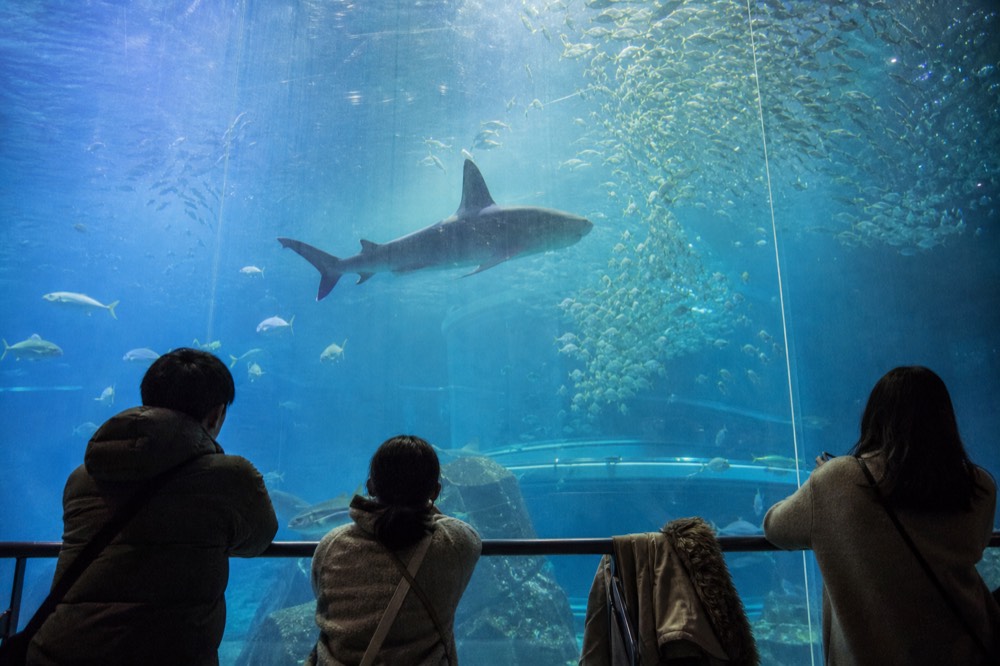
Honestly, not much. Kaiyukan itself budgets 90 to 120 minutes for a visit, the whole route is a single downward spiral from the 8th floor to the 3rd, and the two animals most visitors come for, the whale sharks, are in the one central tank you cannot miss. Whether the building is first or fifth in the world barely registers once you are inside the spiral.
What does change your visit is timing and tickets. Entry runs in 15-minute admission slots with a capped number of tickets per slot, a system introduced explicitly to control crowding and cut queueing. Re-entry ended on 15 June 2026, so once you walk out, you are done; plan meals and the Ferris wheel around that rather than assuming you can pop back in. The Aleutian Islands tank is currently closed for renovation, its animals moving to Aquaworld Ibaraki Oarai Aquarium, so count 17 walkable permanent zones for now. And since April 2026 there are new bag-size rules inside, with luggage over certain dimensions barred; details are in our planning guides.
| Adult price on bookable dates | How often it comes up |
|---|---|
| ¥2,800 | The most common level, 83% of the 59 bookable dates |
| ¥2,900 | A handful of moderately busy dates |
| ¥3,200 | A few high-demand dates |
| ¥3,500 | Peak dates only, clustered on public holidays |
The whale shark question is the one place scale does matter to visitors. Kaiyukan's Pacific tank is deep enough, 9 meters, that the sharks are fed at the surface and the aquarium's own advice is that the upper floors give the better view of a feeding, when a shark upends vertically to suck in food. Time your admission slot against the published feeding timetable, otters at 11:30, 13:30 and 15:30, dolphins at 11:40, 14:00 and 16:30, penguins at 10:00 and 14:20, and even a skeptical visitor stops caring about rankings. The feedings can be cancelled without notice depending on the animals' condition, so treat the timetable as a plan, not a promise.
It is also worth knowing what kind of institution you are giving your money to. Kaiyukan is a member of the Japanese Association of Zoos and Aquariums, JAZA, and it was certified a museum-equivalent facility by the Osaka Prefectural Board of Education back in July 1994. It runs its own biological research institute, the Iburi Center in Tosashimizu, Kochi, opened in 1997, which among other things supplied the ocean sunfish now in the Pacific tank. These are the credentials of a research institution that admits tourists, not a theme park with fish, and they hold up regardless of any size ranking.
Whatever date you land on, the ticket is the same product at every price level, and the age bands are strict: adult from 16, child from 7 to 15, young child from 3 to 6, under 3 free.
So, is Kaiyukan the biggest aquarium in the world? No. It is one of the largest by total water volume, it holds more species than any comparable Japanese aquarium, it has been collecting visitors at a rate very few attractions anywhere can match for 36 years and counting, and it is one of the only major aquariums in the country whose scale is genuinely hard to grasp from any single vantage point. That is a better recommendation than a myth, and it is one the aquarium's own numbers can carry. The building's real boast is not a superlative at all: it is a 5,400-ton tank you walk around for eight floors, filled by truck, holding two whale sharks that a million people a year come to stand above.
Before the practical questions, here are the three ticket tiers one more time, so you can match ages to prices before you book.
Kaiyukan is not the biggest aquarium in the world, and it is not even the biggest in Japan by every measure: Nagoya's main pool is larger, Nagoya holds more animals, and several newer aquariums abroad exceed it in scale. What Kaiyukan does hold is Japan's largest total water volume, about 11,000 tons, its highest species count at about 620, and a 36-year attendance record few attractions anywhere can match.
Common questions about Kaiyukan's size
Is Kaiyukan the biggest aquarium in the world?
No. It is not the biggest aquarium in the world, and it does not hold Japan's largest single pool, which belongs to the Port of Nagoya Public Aquarium. Its genuine leads are total water volume, about 11,000 tons across 14 tanks, and species count, about 620.
Is Kaiyukan the biggest aquarium in Japan?
Partly. It has the largest total water volume and the most species among Japan's major aquariums on published figures, but Nagoya holds more animals, about 50,000 against Kaiyukan's 30,000, and has Japan's largest main pool at 60 by 30 by 12 meters.
How big is the main tank at Kaiyukan?
The central Pacific Ocean tank holds 5,400 tons of water, is up to 9 meters deep, and measures 34 meters at maximum length. Its width is not published officially, so any article quoting a full rectangle is guessing.
How many animals does Kaiyukan have?
About 30,000 animals across roughly 620 species, in 14 tanks recreating 10 regions of the Pacific. Two whale sharks, Kai and Yu, were in the central tank at the last official measurement, taken 31 October 2025.
Why do people say Kaiyukan is the biggest?
Mostly momentum from its 1990 opening, when it was among the largest aquariums in the world, and from its extraordinary attendance: one million visitors in its first 40 days and 90 million by 1 October 2025. The superlatives stuck long after newer, bigger aquariums were built.
Does it matter that it isn't the biggest?
Almost not at all. The spiral route around one 5,400-ton tank makes the visit feel enormous regardless of rankings, Kaiyukan budgets 90 to 120 minutes for a full circuit, and the whale sharks are unmissable on every floor.