Whale Sharks at Kaiyukan: The Pacific Ocean Tank Explained
Two whale sharks, Kai and Yu, circle a 5,400-ton tank that runs 34 metres at its longest and 9 metres deep. Here is what Kaiyukan's own measurements, feeding timetable and tank records actually say, floor by floor.
Short answer
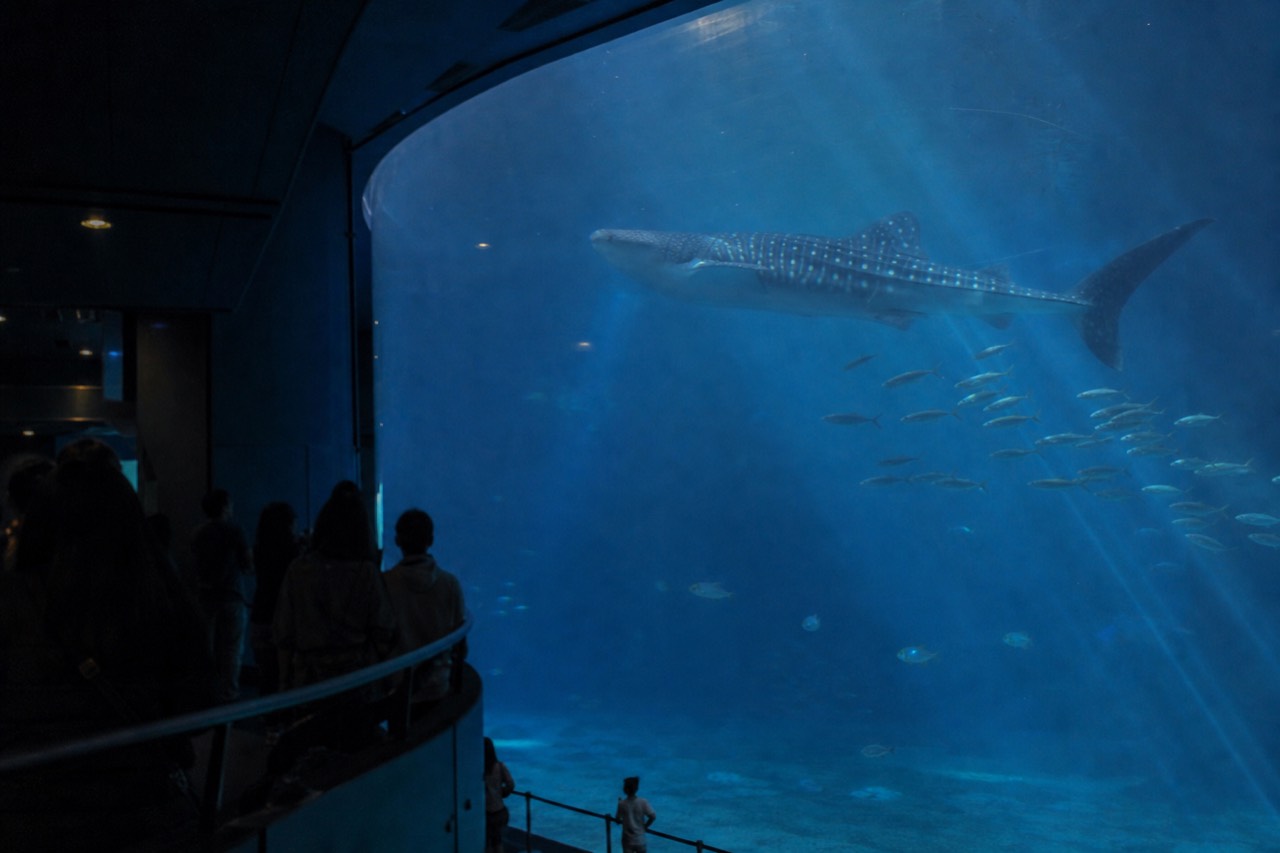
Kaiyukan's Pacific Ocean tank holds two whale sharks, Kai and Yu, in 5,400 tons of water. Adult admission runs ¥2,800 to ¥3,500 by date. The aquarium feeds whale sharks at the surface, so the upper floors of the spiral route give the best view.
What is the whale shark exhibit at the aquarium in Osaka Bay?
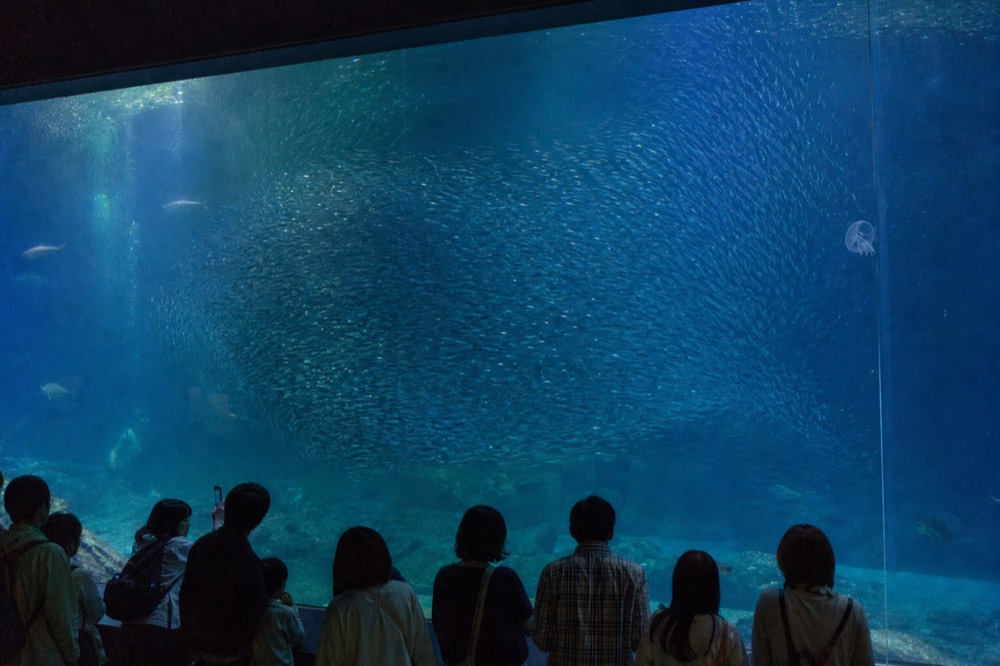
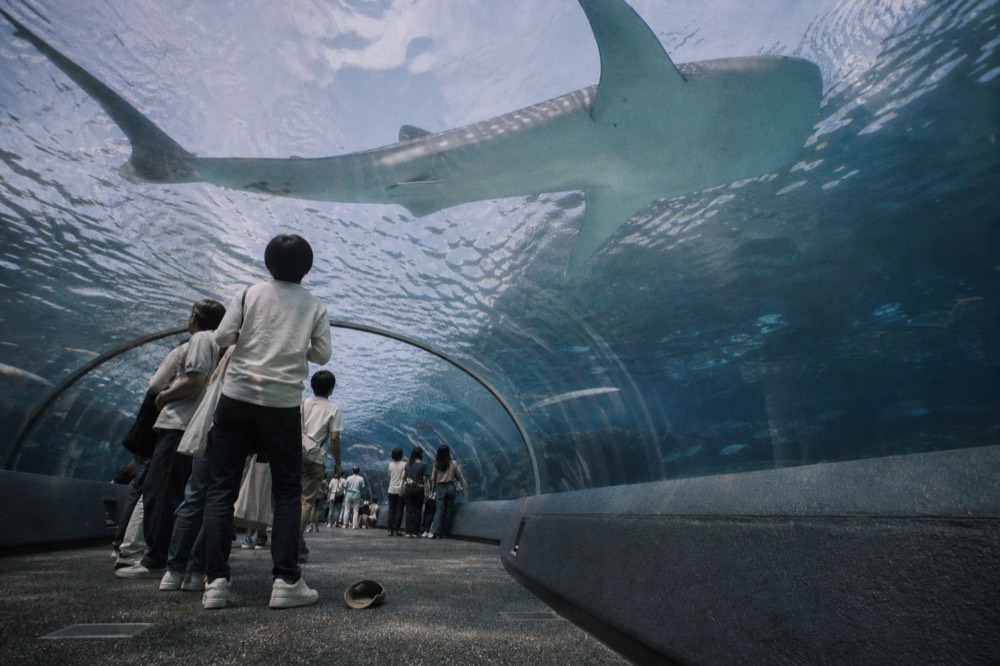
The whale sharks live in the Pacific Ocean tank, the centerpiece of Osaka Aquarium Kaiyukan's spiral route: a 5,400-ton tank with a maximum length of 34 metres and a depth of up to 9 metres, holding about 620 species and 30,000 animals across the aquarium as a whole. The tank sits at the center of the building, and the whole visit is built around descending around it, from the 8th floor down to the 3rd, passing the same water at different depths on every level.
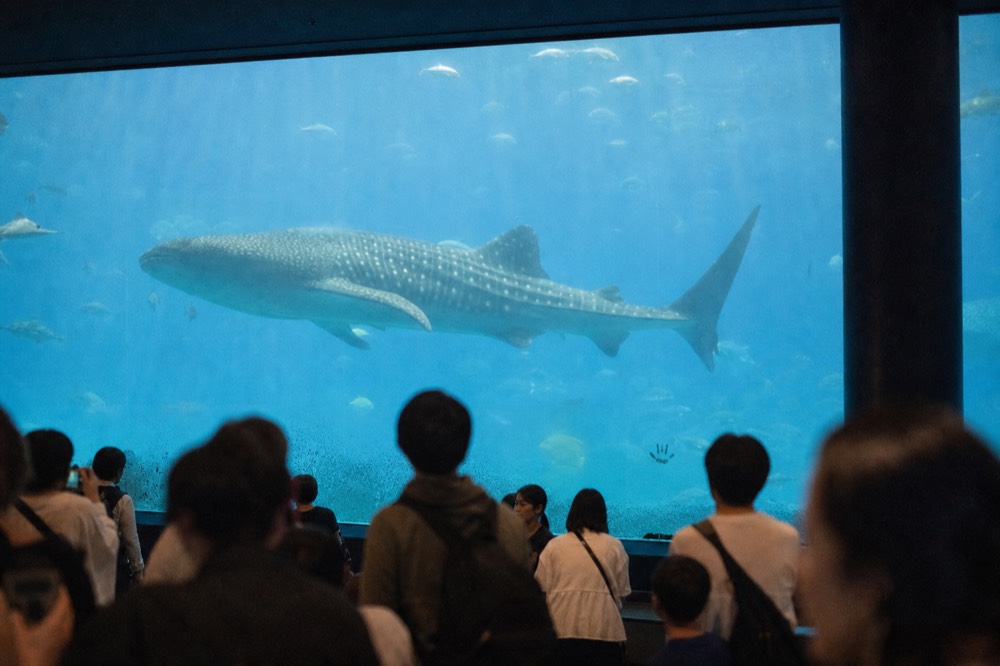
Kaiyukan opened on 20 July 1990 in Tempozan Harbor Village, and the Pacific Ocean tank has been its signature from the start. The building's own description of the route is a spiral descent: you enter through the Entrance Building 3F, pass the Aqua Gate tunnel tank, ride an escalator to the 8th floor, then walk down and around the central tank, 8F to 3F, and out. Every floor gives you the same tank from a different depth, which is why the same animal can look completely different two floors apart.
The scale figures come from Kaiyukan's own school-visit pages, which state a total water volume of about 11,000 tons across the whole aquarium, with the Pacific tank alone holding 5,400 tons at a maximum length of 34 m and a depth of 9 m. One honest caveat: Kaiyukan publishes a maximum length and a depth but never a width, so treat 34 m as a longest dimension, not one side of a rectangle.
The aquarium's species entry for the whale shark, Rhincodon typus, describes it as the world's largest fish, capable of over 12 metres, and a plankton feeder. No aquarium animal in Japan draws more camera flashes. If you are weighing whether the whole visit justifies the ticket price, our is Kaiyukan worth visiting guide works through the numbers; for the tank-by-tank layout, see Kaiyukan floors and map.
How many whale sharks are there at Kaiyukan?
There are two whale sharks, Kai and Yu, at Kaiyukan's last official measurement, taken on 31 October 2025: Kai, a male at 5 m 30 cm and about 1,100 kg, and Yu, a female at 6 m 20 cm and about 1,800 kg, both in the Pacific Ocean tank. The count is date-scoped because Kaiyukan rotates whale shark individuals back to the sea, and no 2026 news item announces an arrival or departure either way.
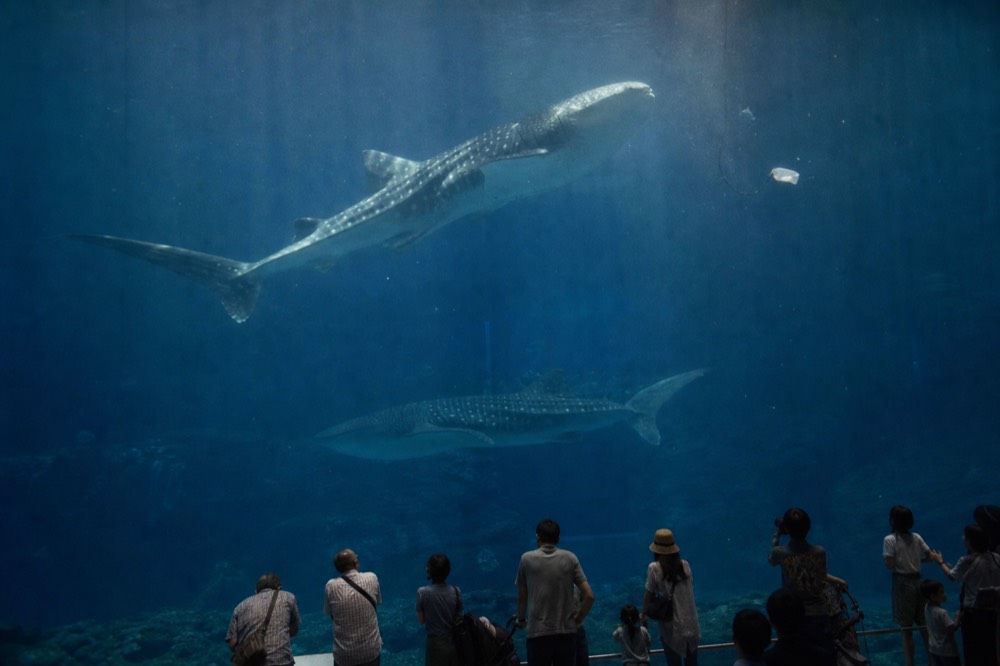
The details are worth reading in full, because Kaiyukan measures its animals yearly and publishes the results, which almost no other aquarium does. The measurement, published in the aquarium's own 2025 news archive, gives each animal's total length, girth, estimated weight and estimated age, and repeats the previous year's figures alongside them, so you can see the growth.
| Individual | Sex | Total length | Girth | Estimated weight | Estimated age |
|---|---|---|---|---|---|
| Kai (海) | Male | 5 m 30 cm | 2 m 60 cm | 1,100 kg | 8 to 9 |
| Yu (遊) | Female | 6 m 20 cm | 2 m 70 cm | 1,800 kg | 18 to 19 |
Kai's story is the more remarkable one. He arrived on 2 October 2024 and had grown 60 cm and about 400 kg by the October 2025 measurement, going from 4 m 70 cm and roughly 700 kg to his current 5 m 30 cm and about 1,100 kg in a single year. Yu, the older of the two, held steady at 6 m 20 cm and about 1,800 kg across the same period. A visitor on the day is watching a teenager still putting on length and an adult female who has stopped.
If you are planning the visit around these two animals, the ticket is the same timed entry as everyone else's.
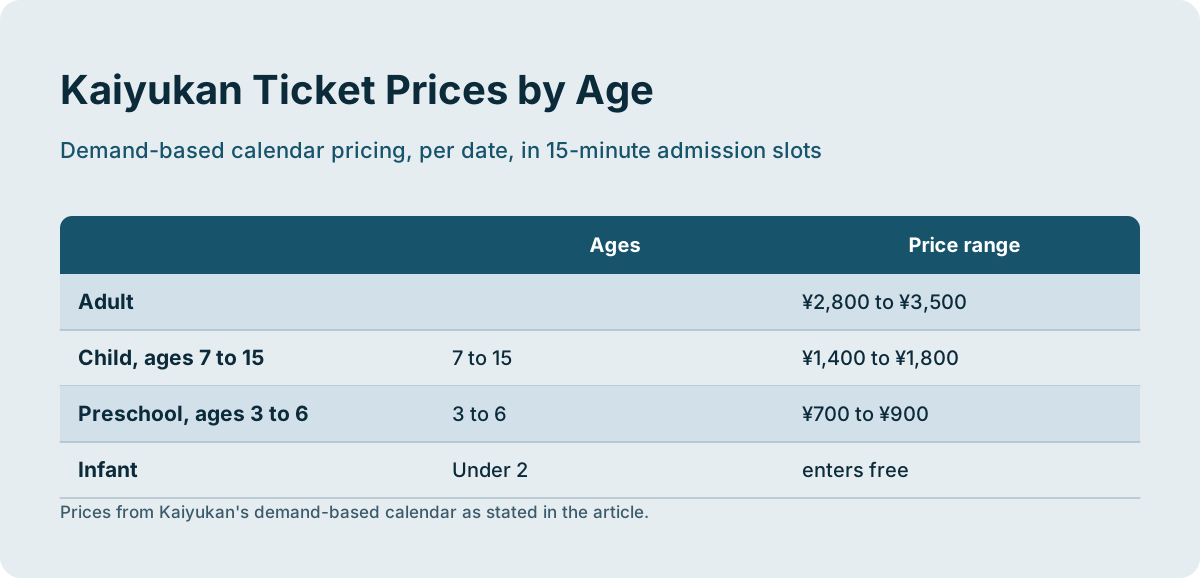
Admission runs in 15-minute slots with a cap per slot, and adult gate prices range ¥2,800 to ¥3,500 depending on the date under the aquarium's demand-based calendar. Child tickets for ages 7 to 15 run ¥1,400 to ¥1,800, and preschool tickets for ages 3 to 6 run ¥700 to ¥900. Under 2 enters free. On the dates currently bookable, more than three quarters sit at the ¥2,800 adult level.
Which floor gives the best view of the whale sharks?
Kaiyukan feeds its whale sharks at the surface, so the upper floors of the spiral route, 8F and 7F, give the better view when a whale shark upends into a vertical position to feed, while the mid floors show the animal's full silhouette against the tank's 9-metre depth. This is Kaiyukan's own published viewing tip, not visitor folklore.
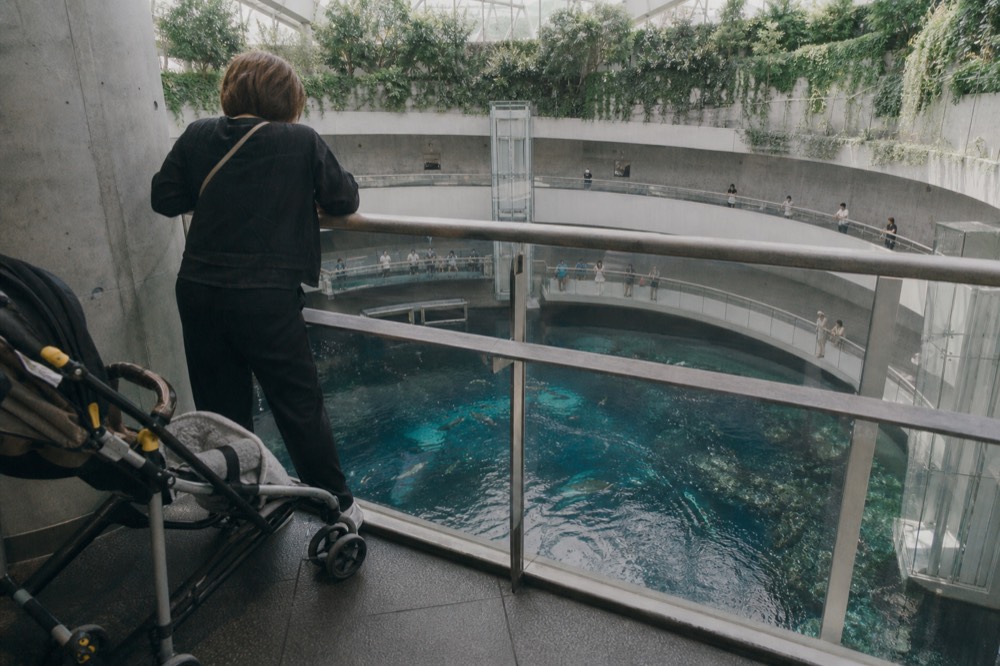
The aquarium's own "advanced viewing" page states it plainly: the whale sharks are fed at the surface, so the upper floors are where you see the vertical feeding posture, when the shark tilts up and sucks in food. Most visitors instinctively stop at the big lower windows where the tank looks deepest and widest, and they are not wrong, the lower floors show Yu's full 6 m 20 cm frame end to end, but the feeding behaviour belongs to the top of the tank.
A practical route: take the escalator to 8F, spend your first ten minutes there watching the surface, then descend slowly. Because the route spirals around the same water, you pass the Pacific tank on nearly every floor between 8F and 3F, so you can track the same animal at successive depths without backtracking. And since re-entry to the exhibition area ended on 15 June 2026, you cannot leave and come back later, so budget the full visit in one pass. Kaiyukan itself budgets 90 to 120 minutes for a visit.
For a family visit timed around the whale sharks, note the practical arrangement of the building: strollers are parked outside the exhibition area (there are no rentals), and the baby care room is in the Entrance Building 2F, so it is worth a stop before you enter the spiral. Our Kaiyukan with toddlers and young kids walkthrough covers the full sequence.
The Pacific Ocean tank by the numbers
The Pacific Ocean tank holds 5,400 tons of water, runs 34 metres at its longest, and reaches 9 metres deep, making it one of the largest single tanks in any aquarium, and Kaiyukan's own records state the whole building holds about 11,000 tons across 14 tanks recreating 10 regions. Against comparison venues, no other aquarium in Japan pairs this volume with whale sharks.
| Figure | Pacific Ocean tank | Source note |
|---|---|---|
| Water volume | 5,400 tons | Kaiyukan's own facilities blog, stated verbatim |
| Maximum length | 34 m | Kaiyukan school-visit pages, stated as a maximum |
| Depth | Up to 9 m | Kaiyukan's "advanced viewing" page |
| Width | Not published | Kaiyukan has never printed a width |
| Whale sharks | Two, Kai and Yu | Official 2025 measurement |
The depth figure has a specific meaning: Kaiyukan describes the tank as giving "the feeling of diving up to 9 metres deep". That is why the same shark reads differently at each floor. On 8F you see the surface and the feeding behaviour; on 4F you see the animal in mid-water against schools of Pacific fish; on 3F you look up through the full column. Visitors who only stop at one window are, in effect, seeing one-ninth of the exhibit.
For scale against the rest of Japan, the comparison is stark. Port of Nagoya's main pool is Japan's largest by footprint at 60 m long by 30 m wide by 12 m deep, but Nagoya keeps no whale sharks. Sumida Aquarium's largest stated volume is a 350-ton penguin pool. Kyoto Aquarium's main tank holds about 500 tons. Kaiyukan is the only aquarium in the country where whale sharks swim in a tank of this volume, which is the single honest answer to what makes the place special, a point our what is Kaiyukan famous for piece develops.
Why the seawater is trucked in
The sea directly in front of Kaiyukan is the mouth of the Aji River, whose salinity and turbidity swing too much to use, so the aquarium trucks seawater in from elsewhere, about 300 tons pumped per collection and about 350 tons delivered per run, a fact from Kaiyukan's own facilities team blog. The Pacific tank's 5,400 tons did not come out of Osaka Bay.
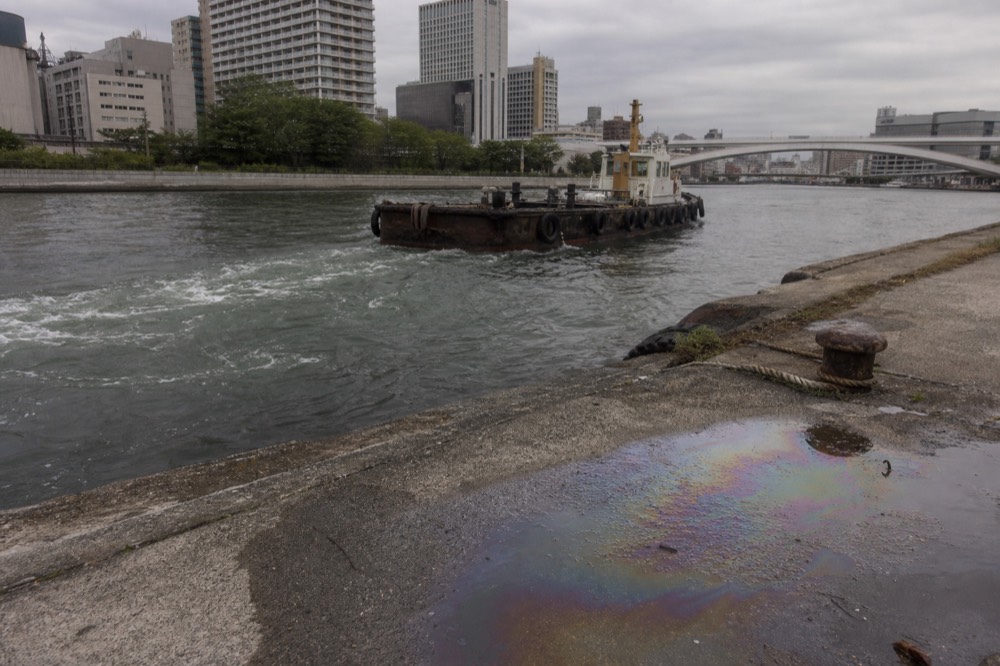
This is the detail almost no visitor considers. The building sits on the waterfront, next to the Tempozan Ferris wheel, at 1-1-10 Kaigandori, Minato-ku, and it looks like it should draw straight from the harbour outside. It does not. The water in front of the aquarium is brackish river-mouth water, and a whale shark tank needs stable salinity, so the facilities team maintains a supply chain of seawater delivered by tanker. The original staff post describing the process is still on the aquarium's blog, alongside the 5,400-ton figure.
The wider water system is also where Kaiyukan's research arm connects. The aquarium runs its own Osaka Aquarium Biological Research Institute Ibuki Center in Tosashimizu, Kochi, opened in 1997, which among other things supplies animals, the ocean sunfish that arrived in the Pacific tank on 4 July 2025 came from the Iburi Center. So the tank's story runs from a collection site on Shikoku's Pacific coast to a trucked delivery in Osaka Bay to a spiral building in Tempozan.
When are the whale sharks fed?
Pacific tank fish are fed at 10:30 and 15:00, per Kaiyukan's published feeding timetable, and the whale sharks are fed at the surface, which is why the upper floors give the better view of the vertical feeding posture, though the aquarium warns times may be cancelled or changed without notice depending on the animals' condition.
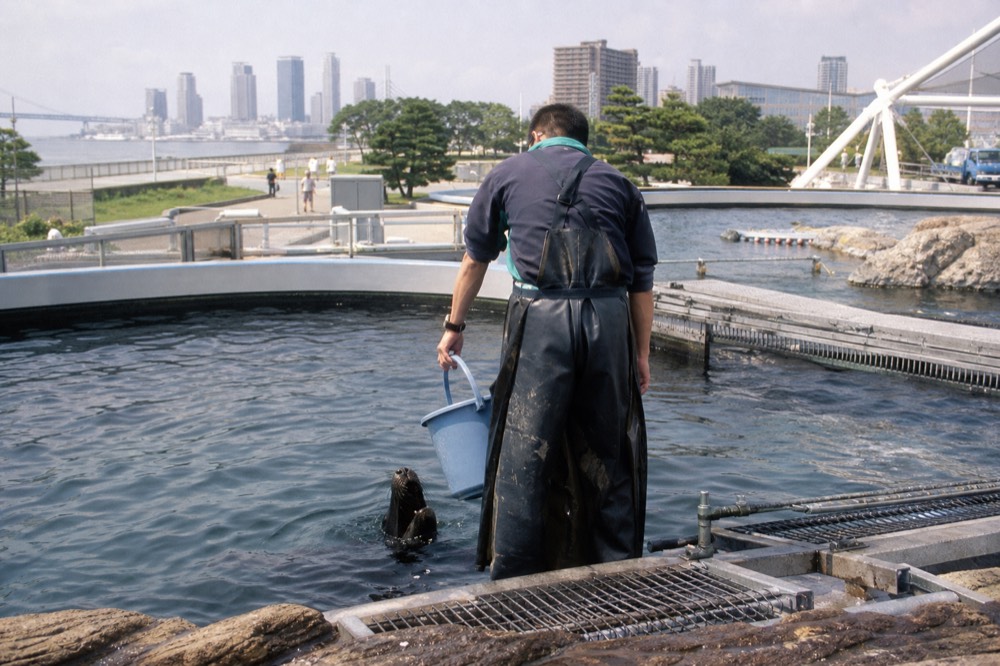
Kaiyukan publishes a full feeding timetable per zone, and it is the single most useful planning document for the visit. It carries no day-of-week variation, it is one timetable for all days, but it also comes with an explicit caveat that sessions depend on the animals' condition. The published times for the zones around the central tank and the 7th floor:
| Floor | Zone | Animal | Times |
|---|---|---|---|
| 7F | Japan Forest | Otter | 11:30, 13:30, 15:30 |
| 7F | Monterey Bay | Sea lion / seal | 09:50, 13:20, 14:50 |
| 7F | Antarctica | Penguins | 10:00, 14:20 |
| 7F | Tasman Sea | Pacific white-sided dolphin | 11:40, 14:00, 16:30 |
| 6F | Pacific Ocean | Pacific fish | 10:30, 15:00 |
| 4F | Arctic Region | Ringed seal | 10:50, 15:35 |
Note what the table does not say: there is no separate published "whale shark feeding time". The whale sharks are fed at the surface, and the Pacific tank's scheduled session is the 6F Pacific fish slot at 10:30 and 15:00, but the aquarium does not guarantee the whale sharks feed on schedule. The honest planning advice is to be on 8F or 7F around those times with modest expectations, and to treat any vertical feeding posture as a bonus rather than a booked show. For the rest of the daily rhythm, our best time of day to visit Kaiyukan analysis covers the quiet windows.
Two other Pacific tank residents arrived recently and are worth scanning the water for. Two sand tiger sharks, a female at 2.7 m and a male at 2.5 m, arrived in May 2025 from Tokai University Marine Science Museum, the first time Kaiyukan has exhibited the species. An ocean sunfish, a male at 97 cm, arrived on 4 July 2025. A sand tiger shark special exhibition has also been running on the 4th floor since 17 July 2026.
Do you need a timed ticket to see the whale sharks?
Yes: Kaiyukan admits visitors by designated date and time slot, sold in 15-minute windows with a capped number of tickets per slot, so on busy dates a walk-up visitor can miss the day entirely, and same-day counter tickets are only sold from opening until last admission. Advance purchase is what the aquarium itself recommends.
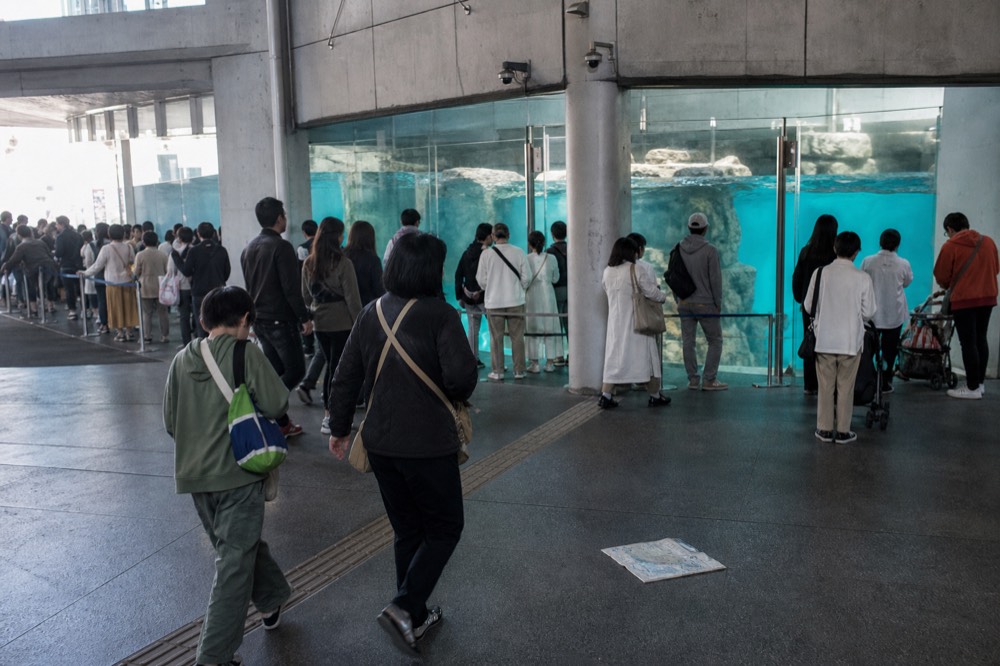
The timed system was introduced explicitly to control crowding and cut queueing, per the aquarium's own announcement, and the same article ended same-day re-entry from 15 June 2026. Two consequences follow for a whale shark visit. First, your slot time matters more than your arrival enthusiasm: a 10:00 slot puts you on 8F close to the 10:30 Pacific fish feeding, while a 15:00 slot aligns with the afternoon session. Second, once you are in, you are in for the whole visit, so the surface-watching-first strategy in the floors section above is the one that works.
Ticket prices move with a demand-based calendar, so there is no single "the price". The bookable distribution is the useful fact: of the dates currently on sale, more than three quarters sit at ¥2,800 for an adult, with the remainder running up to ¥3,500 on the busiest days. The cheapest adult day is not ¥2,700, that level does not appear among currently bookable dates at all, though it was charged on 59 days between March and August 2026. If your dates are flexible, checking the calendar before booking is the single biggest saving available.
The listing is rated 4.8 across about 14,894 reviews, and it sells the same timed entry the aquarium sells, priced about $18 for an adult, about $4.75 for a young child aged 3 to 6, with children 16 and over charged the adult rate. The from-price belongs to the youngest tier, not the adult ticket, a distinction worth knowing before you compare totals for a family.
How does the whale shark tank compare with other big aquariums?
No aquarium in Japan matches Kaiyukan's combination of a 5,400-ton tank and whale sharks: Nagoya's main pool is larger by footprint but keeps none, Tokyo Sea Life Park charges ¥700 flat but has no whale sharks, and Sumida, at ¥2,700 flat, is a modern city aquarium with no animal in this size class. The whale sharks are the differentiator, full stop.
The honest comparison table, using each operator's own published figures, makes the point better than adjectives do. Note that none of the five comparison venues uses demand-based pricing; Kaiyukan is the outlier with its variable calendar, which is why its row is a range.
| Venue | Adult admission | Signature scale figure | Whale sharks |
|---|---|---|---|
| Kaiyukan, Osaka | ¥2,800 to ¥3,500 by date | 5,400-ton Pacific tank, 34 m max length | Yes, two |
| Port of Nagoya | ¥2,030 flat | Main pool 60 m by 30 m by 12 m | No |
| Kyoto Aquarium | ¥2,600 flat | Main tank about 500 tons | No |
| Sumida Aquarium, Tokyo | ¥2,700 flat | Penguin pool about 350 tons | No |
| Tokyo Sea Life Park | ¥700 flat | Bluefin tuna tank 2,200 cubic metres | No |
| NIFREL, Suita | ¥2,400 flat | 8 zones; scale not published | No |
NIFREL deserves a special mention because it is produced by the same company, Osaka Aquarium Kaiyukan Co., Ltd., and it is the natural second stop for anyone in Osaka who loves the big-tank experience. But NIFREL is a different animal: a design-led "sensory" aquarium with 8 zones, no published species or water-volume figures, and no whale sharks. Our NIFREL or Kaiyukan comparison works through the choice in detail, and the best aquariums in Japan guide places both in the national picture.
For visitors pairing the visit with the rest of Tempozan Harbor Village, the aquarium sells set tickets with the Santa Maria sightseeing ship, LEGOLAND Discovery Center Osaka and the Captain Line shuttle, and the add-on for Santa Maria is ¥1,500 on an adult ticket. There is no Kaiyukan-plus-Ferris-wheel combo, despite what some guides claim; the wheel's own operator sells none. The things to do near Kaiyukan guide covers the full neighborhood.
One practical note to finish: a paid Jinbei Backyard ticket exists as an add-on that takes you behind the Pacific Ocean tank to see the whale sharks from above the water. It runs on scheduled dates only, so if seeing Kai and Yu from the surface is the goal, check the aquarium's ticket page for the backyard schedule when you pick your date.
For an adult traveler booking a single timed slot, the same listing covers the full ¥2,800 to ¥3,500 date range, and the price you see is the price for your chosen day.
Families with children aged 7 to 15 pay the child tier, ¥1,400 to ¥1,800 by date, and the same 15-minute slot logic applies: pick a morning slot if you want the 10:30 Pacific tank feeding, an afternoon one for the 15:00 session.
Whichever tier you need, the same three ticket types cover every visitor aged 3 and over, and under 2 enters free, so a full family booking is one transaction on one date.
This guide's core answers in brief: Kaiyukan keeps two whale sharks, Kai and Yu, in a 5,400-ton Pacific Ocean tank that runs 34 m at its longest and 9 m deep; the upper floors give the best view because whale sharks feed at the surface; the published Pacific tank feeding slots are 10:30 and 15:00; and entry requires a timed 15-minute slot ticket, with adult admission at ¥2,800 to ¥3,500 by date. The questions below cover the details visitors ask most often.
Common questions about whale sharks at Osaka's Kaiyukan
How many whale sharks are at Osaka Aquarium Kaiyukan?
Two, at Kaiyukan's last official measurement taken on 31 October 2025: Kai, a male at 5 m 30 cm and about 1,100 kg, and Yu, a female at 6 m 20 cm and about 1,800 kg. The count is date-scoped because Kaiyukan rotates individuals back to the sea, and no 2026 announcement changes it either way.
Which floor is best for seeing the whale sharks?
The upper floors, 8F and 7F. Kaiyukan's own viewing advice says whale sharks are fed at the surface, so the upper floors give the better view when a shark upends vertically to feed. The lower floors show the animal's full silhouette against the tank's 9-metre depth instead.
How big is the Pacific Ocean tank?
It holds 5,400 tons of water, runs 34 metres at its longest, and reaches 9 metres deep. Kaiyukan publishes a maximum length and a depth but never a width, so no "34 m by X" figure exists to quote.
What time are the whale sharks fed?
The published Pacific tank feeding slot for Pacific fish is 10:30 and 15:00. There is no separate guaranteed whale shark feeding time, and the aquarium warns that all feeding sessions may be cancelled or changed without notice depending on the animals' condition.
Where does the aquarium's seawater come from?
It is trucked in. The Aji River mouth directly in front of Kaiyukan is too brackish and turbid to use, so the facilities team arranges deliveries of about 350 tons per run from a stable seawater source.
Do I need a timed ticket to see the whale sharks?
Yes. Kaiyukan admits by designated date and 15-minute time slot with a cap per slot, and the aquarium itself recommends advance purchase. The listing rated 4.8 across about 14,894 reviews sells the same timed entry.