What is so special about Kaiyukan?
Kaiyukan isn't just big. It's built as a single spiral descent that shows you the same ocean at eight depths. Here's why that design makes it unlike any other aquarium.
What is so special about Kaiyukan?
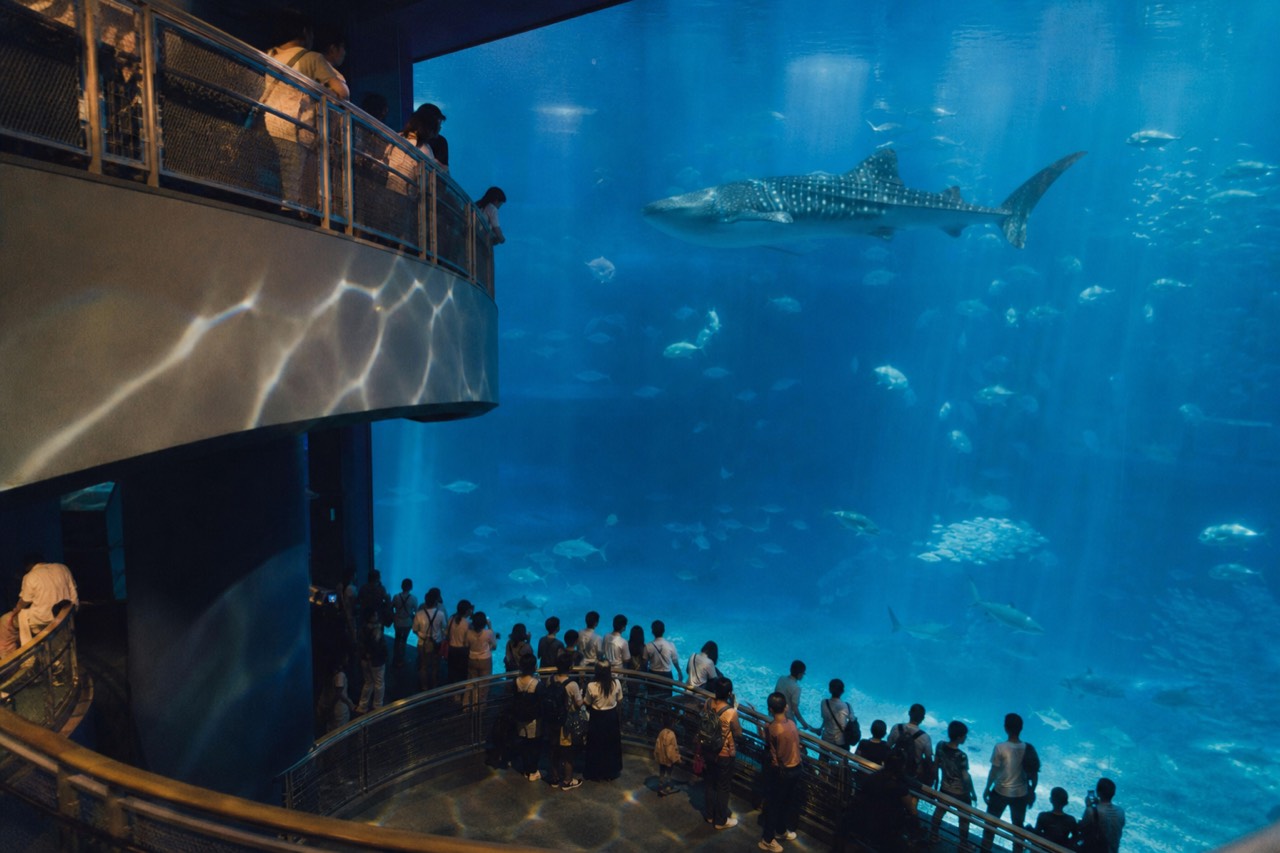
Kaiyukan is the world's largest aquarium built as a single spiral descent, a top-down route that starts on the eighth floor and winds around a central 5,400-ton tank so you meet the same whale sharks, rays, and schooling fish at eight different depths, from the sunlit surface to the dark midwater, all without backtracking. That architecture, paired with about 620 species in 14 tanks, makes it feel like one continuous dive rather than a collection of exhibits.
The first thing you see after the entry tunnel isn't the star attraction. It's an escalator. Kaiyukan opens with a short walk through the Aqua Gate, a glass tunnel where fish swim overhead, and then every visitor rides the same long escalator up to the eighth floor, the building's highest point open to the public. From there the route is a single gradual ramp, spiralling down through 19 exhibition areas, each one ringing the central tank at a different level. You never have to choose a left or right fork, never wonder if you missed something, and you never see the Pacific Ocean tank from the same angle twice. That forced continuity is what makes Kaiyukan feel different from a hall of separate tanks. It's a narrative, not a floor plan.
The central tank holds 5,400 tons of seawater and stretches a maximum of 34 metres across, with a depth of 9 metres. The glass panels are huge, but they sit above a curved viewing gallery, so the water seems to wrap around you. At the top, on the eighth floor, you're looking down at the surface, watching the whale sharks' dorsal fins slice the light. One floor down, you're at eye level with a manta ray gliding past. By the sixth floor you're staring into the midwater, where the sand tiger sharks laze in the current. Near the bottom, the tank feels darker, cooler, and the fish that live near the reef floor come into focus. The building itself is only 30 metres tall, but the same volume of water is reinterpreted eight times over, and the illusion of depth comes from the architecture, not from the building's height.
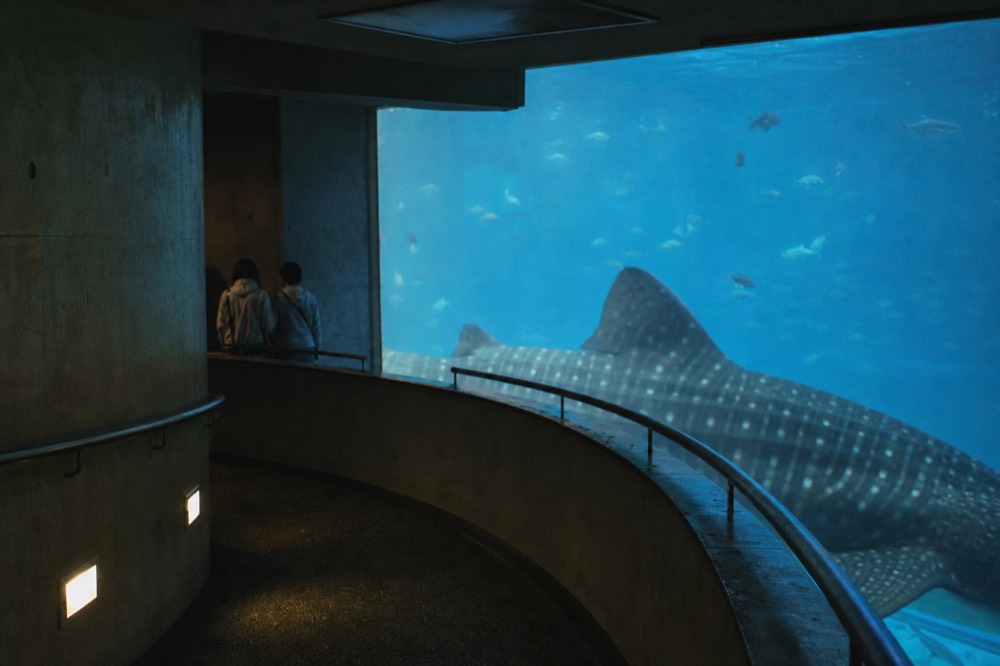
The numbers put the scale in perspective. Kaiyukan holds about 11,000 tons of total water across 14 tanks, exhibits about 620 species and roughly 30,000 animals, and welcomed its 90 millionth visitor in October 2025. Yet the size is only part of the story. The layout, which the aquarium itself describes as "a building where you walk down and around, following a single route," is a deliberate design choice that dates back to the opening on 20 July 1990. The idea was to recreate the Pacific Rim in a compact urban site, and the architects solved it by stacking the biomes vertically around a central void, each zone a different corner of the Ring of Fire. The Aleutian Islands tank is currently closed for renovation, but the other 15 permanent zones plus the temporary special exhibition fill the ramp without a gap.
The three age tiers that make up a visit are themselves a quiet part of the specialness. Kaiyukan uses demand-based pricing, so the cost of an adult ticket swings between ¥2,800 and ¥3,500 depending on the date. On the current bookable calendar, more than three quarters of the dates are ¥2,800 for an adult, about $17.93 at the September 2026 rate. Children aged 7 to 15 pay ¥1,400 to ¥1,800, and young children aged 3 to 6 pay ¥700 to ¥900. Under-twos enter free. The price ladder is transparent, but it changes date by date, and no other major Japanese aquarium runs a variable calendar quite like this. The booking link on the page shows the live price for your exact slot, so you know what you're paying before you arrive.
Why is the spiral route so famous?
The spiral route is famous because it forces every visitor to experience the central tank at every depth, in order, with no shortcuts, creating a 90-to-120-minute journey that feels like a descent into the ocean rather than a gallery walk. The ramp is gentle enough for strollers and wheelchairs, and the zoo-like zones facing outward from the spiral give each biome its own distinct microclimate, from the Antarctic penguin pool to the humid Ecuador rainforest dome.
The aquarium's own school-group FAQ budgets 90 to 120 minutes for a full visit, and the route's design makes that time feel inevitable. You can't rush past the Pacific tank to get to the jellyfish faster, because the jellyfish are on the third floor, at the bottom of the spiral. The structure strips away the museum fatigue that comes from decision-making, and the pay-off is that you notice the way the whale shark's colour shifts from slate-grey near the surface to a deeper blue in the lower windows. The tank's acrylic panels are enormous, some of the largest in Japan, and the curve of the walkway means you can stand at the railing and see the same fish from a completely different angle just by walking a few metres further.
The non-central zones are arranged as outward-facing bays, each one a separate environmental chamber. The Japan Forest tank on the seventh floor is a freshwater stream habitat with river otters, while the Ecuador Rainforest zone houses capybaras and tropical birds in a hot, humid dome. The Antarctic tank, also on the seventh floor, is a glass-fronted penguin pool kept at near-freezing temperatures. Because the building stacks them vertically, the climate shift between a rainforest and a polar habitat is literally a few steps, and the transition makes the spiral feel like a journey through latitudes, not just a list of exhibits.
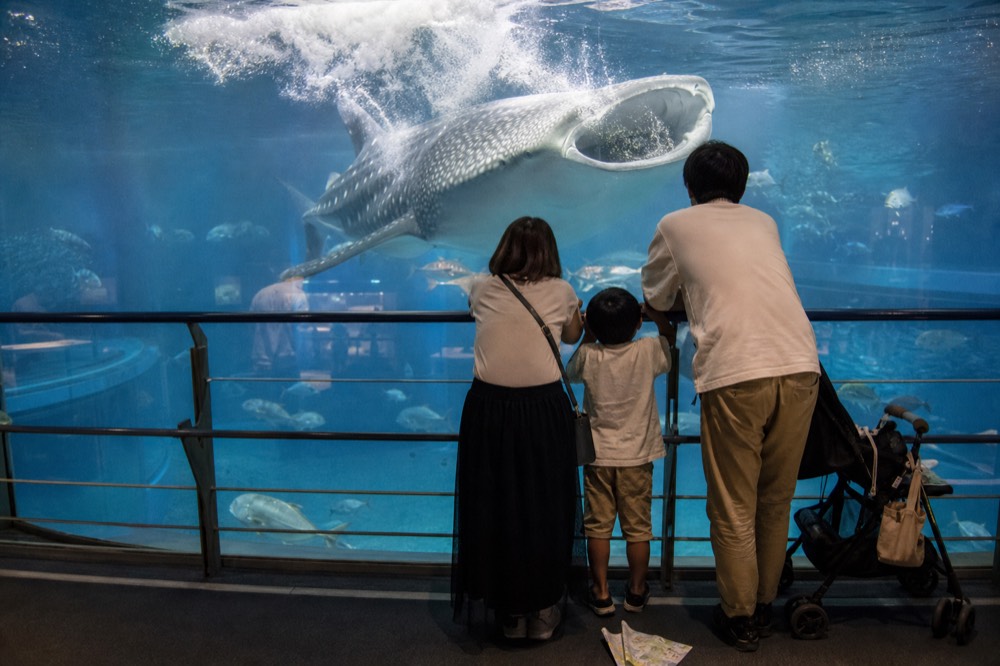
The design also creates a specific viewing rhythm. Every few minutes the ramp delivers you to a new window on the Pacific tank, then a side bay, then back to the Pacific tank. The whale sharks, Kai and Yu, are the visual anchor. The male, Kai, measured 5.3 metres and 1,100 kg at the aquarium's last measurement in October 2025. The female, Yu, is larger, at 6.2 metres and 1,800 kg. Both are young, and Kai has grown 60 cm since arriving in October 2024. You see them from above, then from the side, then from below, and the aquarium's feeding advice, that the best view of a feeding whale shark is from the upper floors because they upend vertically to suck in food, turns out to be true because the building lets you choose your floor for it.
The feeding timetable is part of the rhythm, too. The aquarium publishes a single daily schedule, and the times are staggered so you can catch several feedings during a single visit. The Pacific white-sided dolphins in the Tasman Sea zone are fed at 11:40, 14:00, and 16:30. The otters in Japan Forest eat at 11:30, 13:30, and 15:30. The ringed seals in the Arctic region are fed at 10:50 and 15:35. Because the route is linear, you can plan your walk to hit the mid-morning feeding on the upper floors, then the afternoon sessions on the lower floors, and the spiral itself serves as your timeline.
| Floor | Zone | Animal | Feeding times |
|---|---|---|---|
| 7F | Japan Forest | Otter | 11:30, 13:30, 15:30 |
| 7F | Monterey Bay | Sea lion & seal | 09:50, 13:20, 14:50 |
| 7F | Gulf of Panama | Coati | 11:15, 15:30 |
| 7F | Antarctica | Penguins | 10:00, 14:20 |
| 7F | Tasman Sea | Pacific white-sided dolphin | 11:40, 14:00, 16:30 |
| 6F | Pacific Ocean | Pacific fish | 10:30, 15:00 |
| 4F | Arctic Region | Ringed seal | 10:50, 15:35 |
| 4F | Falkland Islands | Southern rockhopper penguin | 10:50, 15:10 |
The published schedule is subject to change without notice, but the aquarium's own data file updates it daily. The mid-afternoon slot at the Pacific Ocean tank, where the fish are fed in the open water, is a good time to be on the sixth floor, and the ringed seal feeding on the fourth floor often draws a crowd because Yuki, the roly-poly seal that went viral, is still in the Arctic tank. A keeper blog post from June 2026 describes her as healthy and active, along with her tankmates Arare and Moya.
The adult ticket is the most flexible way to experience the feeding rhythm. The price is date-based, so checking the live listing before you book is the only way to lock in a slot at the lower end of the range. The timed-entry system, introduced in 2026, means you choose a 15-minute admission window, and the ticket is capped per slot to keep the walkway from becoming crowded. The spiral route works best when the crowd is thin, and the slot system is designed to preserve that.
What makes the Pacific Ocean tank different from other big tanks?
The Pacific Ocean tank is different because it is the centre of the building, not a standalone exhibit, and its 5,400-ton water volume, 34-metre maximum length, and 9-metre depth are visible from eight different floors, each one revealing a different layer of the same ecosystem. No other aquarium shows you the same whale shark from the surface, the midwater, and the reef floor in a single unbroken walk.
The tank's shape is a vertical cylinder wrapped by the spiral ramp, and the viewing windows are placed at different heights rather than arranged in a single panoramic gallery. This means the light changes. Near the top, sunlight from the skylight penetrates the water, and the whale sharks' spotted backs are clear and sharp. By the sixth floor, the water is a deeper blue, and the sand tiger sharks, which arrived in May 2025, are more visible. Those two sand tigers, a female at 2.7 metres and a male at 2.5 metres, were the first of their species ever exhibited at Kaiyukan. An ocean sunfish, a male measuring 97 cm, arrived in July 2025 and swims in the same tank, its slow, sideways drift a familiar sight in the middle layers.
The tank's water volume, 5,400 tons, is about half of Kaiyukan's total 11,000 tons, and the windows are designed to minimise distortion. The acrylic panels are curved to match the walkway, and the tank's back wall is textured to mimic a Pacific reef slope. The effect is that you see the animals in the water column first, then the reef, and the tank's own depth is the transition. At the bottom, near the third floor, the view is of the reef floor itself, where the benthic fish and the cleaner wrasse stations are visible. The same whale shark that looked huge near the surface now looks even larger from below, silhouetted against the light.
The tank also serves as the hub for the rest of the building. The outer zones, like the Seto Inland Sea and the Cook Strait, are placed around it, and the route switches between these side bays and the central tank every few minutes. A baby porcupinefish, born in the Cook Strait tank and measuring about 3 cm, went on display in September 2026 at the keeper counter on the fourth floor, and the contrast between that tiny fish and the 1,800-kg whale shark in the next room is a deliberate part of the experience.
The seawater itself is a logistical feat. The mouth of the Aji River, directly in front of Kaiyukan, has salinity and turbidity that swing too much to use, so the aquarium trucks in about 350 tons of fresh seawater per run from a collection point further out, pumping about 300 tons per collection. The cost and effort of that operation, for a tank that holds 5,400 tons, is part of what makes the Pacific Ocean tank possible in an urban port location.
| Feature | Pacific Ocean tank (Kaiyukan) | Kyoto Aquarium main tank | Nagoya main pool | Sumida Aquarium Ogasawara tank |
|---|---|---|---|---|
| Volume | 5,400 tons | ~500 tons | 60 m × 30 m × 12 m (volume not published) | Not published |
| Max. length | 34 m | Not published | 60 m | Not published |
| Depth | 9 m | Not published | 12 m | Not published |
| Key species | Whale shark, sand tiger shark, ocean sunfish, manta ray | None of these | Captive-born dolphin, beluga, penguin | None of these |
| Visitor view | 8 floors, spiral | Single-level gallery | Large arena, single-level | Single-level gallery |
The comparison table is not about size alone. Nagoya's main pool is larger in length and depth, but it is viewed from a single spectator gallery. Kaiyukan's tank is smaller and shallower, yet you see it from eight different angles, and that layered viewpoint is what makes it memorable. The whale sharks are the difference, too. Kyoto Aquarium, Sumida Aquarium, and Nagoya do not keep whale sharks. Kaiyukan is one of only a handful of aquariums in Japan, and the world, that does.
How do the whale sharks shape the whole visit?
The two whale sharks, Kai and Yu, are the psychological centre of the entire building, and the spiral route is built around them. You see them from the surface, then at eye level, then from below, and the aquarium's feeding schedule, the viewing advice, and even the optional Jinbei Backyard ticket are all designed to let you experience the same animals from different perspectives.
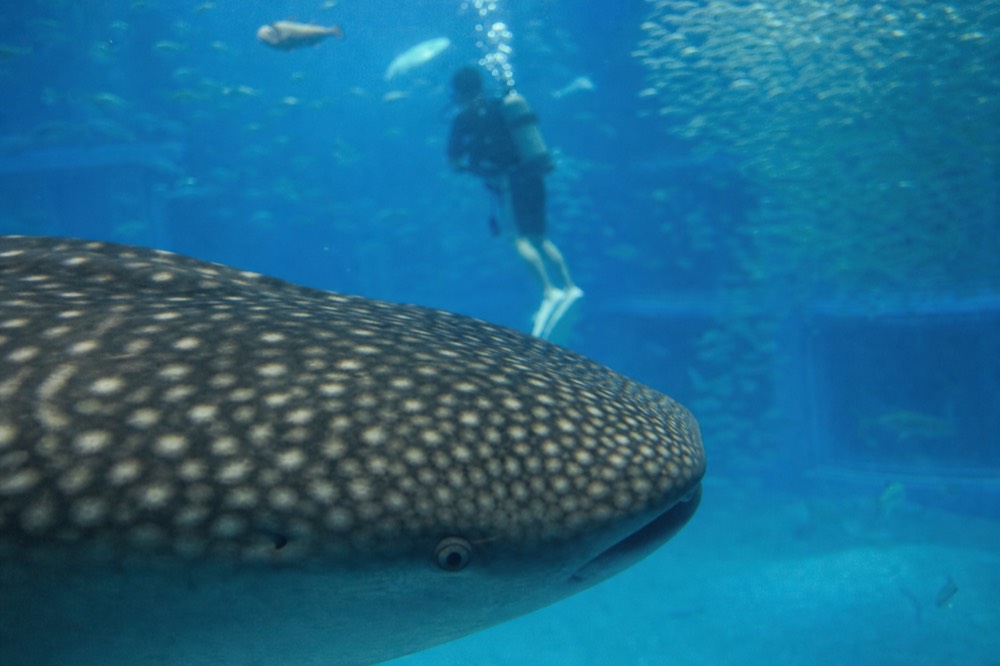
The measurements taken in October 2025 give a sense of their scale. Kai, the male, is 5.3 metres long and weighs about 1,100 kg. He arrived in October 2024 and has grown 60 cm since then. Yu, the female, is 6.2 metres and 1,800 kg, and her length has not changed in the same period. Both are young, and the aquarium's rotation programme means they may eventually be released back to the sea, but for now they are the largest fish in the building.
The whale sharks are fed at the surface, and the aquarium's own advice is to watch from the upper floors, because the sharks upend vertically to suck in plankton-rich water. The seventh floor, near the Japan Forest and Monterey Bay zones, gives a clear view of the feeding, and the angle of the glass means you can see the sharks' spotted backs and the way their gill slits flare. The sixth floor, one level down, is at eye level with the sharks when they swim horizontally, and the sand tiger sharks often share the frame. By the fourth floor, you are looking up at the sharks' pale bellies, and the tank's depth makes the same animal look completely different.
The Jinbei Backyard ticket, a paid add-on available on scheduled dates, takes you behind the tank to see the whale sharks from above the water. The surface view is a different experience entirely, and the ticket books out quickly. The aquarium's official ticket page lists it as a separate option, and the live listing shows whether it is available on your date. The combination of the spiral route and the backyard tour means you can see the same whale sharks from the walkway, the lower windows, and the open water in a single visit.
The whale sharks are not the only stars. The Maldives Zone touch pool, on the lower floors, lets visitors touch small sharks and rays, and the hand-washing stations are placed right next to it. The jellyfish area, called 海月銀河 (Moon Jellyfish Galaxy), is a dark room with backlit tanks that feels like a gallery, and the Large Jellyfish display, which ran from August 2026 with two ~60 cm bell-diameter Ariake Bizen Kurage, gave the space a sense of scale. The sea angels, about 140 clione collected in the Arctic, went on display in August 2026 in the Arctic Region section, and they are visible from the same ramp that leads to the penguins.
The feeding times table is posted on the aquarium's official program page, and the times are the same every day. The Pacific white-sided dolphins in the Tasman Sea zone are fed three times, the penguins twice, and the otters three times. The schedule is staggered, so you can catch the morning dolphin feeding at 11:40, then move down to the Pacific Ocean tank for the 15:00 fish feeding, and still have time to see the ringed seals at 15:35. The spiral route makes this timing natural because you are already moving downward through the building.
The souvenir shop, renovated in December 2025, is near the exit, and the coin lockers are available in the entrance building and under the Ferris wheel. The bag policy, updated in April 2026, prohibits anything with three sides totalling 120 cm or more, or any single side over 70 cm, so large suitcases need to be left at the hotel or in the lockers. The stroller policy encourages visitors to park strollers near the entrance and walk, and staff provide elevator assistance for those who need it.
Is Kaiyukan the biggest aquarium in Japan?
Kaiyukan is not the biggest aquarium in Japan by water volume, but it is the largest built as a single spiral descent. The 5,400-ton Pacific Ocean tank, the 34-metre maximum length, and the eight-floor viewing route make it feel larger than its dimensions. The Port of Nagoya Public Aquarium has a larger main pool, and Tokyo Sea Life Park has a 2,200 m³ tuna tank, but neither offers the same layered experience.
The numbers are worth comparing. Nagoya's main pool is 60 metres long, 30 metres wide, and 12 metres deep, and it holds captive-born dolphins, belugas, and penguins in a large arena. Tokyo Sea Life Park, at Kasai, houses over 500 species in a 2,200 m³ doughnut-shaped tuna tank, and its adult ticket is just ¥700. Kyoto Aquarium's main tank holds about 500 tons of artificial seawater, and Sumida Aquarium's Ogasawara tank holds about 45 species and 450 fish in a tank of undisclosed volume. None of these keep whale sharks, and none are built as a vertical spiral.
Kaiyukan's total water volume, about 11,000 tons, is spread across 14 tanks, not concentrated in one pool. The Pacific Ocean tank accounts for half of that, and the rest is distributed among the 15 permanent zones, each one a separate water system. The building's architecture, not the raw volume, is what makes the experience feel bigger. The spiral ramp means you never see the whole tank at once, and the repeated reveals create a sense of scale that a single panoramic window cannot match.
The building height is 30 metres, and the glass upper section brings it to 50 metres. The route starts at the eighth floor, at the top of the building, and the central void is open from the eighth floor to the third floor, so the vertical drop is about five storeys. The ramp is gentle, and the total walk is about 1.2 kilometres, winding downward without stairs. The design is a feat of urban engineering, and the fact that it was built in 1990, before digital modelling, makes it more remarkable.
The aquarium's visitor numbers also tell a story. It reached 90 million visitors on 1 October 2025, and its 36th anniversary was on 20 July 2026. The first million visitors arrived on day 40 of operation, in August 1990, and the pace has been steady since. The aquarium is a member of the Japanese Association of Zoos and Aquariums (JAZA), and its research institute, the Ibuki Center in Kochi, breeds and studies marine animals for the exhibits.
| Aquarium | Adult admission | Key scale | Whale sharks? | Route design |
|---|---|---|---|---|
| Kaiyukan (Osaka) | ¥2,800–¥3,500 (date-based) | 5,400-ton Pacific tank, 34 m max length, 9 m depth, 14 tanks, 620 species, ~30,000 animals | Yes, 2 | Single spiral, 8 floors |
| Nagoya Port Aquarium | ¥2,030 flat | Main pool 60 m × 30 m × 12 m, ~500 species, ~50,000 animals | No | Two buildings, arena gallery |
| Kyoto Aquarium | ¥2,600 flat | ~500-ton main tank, ~200 species, ~10,000 animals | No | Single-level gallery |
| Sumida Aquarium (Tokyo) | ¥2,700 flat | Ogasawara tank ~45 species, 450 fish; penguin pool 350 t | No | Single-level gallery |
| Tokyo Sea Life Park (Kasai) | ¥700 flat | 2,200 m³ tuna tank, >500 species | No | Single-level gallery |
The table shows that Kaiyukan's nearest competitor in ticket price is Sumida Aquarium, at ¥2,700 flat, but the experience is completely different. Sumida is a modern indoor aquarium attached to Tokyo Skytree, with a small Ogasawara tank and a penguin pool. Kyoto Aquarium is a similar size, with a 500-ton main tank and no whale sharks. Nagoya is larger in some dimensions, but the viewing is a single gallery, and the ticket is cheaper. Tokyo Sea Life Park is the value option, at ¥700, but it is in a different class. Kaiyukan's pricing is higher, but the building itself is the justification.
How does the timed-entry system change the experience?
The timed-entry system, introduced alongside the end of re-entry in June 2026, means you choose a 15-minute admission slot when you book, and the number of tickets per slot is capped. This spreads the crowd across the day, keeps the spiral walkway from becoming jammed, and makes a weekday morning visit feel almost private, provided you book the right slot.
The change was announced on 21 May 2026 and took effect on 15 June 2026. The aquarium's official reason was crowd control and queue reduction, and the cap per slot is real. The slot system is not a suggestion; it is enforced, and same-day tickets are sold only at the counter from opening until last admission, subject to availability. The online e-ticket goes on sale about 30 days before the date, and the aquarium recommends booking in advance, because popular slots sell out quickly.
The knock-on effect is that the route flow is more predictable. Before the change, visitors could arrive at any time and the walkway would bunch up near the whale shark windows. Now, the capped slots mean that the crowd is spread more evenly, and the spiral's own design, wide enough for two strollers side by side in most places, handles the flow better. The best time for a quiet visit is a weekday morning, right at opening, and the current schedule in September 2026 shows a typical weekday opening at 10:30, with last admission at 19:00 and closing at 20:00. On weekends and holidays, the aquarium opens at 09:30, and the earliest opening in the year is 08:00 on peak dates like 20, 21, and 22 September 2026, when the aquarium also closes at 21:00.
The re-entry policy change means you cannot leave and come back on the same ticket. The aquarium's announcement cited the timed-entry system as the reason, and the rule is now printed on the official ticket page. For visitors planning a full day at Tempozan Harbor Village, this means you need to time your visit carefully. The Tempozan Marketplace, the Giant Ferris Wheel, and the Santa Maria cruise are all outside the paid area, so you can do them before or after your Kaiyukan slot. The Ferris Wheel's regular fare is ¥1,000, and the Santa Maria day cruise is ¥1,800, with a combo ticket that adds the boat ride to the aquarium admission on the same date.
The set tickets are sold at the aquarium's counter, and the price moves with the admission calendar. The Santa Maria add-on costs ¥1,500 for an adult, so the total on a ¥2,800 admission day is ¥4,300. The LEGOLAND Discovery Center add-on is ¥2,800, making the total ¥5,600 on a typical day. The Captain Line shuttle boat to Universal Studios Japan adds ¥900, for a total of ¥3,700. These set tickets are not available on every booking platform, and the aquarium's own ticket page is the most reliable source for them.
| Set ticket | Add-on cost (adult) | Total on a ¥2,800 day | Total on a ¥3,500 day |
|---|---|---|---|
| + Santa Maria cruise | ¥1,500 | ¥4,300 | ¥5,000 |
| + LEGOLAND Discovery Center | ¥2,800 (¥3,000 on peak days) | ¥5,600 | ¥6,500 |
| + Captain Line shuttle boat | ¥900 (¥1,100 on peak days) | ¥3,700 | ¥4,600 |
The set ticket prices are not fixed. The add-on cost is layered on top of that day's admission price, so the total moves with the calendar. The table shows the range on a typical ¥2,800 day and the most expensive ¥3,500 day. The Santa Maria and Captain Line add-ons are the most affordable ways to bundle a second attraction, and the LEGOLAND set ticket is the priciest, but it includes full entry to the Discovery Center, which normally costs ¥2,200 to ¥3,300 on its own.
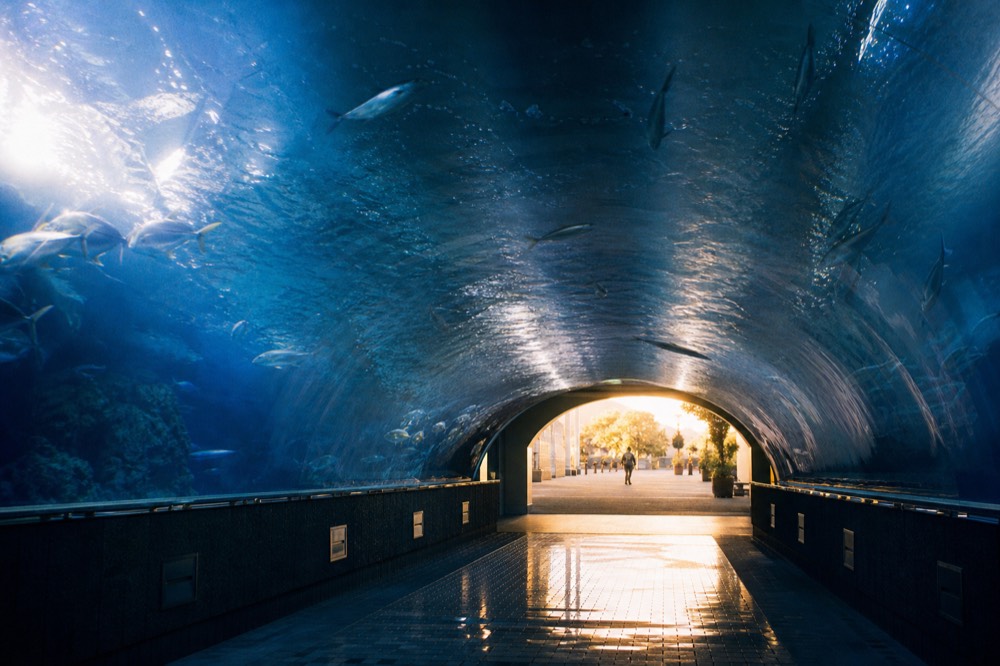
The entrance building itself is part of the sequence. The Aqua Gate tunnel, opened in 1998, is a 3.5-metre-high acrylic tube that wraps around the entrance hall, and the fish swim above and beside you. The lighting is kept low, and the transition from the bright Osaka afternoon to the tunnel is a deliberate sensory shift. The tunnel leads to the escalator, and the escalator delivers you to the eighth floor, where the Japan Forest tank opens the route. The entire sequence, from the ticket counter to the eighth floor, takes about five minutes, and the aquarium's own design documents describe it as a "journey from the surface to the depths."
The lockers are placed near the entrance, and the nursing room is on the second floor of the entrance building, with a kids' toilet, a diaper-changing bed, and a formula preparation device. A second nursing room, inside the paid area behind the Aqua Gate, is for nursing only, with no hot water or changing facilities. The Tempozan Marketplace, on the third floor, also has a nursing booth and a family zone. The stroller policy means you leave the stroller at the parking area near the ticket counter, and staff provide elevator assistance for the escalator section. The route itself uses slopes, not stairs, and the aquarium's barrier-free information says most of the route is accessible.
Common questions about what is so special about Kaiyukan
What is so special about Kaiyukan?
The unique spiral route is the core answer. Kaiyukan is built around a single 5,400-ton Pacific Ocean tank, visible from eight floors as you descend a continuous ramp, so you see the same whale sharks, rays, and schooling fish at the surface, midwater, and reef floor in one unbroken walk. The building, opened in 1990, is a vertical Pacific Rim, with 19 exhibition areas stacked around the central void, and the design forces an immersive 90-to-120-minute journey with no backtracking.
Why is Kaiyukan famous?
Kaiyukan is famous for its whale sharks and its one-of-a-kind spiral architecture. The two whale sharks, Kai and Yu, are the largest fish in the building, and the feeding schedule, the layered viewing angles, and the optional Jinbei Backyard ticket all revolve around them. The aquarium is also one of only a handful of facilities in the world that keep whale sharks in a walk-around tank with multiple viewing depths.
Is Kaiyukan the biggest aquarium in Japan?
No, it is not the biggest by water volume or tank size. The Port of Nagoya Public Aquarium has a larger main pool, and Tokyo Sea Life Park has a larger tuna tank. But Kaiyukan is the largest spiral aquarium, and the 5,400-ton central tank, seen from eight floors, makes it feel larger than its dimensions suggest.
How long does it take to visit Kaiyukan?
The aquarium's own school-group FAQ budgets 90 to 120 minutes. The spiral route is about 1.2 kilometres long, and the feeding times are staggered so you can catch several during a single visit. With the timed-entry system, a weekday morning slot gives the most relaxed pace.
Do you need to book Kaiyukan in advance?
Yes, the timed-entry system means you choose a 15-minute admission slot when you book, and the number of tickets per slot is capped. Online e-tickets go on sale about 30 days before the date, and same-day tickets are sold only at the counter, subject to availability. Booking in advance is the only way to guarantee your preferred slot.
Are there whale sharks at Kaiyukan?
Yes, there are two whale sharks, Kai and Yu, in the Pacific Ocean tank. The last measurement in October 2025 recorded Kai at 5.3 metres and 1,100 kg, and Yu at 6.2 metres and 1,800 kg. Both are visible from the spiral ramp, and the aquarium's feeding advice says the best view is from the upper floors.
The spiral is the secret. The whale sharks are the reward. The rest is just a very well-designed building that makes you feel like you're inside the ocean, not standing in front of it. Visit the Osaka Aquarium page for more practical guides, or read about the whale sharks in detail and the floor-by-floor route to plan your walk.