How many floors does Kaiyukan have?
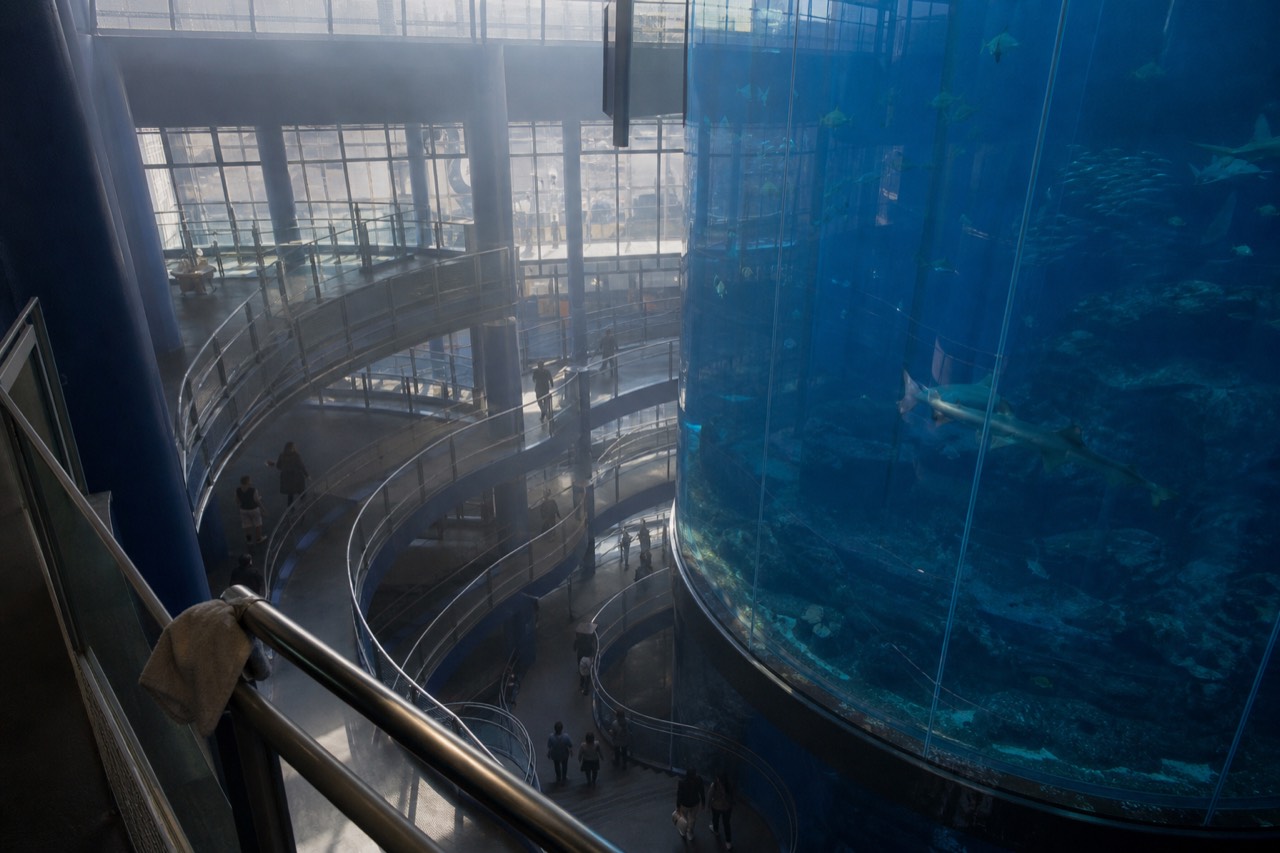
Kaiyukan has eight exhibition floors plus an entrance building, arranged as a one-way spiral descent around the central Pacific Ocean tank. Here is what sits on every floor and how the layout shapes your visit.
How many floors does Kaiyukan have?
Kaiyukan has eight exhibition floors, numbered 8 down to 3, plus a separate Entrance Building whose 3rd and 4th floors bookend the route. You enter on the Entrance Building 3F, ride an escalator to the 8th floor, then spiral downward around the central Pacific Ocean tank until you exit where you started.
That sentence is the whole architectural idea, and it is worth slowing down on, because almost every piece of practical advice about visiting Kaiyukan flows from it. The aquarium opened on 20 July 1990, and its designers built the route as a descent on purpose. The official wording on the aquarium's own site describes the structure as one where you walk along the route from the upper floors of the building, spiraling down and around, and that is exactly what happens. There is no way to skip floor five, no way to do the floors in reverse, and no way to go back up without leaving the exhibition area, because same-day re-entry ended on 15 June 2026.
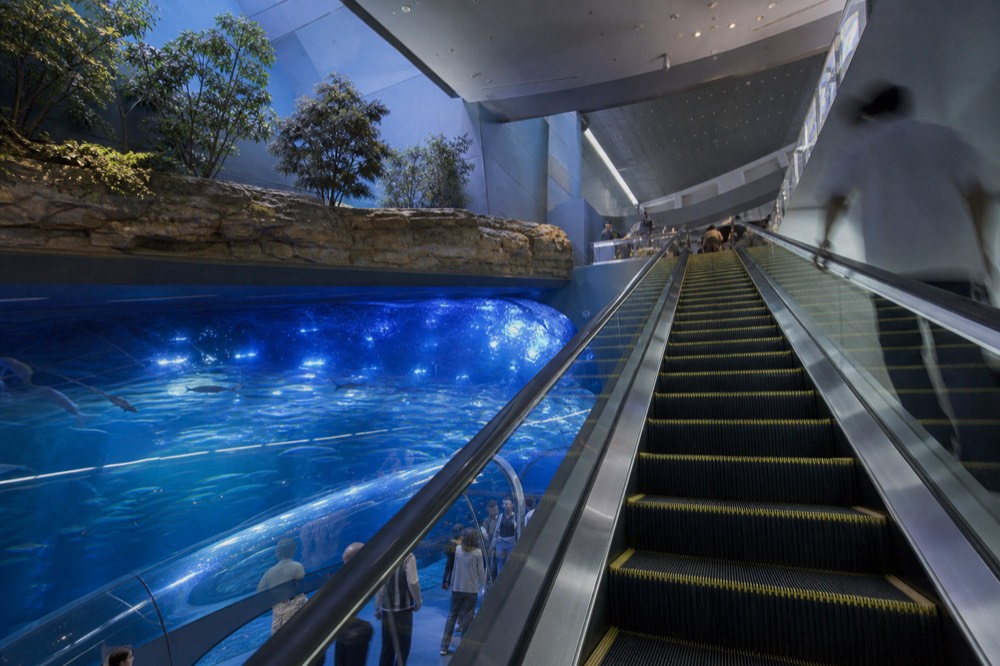
The visit starts with a taste of what is coming: the Aqua Gate, a walk-through tunnel tank that opened on 17 April 1998, sits at the entrance on the Entrance Building 3F. From there the escalator lifts you to the 8th floor and the Japan Forest zone, and the descent begins. The whole building holds about 620 species and 30,000 animals across 14 large and small tanks recreating 10 regions of the Pacific, with a total water volume of about 11,000 tons. The building itself is 30 metres tall, or 50 metres if you count the glass upper section.
One honest note on the count itself: different sources will tell you Kaiyukan has six, seven or eight floors, and the disagreement comes from how you treat the Entrance Building. The aquarium's own floor map, published at kaiyukan.com's area map page, numbers the exhibition floors 8 through 3 and treats the Entrance Building separately. Using that map as the authority, the answer is eight exhibition floors plus the entrance structure, and that is the framing used throughout this article. Visitors who want a fuller walkthrough of the zones, the layout and the wayfinding can also read the companion Kaiyukan floors and map guide, which pairs with this article's focus on the descent itself.
Why the floors run as a one-way spiral
The one-way descent exists to control crowd flow and to tell a story at the same time: each ring of the spiral returns you to the same central tank, the Pacific Ocean, at a different depth. The design means traffic never splits into oncoming streams, and every visitor sees every zone, whether the building is full or quiet.
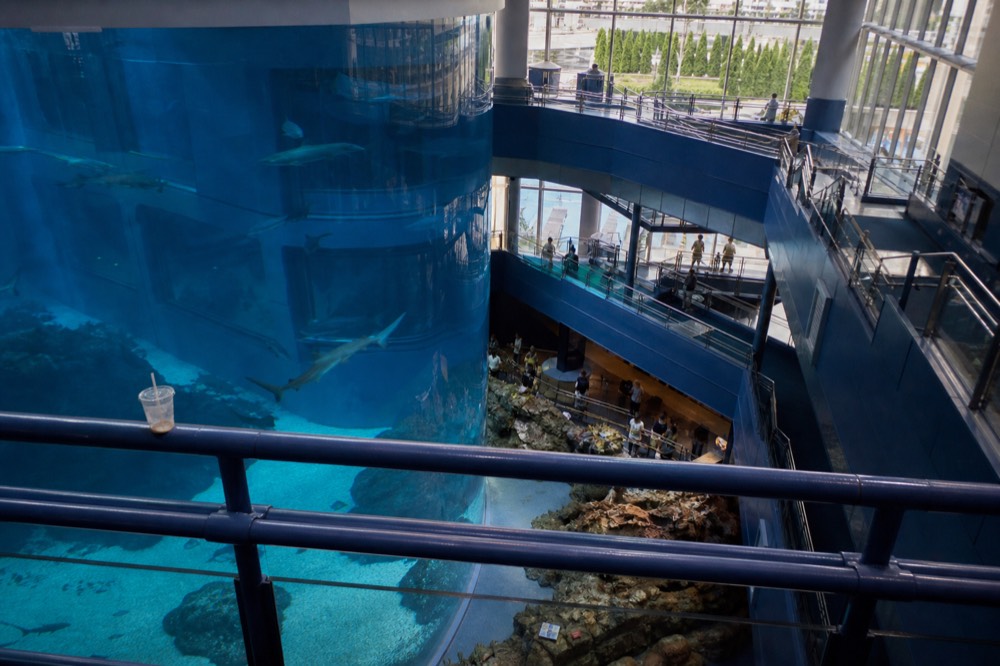
The centrepiece of the spiral is the Pacific Ocean tank, which holds 5,400 tons of water, has a maximum length of 34 metres, and runs up to 9 metres deep. The aquarium's own description says the tank gives you the feeling of diving to a maximum depth of 9 metres, and the floor plan makes that literal. On floor 8 you look down on the surface of that water from above; by floor 4 you are standing near its floor watching rays and sharks pass at eye level. The same tank is therefore not one exhibit but at least six, one per floor.
That structure explains a quirk first-time visitors often notice: you keep seeing the same fish. A whale shark that swam past you on floor 7 will swim past again on floor 5 from a different angle, in different light. It is a deliberate repetition, and it rewards patience, because the second or third view of the Pacific tank is often the one where the scale finally lands. At Kaiyukan's last measurement, taken on 31 October 2025, the tank held two whale sharks: Kai, a male at 5 m 30 cm and an estimated 1,100 kg, and Yu, a female at 6 m 20 cm and an estimated 1,800 kg.
There is also a crowd-management logic here. A one-way route with a fixed direction cannot gridlock the way a free-roaming museum can, which is why the aquarium has leaned further into the model: since 2026, admission has been by timed-entry ticket sold in 15-minute slots with a capped number of tickets per slot, explicitly to control crowding and cut queueing. The floors and the ticketing system are two halves of the same plan. Planning a visit around that system is covered in detail in the Kaiyukan tickets guide.
What lives on each floor
Each floor of the descent carries distinct zones, and the aquarium's own published map and encyclopedia list 19 exhibition areas in total, 18 permanent plus one temporary show. Floor 8 holds Japan Forest, floor 7 concentrates five zones including Antarctica and the Tasman Sea, and the lower floors descend through temperate and cold waters to the Arctic and Falkland Islands.
The spread is not even, and that unevenness is useful to know before you go, because the top floors carry the most variety and the busiest viewpoints. The Aleutian Islands tank is currently closed for renovation, per the official exhibition page, with its animals moved to Aquaworld Ibaraki Oarai Aquarium, so the zone count you can actually walk through is one lower than the published total right now.
Here is the floor-by-floor breakdown as the route presents it, using the zone names printed on the aquarium's own English exhibition headings:
| Floor | Zone | What you see |
|---|---|---|
| 8F | Japan Forest | Forest habitat at the top of the descent, otters and freshwater life |
| 7F | Aleutian Islands | Closed for renovation |
| 7F | Monterey Bay | Sea lions and seals |
| 7F | Gulf of Panama | Coatis and coastal species |
| 7F | Ecuador Rainforest | Rainforest species |
| 7F | Antarctica | Penguins |
| 7F | Tasman Sea | Pacific white-sided dolphins |
| 6F to 5F | Pacific Ocean | The central tank at multiple depths |
| 4F | Arctic Region | Ringed seals, including Yuki |
| 4F | Falkland Islands | Southern rockhopper penguins |
| 4F to 3F | Cook Strait, Japan Deep, Seto Inland Sea, Coast of Chile | Deeper and cooler water species |
| Entrance Building 4F | Jellyfish, Great Barrier Reef, Seasonal Exhibits | Jellyfish gallery and reef tank |
Feeding times are published per zone, and because the route is one-way, they are worth matching against your slot. The timetable carries no day-of-week variation; the aquarium notes times may be cancelled or changed depending on the animals' condition.
| Floor | Zone | Animal | Feeding times |
|---|---|---|---|
| 7F | Japan Forest | Otter | 11:30, 13:30, 15:30 |
| 7F | Monterey Bay | Sea lion / seal | 09:50, 13:20, 14:50 |
| 7F | Gulf of Panama | Coati | 11:15, 15:30 |
| 7F | Antarctica | Penguins | 10:00, 14:20 |
| 7F | Tasman Sea | Pacific white-sided dolphin | 11:40, 14:00, 16:30 |
| 6F | Pacific Ocean | Pacific fish | 10:30, 15:00 |
| 4F | Arctic Region | Ringed seal | 10:50, 15:35 |
| 4F | Falkland Islands | Rockhopper penguin | 10:50, 15:10 |
One official viewing tip that the floor plan makes sense of: the whale sharks are fed at the surface, so the upper floors give the better view of a feeding, when the animal upends into a vertical position to suck in food. If a feeding is on your list, buy a slot that puts you on the upper floors at the right hour rather than racing the one-way route.
How long the descent takes
Kaiyukan itself budgets 90 to 120 minutes for a visit, and that figure is a direct consequence of the floor plan: a fixed one-way route through eight floors has a fairly predictable walking time. Families with young children and visitors who want to catch a feeding should plan for two to three hours, since you cannot loop back for a second attempt.
The 90-to-120-minute figure comes from the aquarium's own school-group FAQ, which is the only official page that states a duration. It is a school-group page rather than the general visitor FAQ, so treat it as Kaiyukan's planning number rather than a promise, but it matches how the route behaves. Because you cannot re-enter, there is no leaving for lunch and returning; the exit dumps you into the Entrance Building 3F next to Tempozan Marketplace and its food alley, Naniwa Kuishinbo Yokocho, which is the natural place to eat either before or after rather than during.
The one-way rule cuts both ways for slow travellers. On the plus side, nobody can overtake you into a zone you are lingering in, and the route never asks you to backtrack. On the minus side, if you reach floor 4 and realise you wanted more time with the dolphins on floor 7, that moment is gone. The practical answer is to budget generously and to slow down on the upper floors, where the zones are densest, rather than saving your time for the bottom. For more on pacing, including what first-timers consistently get wrong, see how long to spend at Kaiyukan.
The Pacific Ocean tank at the centre of the spiral
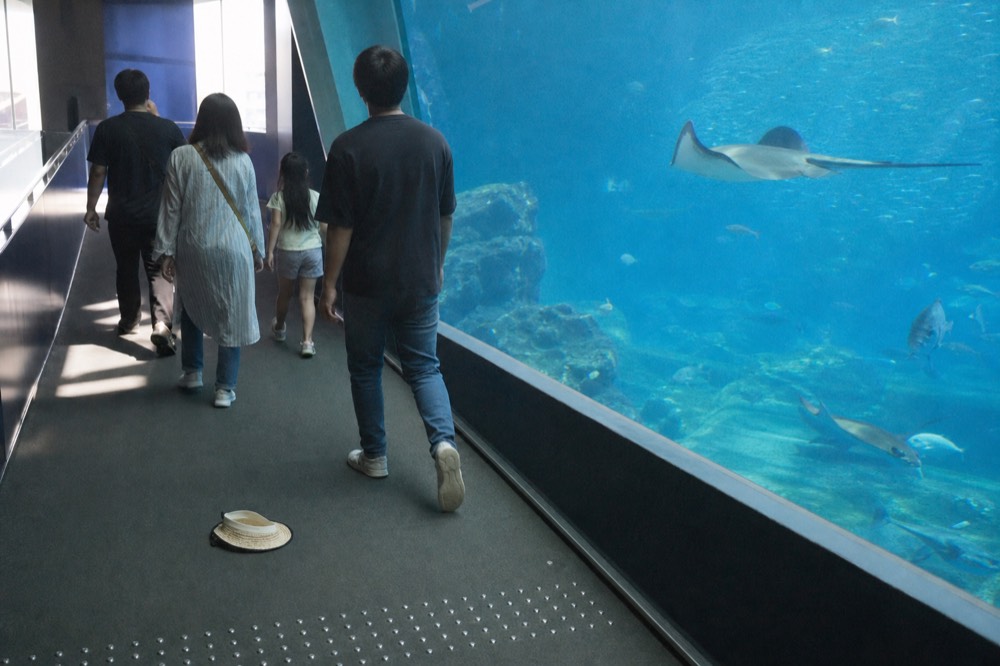
Every floor of the descent orbits one tank: the Pacific Ocean, a 5,400-ton, 34-metre, 9-metre-deep habitat that the building was designed around. The floors exist to give you six or more different views of that single volume of water, from the surface on floor 8 to near the bottom on floor 4, which is why the tank, not any one zone, is the aquarium's signature.
The numbers come from Kaiyukan's own school-visit pages, which state a maximum length of 34 metres, a depth of 9 metres and a total water volume of 5,400 tons. Those pages also give the building-wide figures: about 620 species, 30,000 animals, 14 tanks, about 11,000 tons of water in total. A detail almost nobody quotes is how the water gets there in the first place. The sea directly in front of the aquarium is the mouth of the Aji River, whose salinity and turbidity swing too much to use, so seawater is trucked in, roughly 300 tons pumped per collection and about 350 tons delivered per run, according to the aquarium's facilities team.
The tank's residents are the reason people plan whole trips around the descent. As well as the two whale sharks, Kai and Yu, the Pacific tank gained two sand tiger sharks in May 2025, a female at 2.7 m and a male at 2.5 m, the first time Kaiyukan had ever exhibited the species, and an ocean sunfish, a male at 97 cm, that arrived on 4 July 2025 from the aquarium's own Ibuki Center in Kochi. There is also a paid add-on, the Jinbei Backyard ticket, which takes you behind the Pacific tank to see the whale sharks from above the water on scheduled dates, and it is the only official way to see the tank from any angle the public route does not give you.
Practical things the floor plan changes
A one-way, eight-floor descent changes your logistics more than a normal museum layout does: you cannot re-enter, large bags have been banned inside since April 2026, and the route is mostly slopes, so strollers are parked at the entrance and wheelchairs are guided by staff at the few stairs. Knowing these rules before you arrive is the difference between a smooth spiral and a frustrating one.
The bag rule is the one that catches travellers with luggage. Since 24 April 2026, suitcases, cart-type luggage and anything whose three sides total 120 cm or more, or with any single side over 70 cm, may not be brought inside, and umbrellas 120 cm or longer are also out. Anything wider than 85 cm may be refused outright because some corridors will not take it. Kaiyukan's advice is to leave oversized bags at your hotel or in the coin lockers at the entrance, in Kaiyukan Hall, near the Museum Shop, in Tempozan Marketplace or under the Ferris wheel. The full rules are published on the aquarium's rules and manners page.
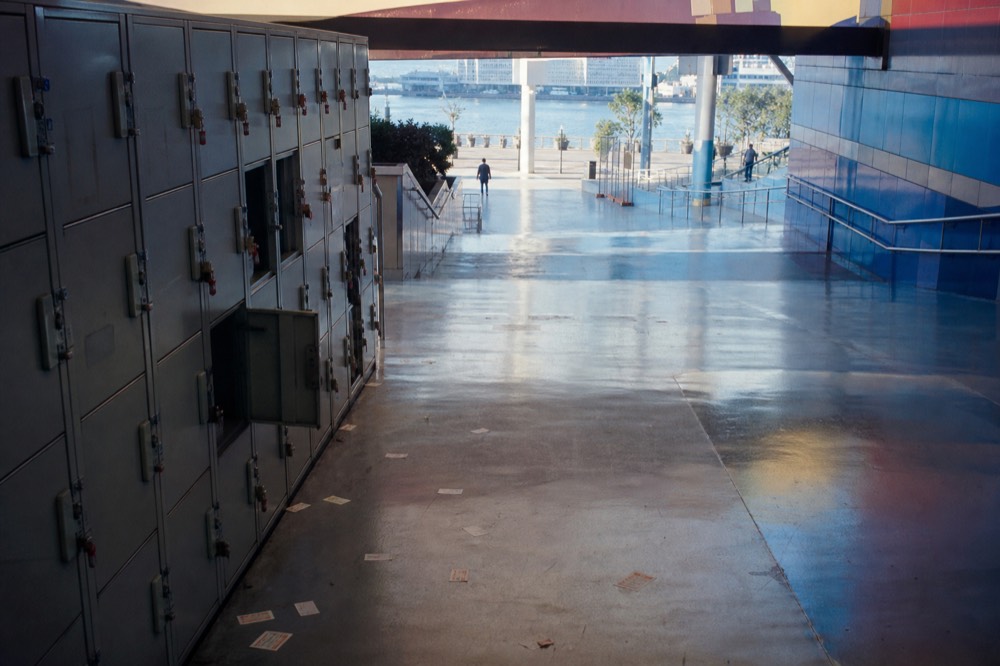
For families, the slope-based route is good news and the re-entry rule is the trade-off. There are no stroller rentals, and the parking area is near the ticket counter, left of the entrance, with staff providing elevator assistance where stairs or escalators interrupt the slope. A baby care room on the Entrance Building 2F has a kids' toilet, nursing room, diaper-changing bed and formula preparation device, and there is a private nursing room behind the Aqua Gate tank inside the paid area, though that one has no hot water or changing facilities. Since you cannot pop out and back in, feed and change before you start the descent or at the Entrance Building 2F facilities first.
| Rule or facility | Detail |
|---|---|
| Re-entry | Ended 15 June 2026; same-day re-entry is not permitted |
| Timed entry | 15-minute admission slots, capped tickets per slot |
| Large bags | Banned since 24 April 2026: three sides over 120 cm total, or any side over 70 cm |
| Corridor width | Anything wider than 85 cm may be refused |
| Strollers | No rentals; parking near the ticket counter, left of entrance |
| Wheelchairs | Free rental, limited supply, at the information desk |
| Baby care | Entrance Building 2F: nursing room, kids' toilet, changing bed, formula device |
| Lockers | Entrance Building, Kaiyukan Hall, Museum Shop, Marketplace, under the Ferris wheel |
The last practical consequence is timing, and it loops back to the floors themselves. Because the route is fixed and the crowd enters in metered 15-minute slots, the upper floors are where a busy day bunches up: everyone starts at floor 8 within minutes of their slot. Later in the route the crowd spreads out and thins. Weekday mornings right at opening are the quietest periods, and Tuesday and Wednesday are typically the least crowded days, which is worth reading alongside the best-time-of-day guidance in when to visit Kaiyukan.
Ticket prices move with demand rather than sitting still, which is the other reason the slot matters. Kaiyukan runs demand-based variable pricing on a date-by-date calendar, and the price for your chosen day is set by that calendar, not by the ticket seller. On the dates currently bookable, adult admission runs ¥2,800 to ¥3,500 depending on the day, with more than three quarters of bookable dates at ¥2,800; children aged 7 to 15 pay ¥1,400 to ¥1,800, and preschoolers aged 3 to 6 pay ¥700 to ¥900, with under 2s free. A ticket for the timed slot that matches your ideal feeding time or a quiet weekday is the one purchase the floor plan makes genuinely consequential, and Check availability on the live listing to see your date's price. The Osaka Aquarium Kaiyukan Ticket is rated 4.8 across about 14,894 reviews, and buying ahead is what the aquarium itself recommends, since the date and time can be changed later from My Page.
| Age tier | Ages | Bookable price range |
|---|---|---|
| Adult | 16 and over | ¥2,800 to ¥3,500 |
| Child | 7 to 15 | ¥1,400 to ¥1,800 |
| Young child | 3 to 6 | ¥700 to ¥900 |
| Infant | Under 2 | Free, no ticket needed |
Kaiyukan's floor plan is not a container for its exhibits, it is the exhibit: eight rings of a spiral around 5,400 tons of water, walked once, in one direction, in about two hours. Once you know that, almost everything else about visiting, from the timed slots to the bag rule to where to eat, arranges itself around the descent. For a broader look at what the experience delivers for the money, is Kaiyukan worth visiting covers the question this article sets up, and Osaka Aquarium as a site exists to answer exactly these layout questions before you commit a half-day of an Osaka trip.
Kaiyukan is an eight-floor exhibition building arranged as a one-way spiral from floor 8 down to floor 3, plus an Entrance Building that holds the way in, the way out and the jellyfish gallery. The six questions below cover the parts of that layout visitors ask about most: going back up, elevators and slopes, strollers, the whale sharks, the feeding schedule and the one zone that is currently closed for renovation.
Common questions about Kaiyukan's floors
How many floors does Kaiyukan have?
Kaiyukan has eight exhibition floors, numbered 8 down to 3, plus the Entrance Building, whose 3rd floor is the way in and out and whose 4th floor holds the Jellyfish and Great Barrier Reef zones. You ride an escalator to the 8th floor and spiral down around the central Pacific Ocean tank.
Can you go back up once you start the descent?
No. The route is one-way, and same-day re-entry ended on 15 June 2026, so once you exit the exhibition area you cannot return. If you want more time with a particular zone, spend it as you pass, because you cannot loop back.
Is there an elevator or do you climb stairs?
Most of the route uses slopes rather than stairs, and staff provide elevator assistance where stairs or escalators exist. Wheelchairs are available free, in limited supply, at the information desk, and the aquarium publishes barrier-free guidance covering accessible toilets at multiple locations.
Are strollers allowed on the floors?
Strollers are parked outside, in the outdoor parking area near the ticket counter to the left of the entrance, and visitors are encouraged to view exhibits on foot. There are no stroller rentals. A baby care room with nursing and changing facilities is on the Entrance Building 2F.
Which floor has the whale sharks?
The whale sharks live in the Pacific Ocean tank at the centre of the building, and you see them from several floors as you descend. The upper floors give the better view of a feeding, since the sharks feed at the surface and upend vertically to suck in food.
Which zone is closed right now?
The Aleutian Islands tank on floor 7 is closed for renovation, and its animals have moved to Aquaworld Ibaraki Oarai Aquarium. The aquarium says renovation details will be announced when decided, so check its exhibition page before a visit if that zone was on your list.