How Long to Spend at Kaiyukan
Kaiyukan's own school-group FAQ puts a visit at 90 to 120 minutes, a figure general visitors rarely see. The spiral route, the feeding timetable and the timed entry slots decide whether your visit lands at the short end or the long one.
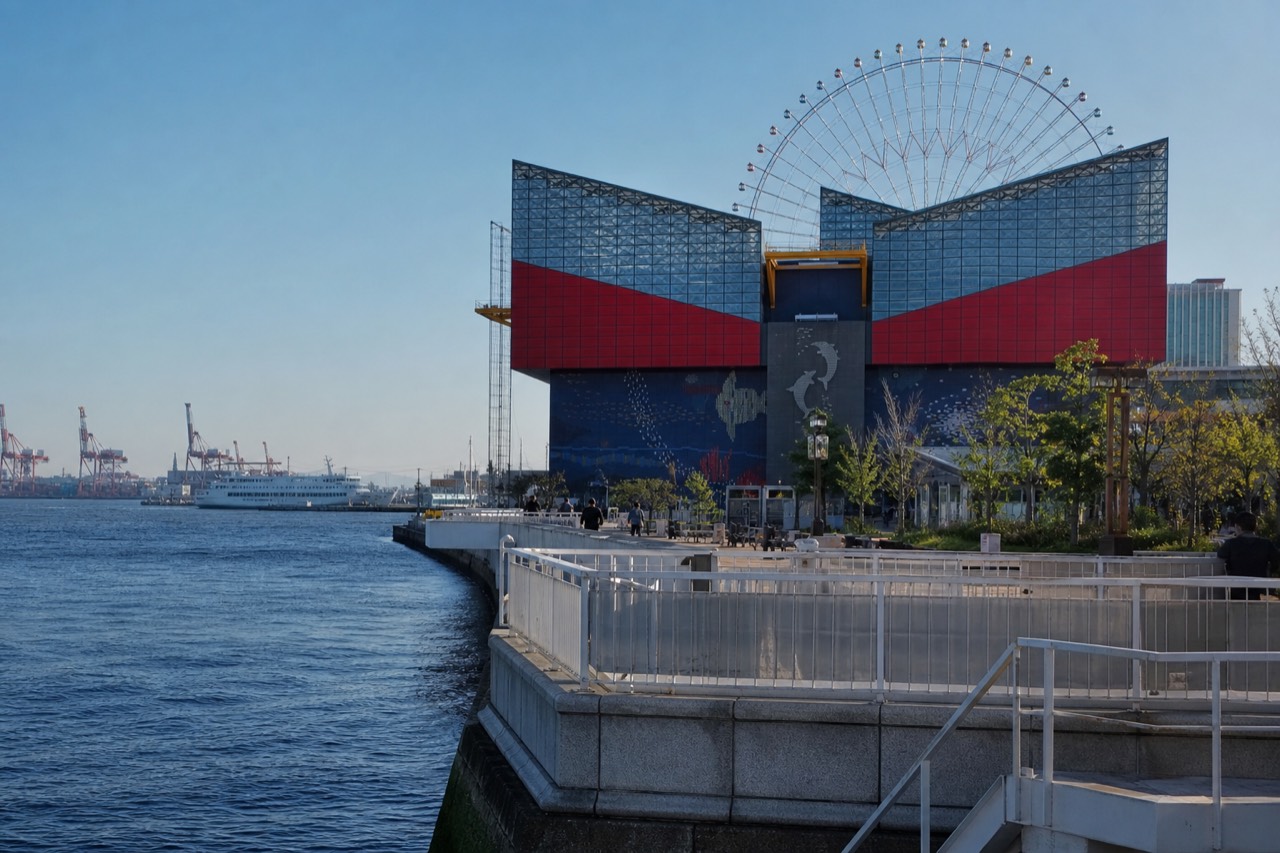
Short answer
Kaiyukan itself budgets 90 to 120 minutes for a visit, stated on its own school-group FAQ. The one-way spiral route from the 8th floor down fixes that minimum, feeding times stretch it, and entry runs in capped 15-minute slots. Families and feeding-time watchers should plan two and a half to three hours.
How long does a visit to the aquarium in Osaka Bay Kaiyukan actually take?
The honest headline figure is 90 to 120 minutes, and it comes from the aquarium itself: Kaiyukan's own frequently asked questions page for school groups states plainly that a visit runs 90 to 120 minutes. Almost no travel article quotes it, because the page sits in the group-visit section of the official site rather than the general visitor area, so the number stays buried where individual tourists never look.
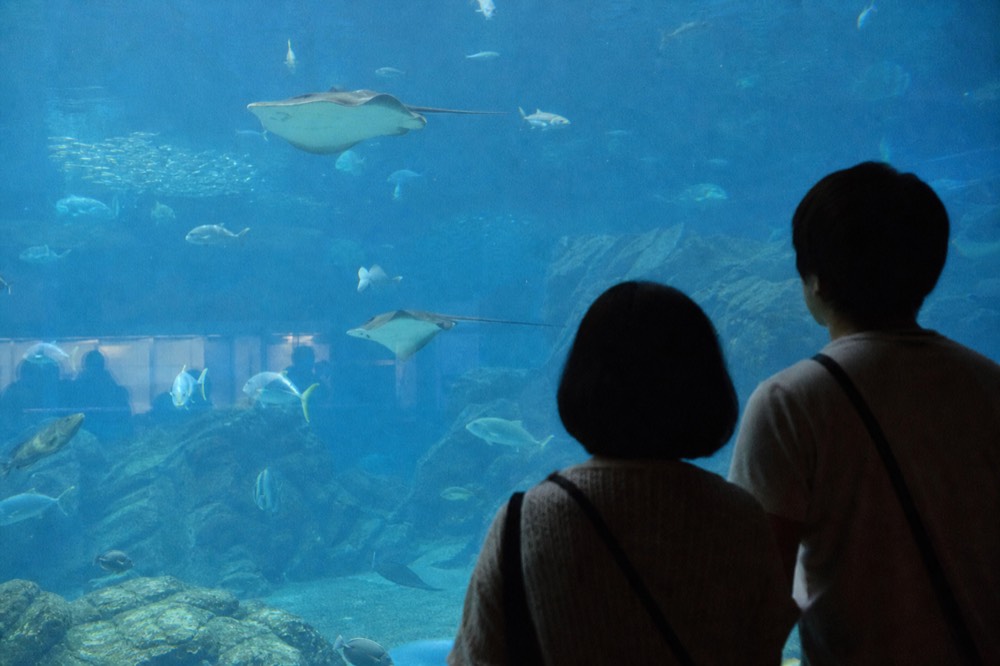
That 90 to 120 minute budget is a school-group planning figure, written for teachers herding classes through on a schedule, so treat it as the aquarium's estimate of a brisk, directed walkthrough rather than a leisurely one. It is still the only official duration statement Kaiyukan publishes, and it is a far better anchor than the vague "two to three hours" that circulates on travel forums. This Osaka Aquarium guide works from that official figure outward, showing what stretches it and what compresses it.
The range matters more than the midpoint. Ninety minutes is achievable if you enter with the flow, keep moving down the spiral, and skip the feeding sessions. Two hours is what the aquarium expects when a group stops at the main tanks. Add children, a feeding-time stop, or a crowded Saturday, and the clock drifts past two hours without much effort. Our fuller walkthrough of what makes the aquarium worth visiting covers what you actually see along the way, which is the real driver of how long you linger.
For planning purposes, book nothing tighter than a two-hour window after your entry slot. If Tempozan Harbour Village is on your day's plan, and it usually should be, the honest total is closer to half a day.
Why the one-way spiral route fixes your minimum time
The building's layout, not your enthusiasm, sets the floor on visit length: you enter on the 3rd floor of the Entrance Building, ride an escalator to the 8th floor, then walk a one-way spiral down around the central Pacific Ocean tank until you reach the exit on 3F again. There is no shortcut to the door, no skipping ahead, and no cutting a floor you are tired of, because the route only runs downward.
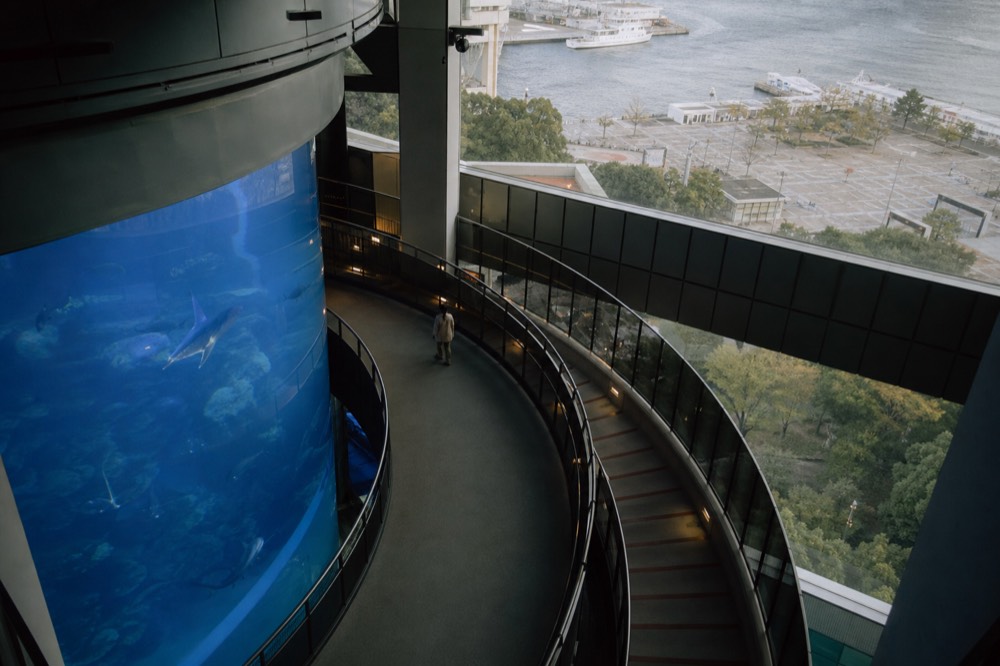
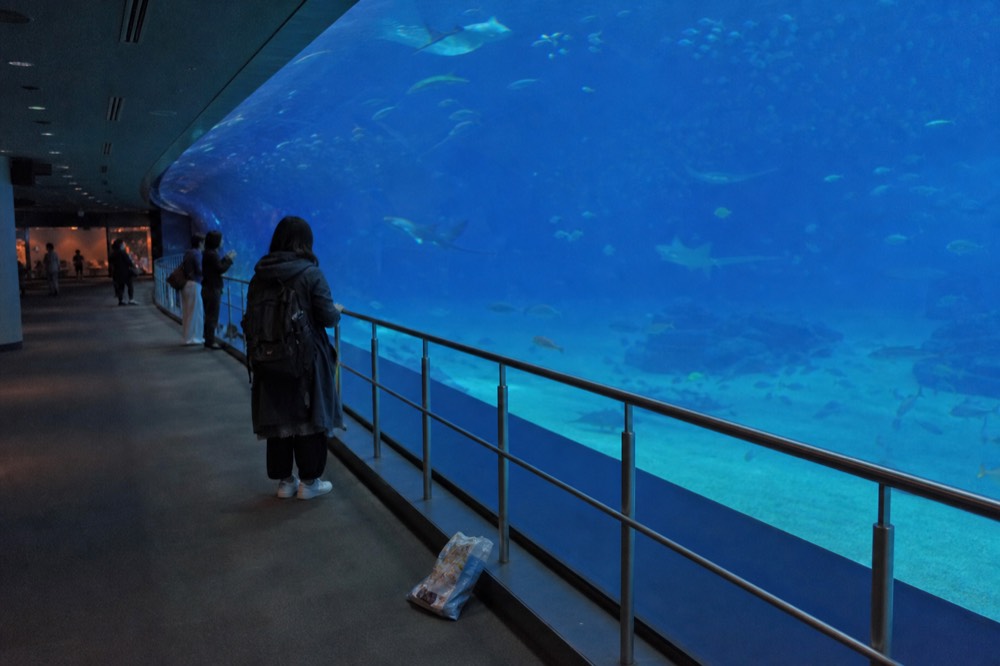
Kaiyukan's own description of the structure says visitors walk the route from the upper floors downward, spiralling as they go. The central tank holds 5,400 tons of water, reaches 9 metres in depth, and has a maximum length of 34 metres, and you revisit it from a different angle on nearly every floor. That repetition is deliberate: the whale sharks, the sand tiger sharks and the ocean sunfish all live in that one tank, and each floor gives a different depth view of them. You can read the full floor-by-floor breakdown for the layout detail.
The 90-minute floor exists because of this geometry. Every visitor, from a rushed business traveller to a family with a toddler, walks the same 8F to 3F descent through 19 exhibition areas. Faster visitors simply pause less at each one. Slower visitors are not adding distance, they are adding stops.
One wrinkle worth knowing before you plan: the Aleutian Islands tank is closed for renovation, per the official exhibition page, so the current route has one fewer stop than older guides describe. On the flip side, the Great Barrier Reef tank reopened after its own renovation in November 2024 and is fully back on the route.
What the 15-minute entry slots mean for your timing
Entry runs in 15-minute timed slots with a capped number of tickets per slot, a system the aquarium introduced explicitly to control crowding, and your slot time is the moment you join the entry queue, not the moment the visit ends. Since 15 June 2026 re-entry has ended entirely, so once you walk out through the Entrance Building, the visit is over; you cannot pop back in for one more look at the whale sharks.
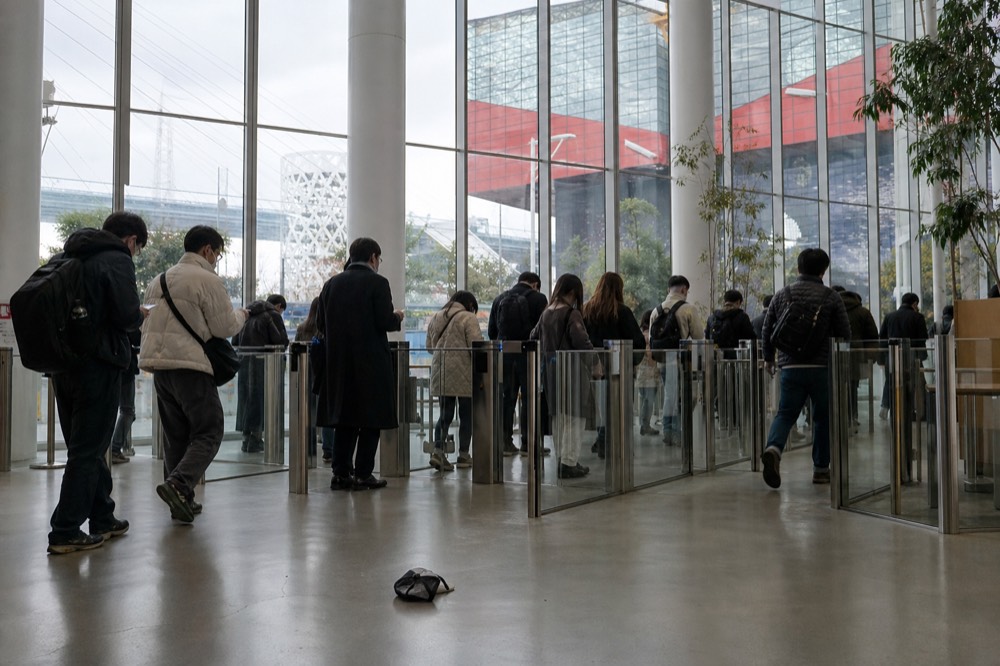
Two timing consequences follow from the slot system. First, arriving early for your slot buys you nothing except time in the Tempozan Marketplace, because entry is batched. Second, the no-re-entry rule means you should eat before you enter or plan food afterwards, not midway. The feeding-friendly food options are covered in our guide to where to eat near the aquarium, and the mall next door makes an easy pre-visit stop.
Last admission is exactly one hour before closing on every dated day in the aquarium's published calendar, so a 20:00 close means 19:00 is the final slot. Booking the last slot gives you that one hour, full stop. It is a real option if you like quiet tanks and blue evening light, but it hard-caps your visit at sixty minutes of the aquarium's official 90 to 120.
The advance e-ticket is what the aquarium itself recommends, and the date and time can be changed later from your booking page, which matters if your Osaka plans are still loose. Same-day tickets are sold only at the counter from opening until last admission, and on peak dates the counter queue eats time the slot system was built to save.
Should you book ahead at all? Our piece on whether you have to book in advance works through the busy-day logic in full; the short version is that a timed e-ticket is the only way to guarantee a specific slot on a weekend.
The feeding timetable that stretches your visit
Feeding sessions are the single biggest variable in visit length: the aquarium publishes a fixed daily timetable across eight zones, from otters fed at 11:30, 13:30 and 15:30 in Japan Forest to ringed seals fed at 10:50 and 15:35 in the Arctic, and each session you stop for adds five to fifteen minutes of standing time. Watch two or three feedings and your visit slides from 90 minutes toward the far side of two hours.
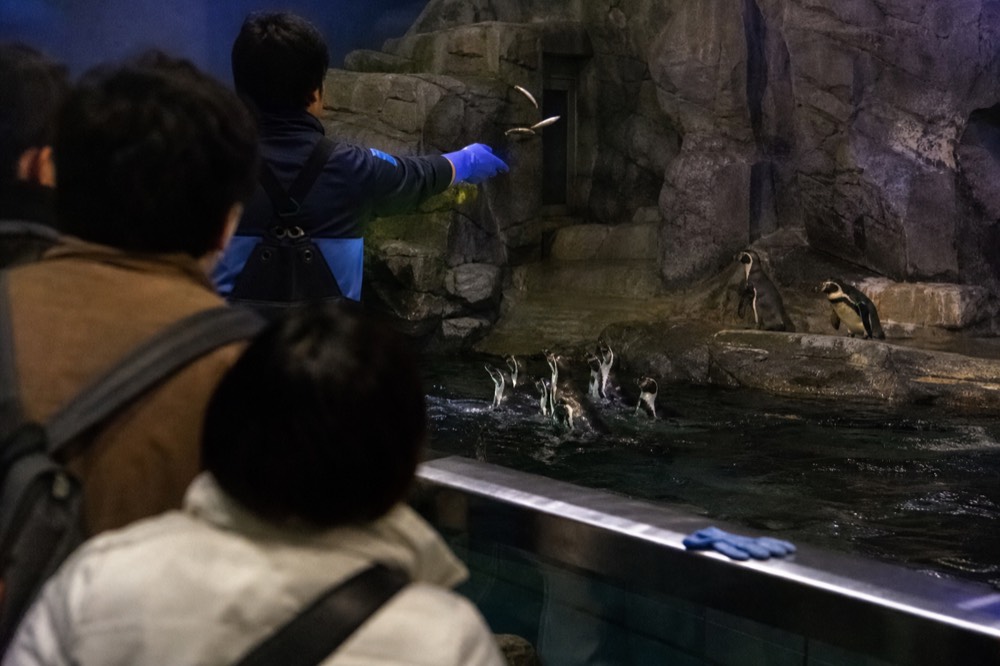
The full published timetable, read from the aquarium's own data file:
| Floor | Zone | Animal | Feeding times |
|---|---|---|---|
| 7F | Japan Forest | Otter | 11:30, 13:30, 15:30 |
| 7F | Monterey Bay | Sea lion / seal | 09:50, 13:20, 14:50 |
| 7F | Gulf of Panama | Coati | 11:15, 15:30 |
| 7F | Antarctica | Penguins | 10:00, 14:20 |
| 7F | Tasman Sea | Pacific white-sided dolphin | 11:40, 14:00, 16:30 |
| 6F | Pacific Ocean | Pacific fish | 10:30, 15:00 |
| 4F | Arctic Region | Ringed seal | 10:50, 15:35 |
| 4F | Falkland Islands | Southern rockhopper penguin | 10:50, 15:10 |
The timetable carries no day-of-week variation, so these times are the same on a quiet Tuesday and a packed Sunday; only the crowd density around each tank changes. The aquarium's own caveat is that sessions can be cancelled or shifted without notice depending on the animals' condition, so treat the table as a plan, not a contract.
One official viewing tip is worth the detour: whale sharks feed at the surface, upending into a vertical position to suck in food, and the aquarium says the upper floors give the better view of it. If feeding-time photography is your goal, an entry slot that puts you on 7F or 6F around the published Pacific tank times is the play. The whale shark guide covers the two current individuals, Kai and Yu, in detail.
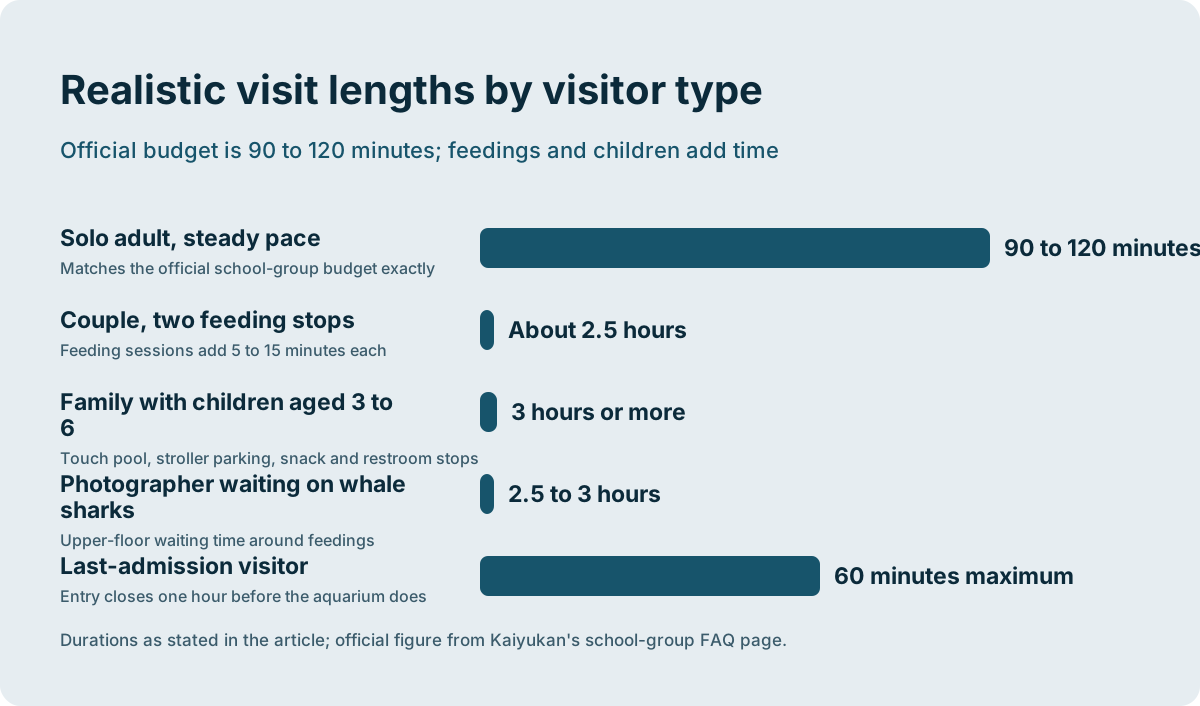
Sample time budgets for different visitors
A solo adult moving with the flow lands at 90 to 120 minutes, matching the official figure; a couple stopping for two feedings should budget two and a half hours; a family with young children should plan three hours plus, because the touch pool, the baby care room and the simple mechanics of a one-way spiral with a toddler all add time that no timetable captures.
| Visitor type | Realistic time | What drives it |
|---|---|---|
| Solo adult, steady pace | 90 to 120 minutes | Matches the official school-group budget exactly |
| Couple or small group, two feeding stops | About 2.5 hours | Feeding sessions add 5 to 15 minutes each |
| Family with children aged 3 to 6 | 3 hours or more | Touch pool, stroller parking, snack and restroom stops |
| Photographer waiting on the whale sharks | 2.5 to 3 hours | Upper-floor waiting time around feedings |
| Last-admission visitor | 60 minutes maximum | Hard cap: entry closes one hour before the aquarium does |
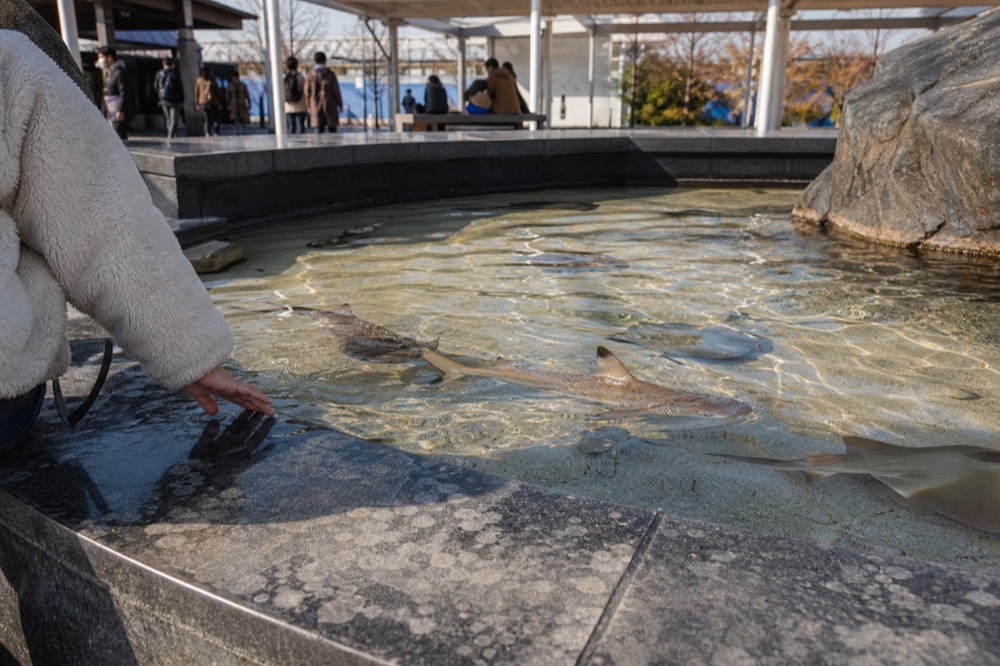
Children in the 3 to 6 range have their own dedicated draw: the Maldives Zone touch pool, one of the larger in Japan, where visitors can touch sharks and rays, with hand-washing stations alongside. There is no rental stroller service, and the aquarium asks visitors to park strollers outside and walk the route, which most of the spiral's slope design makes easy. The full toddlers and young kids guide covers the nursing rooms, the baby care facilities and the practical sequencing.
How crowds change the arithmetic
Crowds do not lengthen the route, they lengthen the pauses: on peak dates the 15-minute slot caps keep entry flowing but the viewing windows at the Pacific tank and the Aqua Gate tunnel back up, and the same 90-minute walkthrough realistically becomes a two-hour shuffle. The quiet windows are weekday mornings right at opening and weekday late afternoons after 16:00, with Tuesday and Wednesday typically the least crowded days.
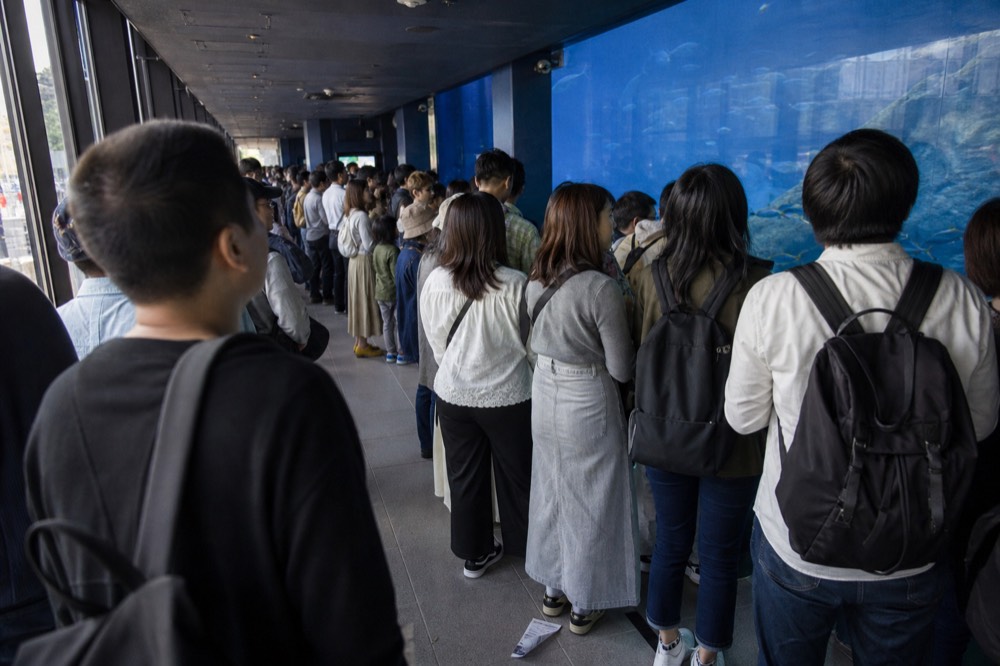
Peak periods to plan around include Golden Week in late April and early May, Obon in mid-August, the New Year holidays, ordinary weekends and Japanese school vacations. A September 2026 visitor report described the crowds as manageable rather than extreme, comparable to a busy city zoo, so even peak-season reports are not automatically a reason to stay away. Our best time of day to visit piece goes deeper on the light and crowd patterns.
The slot system interacts with crowds in one specific way worth knowing. Because each 15-minute slot has a capped ticket count, the aquarium throttles how many people can be inside at once, which means a booked slot is a partial crowd hedge even on a peak date. What it does not hedge is the viewing scrum at the two or three headline tanks, where everyone on your slot and the previous three slots converges.
Budget extra time for the exit, too. The route finishes through the Entrance Building's 4th floor, past the museum shop, which was renovated and reopened in December 2025, and the exit flow on a busy day moves at shuffle pace.
How the price calendar and timing decisions connect
Admission runs on a demand-based price calendar that changes the adult rate by date, from ¥2,800 on the cheapest bookable days to ¥3,500 on the dearest, and the cheap dates are disproportionately the quiet weekdays where your 90-minute visit is most likely to actually take 90 minutes: on the dates currently bookable, more than three quarters carry the ¥2,800 adult rate. Cheaper dates and emptier tanks are the same dates.
| Adult price | Child (7-15) | Preschool (3-6) | How often it comes up |
|---|---|---|---|
| ¥2,800 | ¥1,400 | ¥700 | The most common level, 83% of the 59 bookable dates |
| ¥2,900 | ¥1,500 | ¥700 | A handful of moderately busy dates |
| ¥3,200 | ¥1,650 | ¥800 | A few high-demand dates |
| ¥3,500 | ¥1,800 | ¥900 | Peak dates only, clustered on public holidays |
Children aged 2 and under enter free. The calendar currently publishes only about two months ahead, so for dates beyond the published window nobody, including this site, can tell you the price; check the live listing or the aquarium's own calendar for your date. The official Kaiyukan ticket page explains the demand-based pricing system in the aquarium's own words.
The practical read for timing: the ¥3,500 dates are the demand peaks, which is exactly when the two-hour shuffle applies. If your schedule allows a Tuesday at ¥2,800, you buy both the cheaper ticket and the faster, quieter visit in one decision.
Leave room for the rest of Tempozan
The aquarium sits inside Tempozan Harbour Village, and the honest total for the area is half a day or more: the Tempozan Giant Ferris Wheel, the Santa Maria replica sailing-ship cruise, the retro food alley Naniwa Kuishinbo Yokocho inside Tempozan Marketplace, and LEGOLAND Discovery Center Osaka are all within a two-minute walk of the exit, and set tickets pairing aquarium entry with several of them exist for a reason.

The wheel costs ¥1,000 for ages 3 and over. The set tickets are the clearest signal of how visitors actually spend their time here: the aquarium sells combinations with Santa Maria, with LEGOLAND and with the Captain Line shuttle ferry, and each set price moves with that day's admission price rather than being a fixed number. There is no Kaiyukan-plus-Ferris-Wheel combo ticket, a common myth; the wheel is sold separately, and it is one of the 41 facilities covered free by the Osaka Amazing Pass, while the aquarium itself is not covered by that pass at all.
Our Tempozan Ferris Wheel and Harbour Village guide sequences a full day in the area. The short planning version: two hours inside the aquarium, an hour for food in the Marketplace, an hour for the wheel or the harbour, and you have filled an afternoon without a single train ride. The nearest station is Osakako on the Osaka Metro Chuo Line, about a five-minute walk from Exit 1 per the aquarium's own access page, so the commute cost is close to zero.
Timing traps that catch first-time visitors
The three timing mistakes that cost people the most are booking the last admission slot and expecting a full two hours, planning a mid-visit lunch when re-entry ended in June 2026, and arriving on a ¥3,500 peak date with a 90-minute plan that the crowd density will not allow; each trap is avoidable with one calendar check before you book.
| Trap | Why it costs time | The fix |
|---|---|---|
| Last-admission slot | Hard 60-minute cap before closing | Book an afternoon slot by 17:00 at the latest |
| Planning a mid-visit exit for food | No re-entry since 15 June 2026 | Eat in Tempozan Marketplace before or after |
| Peak-date visit with a tight schedule | Viewing scrum at headline tanks | Pick a ¥2,800 weekday where possible |
| Oversized bags | New size rules since 24 April 2026 | Leave luggage at the hotel or a coin locker |
| Skipping the feeding timetable | Missed sessions cannot be replayed | Match your slot to one or two feeding times |
The bag rule deserves a line of its own. Since 24 April 2026, suitcases, cart-type luggage and anything whose three sides total 120 cm or more, or with any single side over 70 cm, cannot be brought inside, and the aquarium points visitors to coin lockers at the entrance and around Tempozan. It is a small thing that can otherwise cost you twenty minutes at the door. The official rules and manners page lists the full restrictions.
For anyone visiting with a school group, the official school-group FAQ that gave us the 90 to 120 minute figure is the same resource the aquarium points teachers to, which is why the duration statement is framed around group throughput rather than tourist leisure.
Put all of it together and the planning math is simple. The official budget is 90 to 120 minutes, the spiral guarantees you cannot go faster than the route allows, feedings and children stretch the clock, and the slot you book sets the starting gun. Whether you compress the visit into ninety minutes or stretch it across a slow afternoon, the slot is the one timing decision you cannot change on the day without risking the queue.
The short answers: 90 to 120 minutes is the official budget, three hours is the realistic family figure, the last slot caps you at sixty minutes, and re-entry is gone, so the visit you walk into is the visit you finish. The details below cover each timing question in full.
Common questions about how long to spend at Kaiyukan
How long does a visit to Osaka Aquarium Kaiyukan take?
Kaiyukan itself budgets 90 to 120 minutes, stated on its official school-group FAQ. Add feeding-time stops, children or peak-date crowds and a realistic visit runs two and a half to three hours.
What is the minimum time needed at Kaiyukan?
About 90 minutes at a steady pace, because the one-way spiral from the 8th floor down cannot be shortened. The last-admission slot hard-caps a visit at 60 minutes.
How long should families with young children plan?
Three hours or more. The touch pool, stroller parking, baby care facilities and the pace of walking a toddler down a one-way spiral all add time to the official budget.
Do the 15-minute entry slots affect how long I can stay?
No. The slot sets when you enter, not when you leave. You can stay until closing, but last admission is one hour before closing on every dated day, so a final-slot visit is capped at that hour.
Can I leave and re-enter the aquarium?
No. Same-day re-entry ended on 15 June 2026. Once you exit through the Entrance Building, your visit is over, so plan food and breaks around the visit.
Do feeding times make the visit longer?
Yes, by five to fifteen minutes per session you watch. The published timetable runs from 09:50 to 16:30 across eight zones, with no day-of-week variation.