Is Kaiyukan Actually Worth Visiting?
Kaiyukan is one of the world's largest aquariums and Osaka's most-visited paid attraction, but it is not cheap, one zone is closed, and you can no longer re-enter. Here is the honest case both ways.
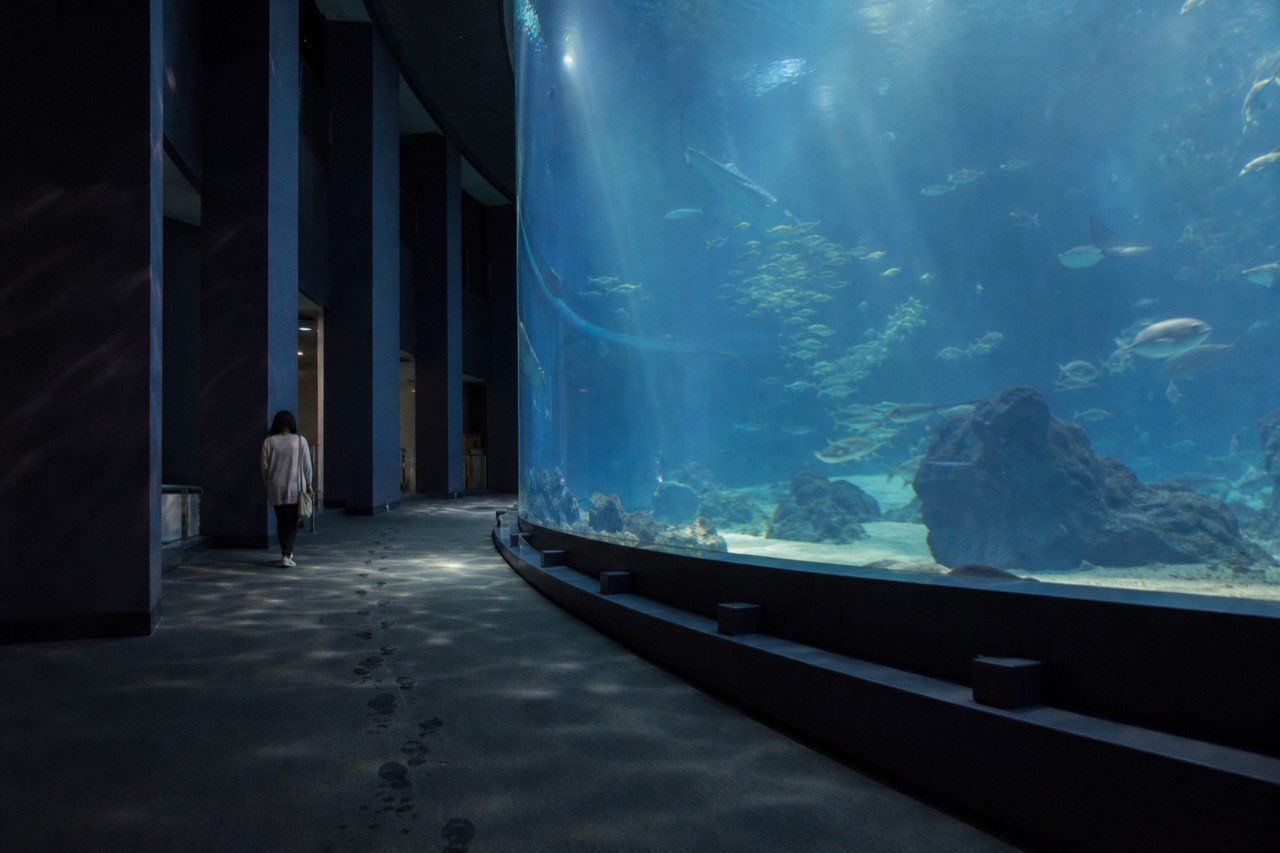
Short answer
Yes, for most visitors Kaiyukan is worth it, with caveats. Adult admission runs ¥2,800 to ¥3,500 by date, about 620 species and 30,000 animals live across 14 tanks, and the whale sharks are genuinely unique in Japan. Skip it only if you are short on time or hate crowds.
Osaka Aquarium Kaiyukan has welcomed more than 90 million visitors since it opened on 20 July 1990, hitting that milestone on 1 October 2025. It is enormous, it is famous, and it is the anchor attraction of the entire Osaka Bay waterfront. None of that automatically makes it worth your money or your half-day.
The honest answer is that Kaiyukan is worth it for most travellers, but not all, and the reasons it might not be are concrete and worth knowing before you hand over ¥2,800 or more per adult. This guide states the case against first, in full, and then works out who the aquarium genuinely suits. Osaka Aquarium itself, as a site, exists to answer exactly this kind of question with the venue's own published numbers rather than marketing copy.
Is the aquarium in Osaka Bay worth it?
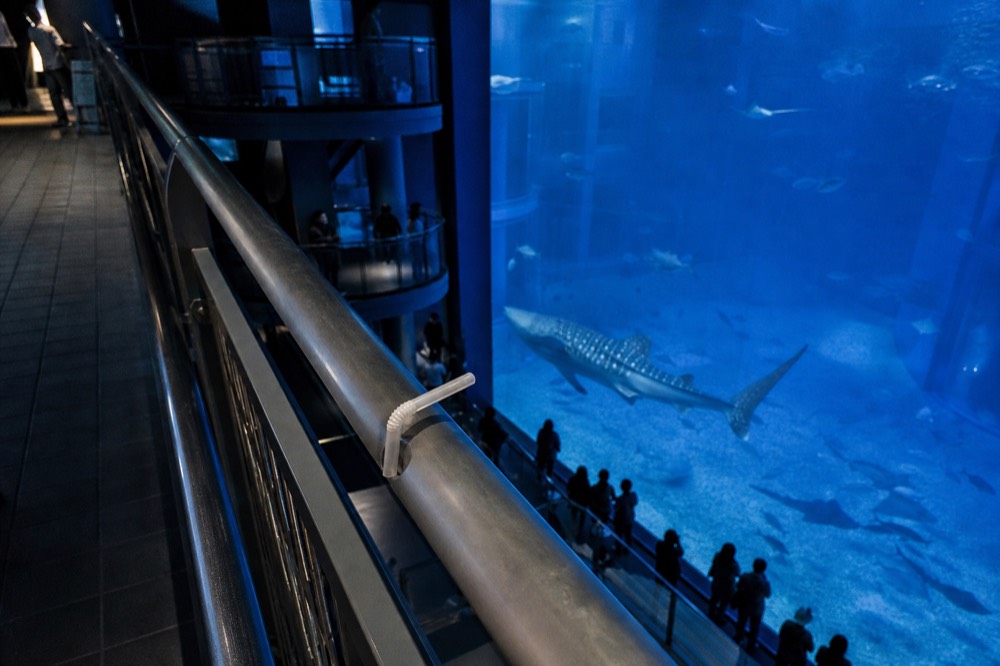
For most visitors, yes. Kaiyukan holds about 620 species and 30,000 animals across 14 tanks totalling roughly 11,000 tons of water, with two whale sharks in a 5,400-ton central tank, an experience no other aquarium in Japan currently matches. The catch is the price: adult admission runs ¥2,800 to ¥3,500 depending on the date, one zone is closed, and crowds peak hard.
That is the short version. The long version depends on what you are comparing it against, how much time you have in Osaka, and whether your visit lands on a cheap date or an expensive one.
Kaiyukan turned 36 years old in July 2026, and it is not coasting. The Great Barrier Reef tank reopened after renovation in November 2024, two sand tiger sharks arrived in May 2025 as a first for the aquarium, and an ocean sunfish joined the Pacific tank in July 2025. The animal collection is actively changing, which matters for a facility this old.
The verdict also depends on what a ticket costs on the day you can actually go, which is less straightforward here than at any other aquarium in Japan. We cover that properly below.
The honest case against Kaiyukan
Kaiyukan's real downsides are its price relative to other Osaka attractions, peak-hour crowds, the Aleutian Islands zone being closed for renovation, and the end of same-day re-entry in June 2026. Each one is verifiable and none appears in most promotional write-ups, which is exactly why they belong in a decision like this.
Start with the price. Kaiyukan runs demand-based variable pricing, which means there is no single admission figure. On the dates currently bookable, adult tickets run ¥2,800 to ¥3,500, children aged 7 to 15 pay ¥1,400 to ¥1,800, and preschoolers aged 3 to 6 pay ¥700 to ¥900. The cheapest adult price in the whole published record is ¥2,700, and it does not appear among the dates you can currently book. The aquarium explains the system on its own ticket page.
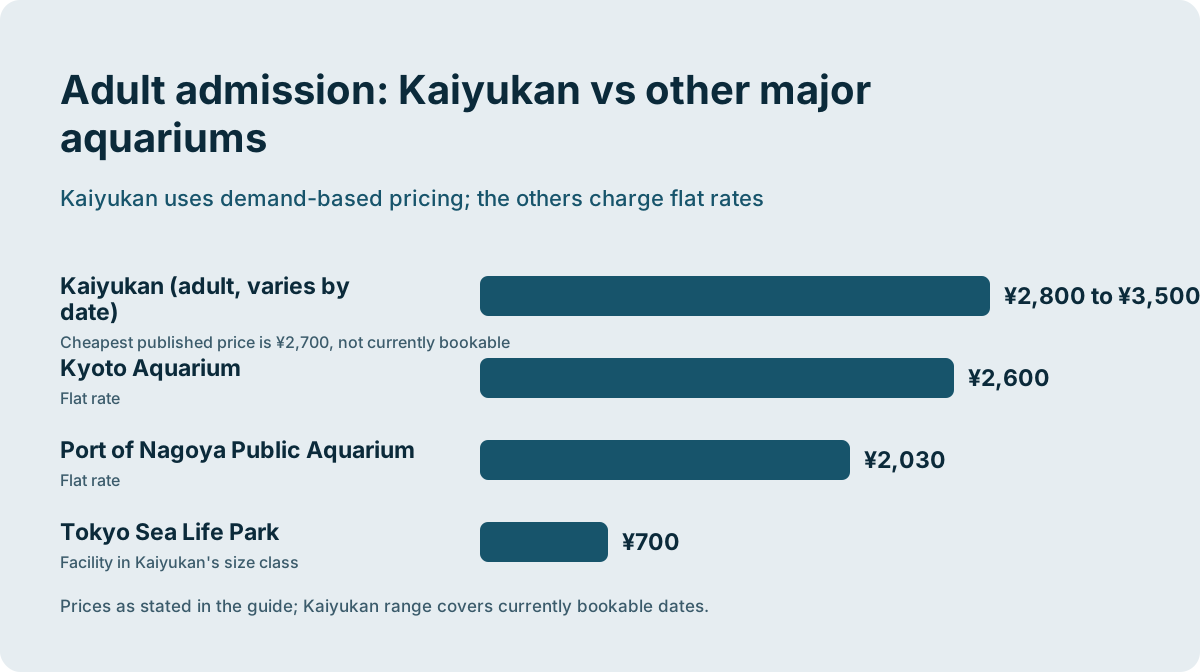
For context, that puts Kaiyukan at or above the price of most other major Osaka-area attractions, and above every comparable aquarium in the region on a bad date. Kyoto Aquarium charges a flat ¥2,600. Port of Nagoya Public Aquarium charges ¥2,030. Tokyo Sea Life Park, a facility in Kaiyukan's size class, charges ¥700. A family of two adults and two school-age children on a ¥3,500 day is paying ¥10,600 in tickets before anyone eats lunch.
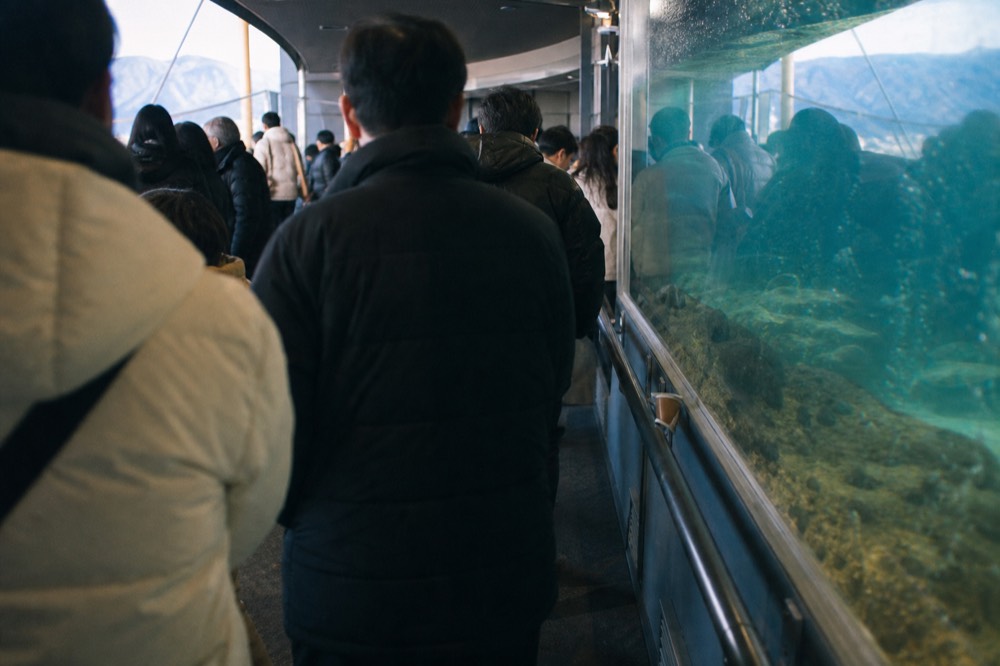
Then there are the crowds. Peak periods to avoid include Golden Week in late April and early May, Obon in mid-August, the New Year holidays, weekends, and Japanese school vacations. Tuesday and Wednesday are typically the least crowded days, and weekday mornings right at opening are the quietest windows. The aquarium introduced capped 15-minute admission slots explicitly to control this, which helps, but it does not make a busy Sunday feel empty.
Third, the Aleutian Islands tank is closed for renovation. The aquarium says so on its own exhibition page, and its animals have moved to Aquaworld Ibaraki Oarai Aquarium. It is one of the listed zones in the building, and right now you cannot see it. Nobody selling you a ticket will highlight that.
Fourth, re-entry ended on 15 June 2026. The aquarium announced it plainly: same-day re-entry is no longer permitted after viewing. Combined with the new bag rules in force since April 2026, which ban suitcases, cart-type luggage and anything whose three sides total 120 cm or more, this makes Kaiyukan a single continuous visit. You cannot pop out to Tempozan Marketplace for lunch and come back. Plan accordingly, because there is no way around it, per the official announcement.
Finally, a family caveat that follows from all of the above: preschoolers pay ¥700 to ¥900, children ¥1,400 to ¥1,800, and under-2s enter free, but a family with two school-age children on a peak date is looking at roughly ¥10,600 in tickets. If your kids are lukewarm about fish, that stings.
What your ticket actually buys
A Kaiyukan ticket buys a top-down spiral route through 18 permanent zones plus the current temporary show, built around a central Pacific tank holding 5,400 tons of water, 9 metres deep and 34 metres at maximum length, home to two whale sharks. That tank and those animals are the product, and they are genuinely rare.
Two whale sharks, Kai and Yu, lived in the Pacific tank at Kaiyukan's last measurement, taken 31 October 2025. Kai, the male, measured 5 m 30 cm and about 1,100 kg, having grown 60 cm since arriving in October 2024. Yu, the female, measured 6 m 20 cm and about 1,800 kg. Kaiyukan rotates whale shark individuals over time, so scope the count to that measurement, but no other aquarium in Japan offers this sight, and few in the world do. Our dedicated guide to the whale sharks at Kaiyukan covers them tank-deep.
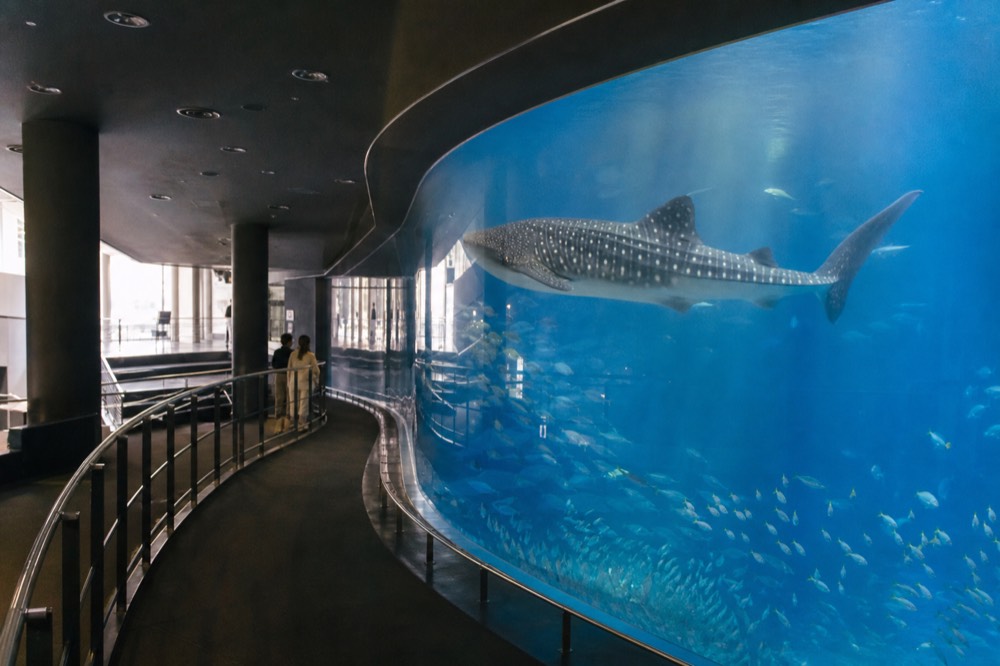
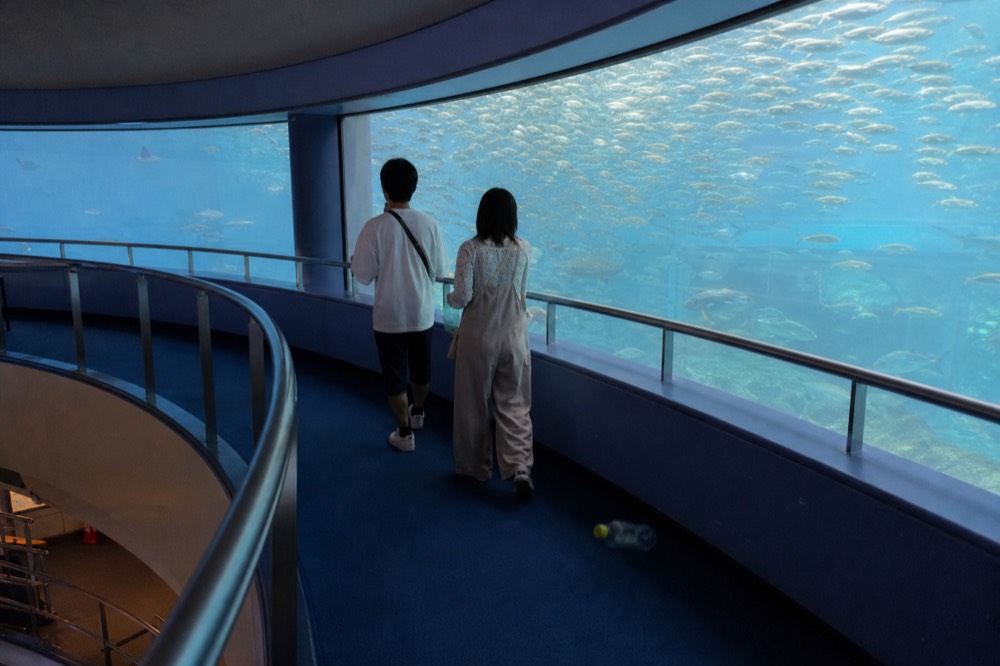
The route itself is architectural. You enter through the Aqua Gate tunnel tank, ride an escalator to the 8th floor, then spiral down around the central tank, viewing it from multiple depths across eight floors: Japan Forest, Monterey Bay, the Gulf of Panama, Ecuador Rainforest, Antarctica, the Tasman Sea, the Great Barrier Reef, the Pacific, and onward down to the Japan Deep and the Falkland Islands. Because you circle the same water at different heights, the whale sharks, the sand tiger sharks that arrived in May 2025, and the 97-cm ocean sunfish that arrived in July 2025 keep reappearing from new angles.
Kaiyukan itself budgets 90 to 120 minutes for a visit, a figure it publishes on its school-group FAQ. Most visitors find two hours realistic at a comfortable pace, more if you time the feedings.
If you want to go deeper on the money side, the ticket options, tiers and how the slots work are laid out in our Kaiyukan tickets guide.
Who Kaiyukan is genuinely worth it for
Kaiyukan is genuinely worth it for first-time Osaka visitors, families with children old enough to engage with animals, anyone with a specific interest in sharks or jellyfish, and travellers who cannot see whale sharks anywhere else on their itinerary. It is weakest for repeat visitors short on time and anyone who actively dislikes crowds.
First-time visitors get the most value, because the building itself is the attraction. The spiral descent around one central tank is a piece of design you cannot shortcut, and it delivers a sustained 90-minute experience rather than a room you wander in and out of.
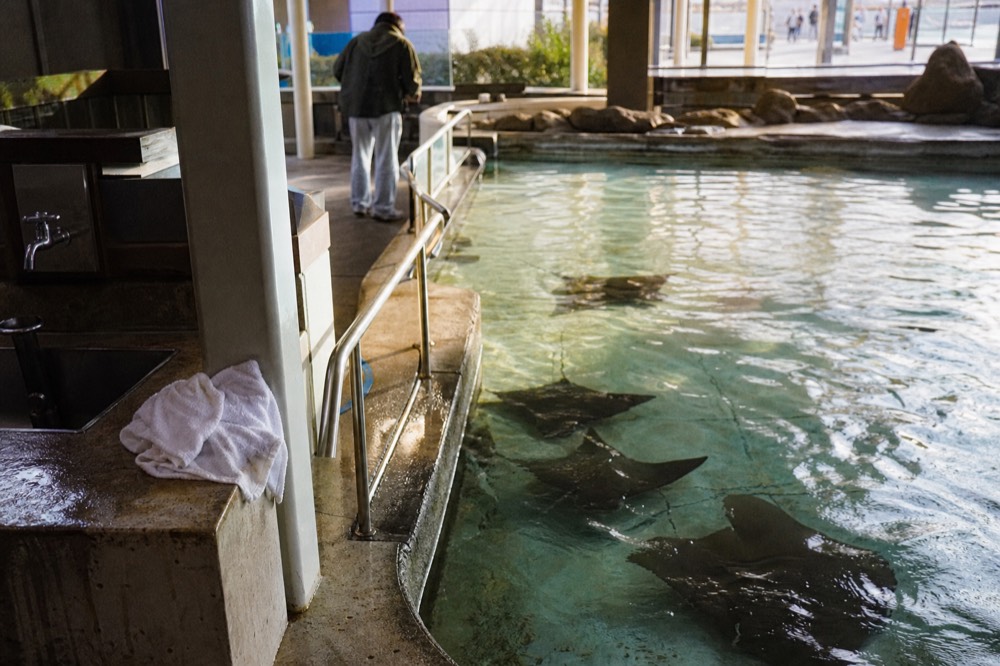
Families are the second clear yes. The Maldives Zone has one of Japan's larger touch pools, where visitors can touch sharks and rays, with hand-washing stations nearby. The baby care room on the 2nd floor of the entrance building includes a nursing room, kids' toilet, diaper-changing bed and formula preparation device, and a second nursing room sits inside the paid area behind the Aqua Gate tank. Strollers are parked outside near the ticket counter, since most of the route uses slopes and the aquarium encourages walking it on foot.
Wildlife-interested travellers are the third yes. The jellyfish gallery, the ringed seals of the Arctic zone, including Yuki, the seal that went viral and was alive and on exhibit when Kaiyukan's keepers last wrote about her in June 2026, and the recent sand tiger shark arrivals give the collection real depth beyond the headline animals. Kaiyukan is a member of the Japanese Association of Zoos and Aquariums, listed in the association's own English member list.
The no group is smaller but real. If you have been before and your time in Osaka is short, the unchanged route plus the closed Aleutian zone weakens a second visit. If you are travelling at absolute peak season and cannot shift your date, the crowd factor is real. And if your budget is tight to the point where ¥2,800 to ¥3,500 per adult competes with a meal you actually want, there are cheaper ways to spend an afternoon in the city.
How the Kaiyukan price really works
Kaiyukan uses a date-by-date price calendar, and it only publishes about two months ahead. On the 59 dates bookable right now, adult admission is ¥2,800 on more than three quarters of them, with the rest rising to ¥2,900, ¥3,200 or ¥3,500. Children pay ¥1,400 to ¥1,800, preschoolers ¥700 to ¥900, under-2s free.
That distribution is the most useful thing to know about Kaiyukan pricing, and almost nobody publishes it. The dearest dates are the public-holiday clusters, at ¥3,500; the vast majority of bookable dates sit at the ¥2,800 floor. Shifting a visit by a day or two can save a family real money.
There is a second, stranger fact. Past the end of the published window, nobody outside the aquarium knows what admission costs, because Kaiyukan has not published those prices yet. Any page quoting a single "current" price is either quoting one date or guessing.
Two discounts exist and they are narrow. Holders of the specified Japanese disability booklets, physical booklet, Mirairo ID app or MynaPortal record only, get half price along with one carer; screenshots and printouts are not accepted. And the Osaka Amazing Pass does not help here at all: Kaiyukan appears on neither the pass's free-admission list of 41 facilities nor its 52-entry special-offer list, per the official pass site. A pass holder still pays Kaiyukan's full gate price, though the pass does cover the Tempozan Giant Ferris Wheel next door. Our Osaka Amazing Pass and Kaiyukan page untangles that fully.
When to go to dodge the crowds
Go on a Tuesday or Wednesday, arrive for your timed slot at opening or after 16:00 on a weekday, and avoid Golden Week, Obon, the New Year holidays and weekends. Kaiyukan opens between 08:00 and 10:30 depending on the date, closes at 20:00 or 21:00, and last admission is exactly one hour before closing, every single day.
Those hours are not fixed. Kaiyukan's own calendar shows seven distinct opening patterns, from a typical weekday 10:30 start to 08:00 early opens on 20 to 22 September 2026, which also close latest at 21:00. Check your specific date on the official hours calendar; our Kaiyukan opening hours guide keeps the patterns in one place.
One practical wrinkle: 13 and 14 January 2027 are the only closure days in the twelve months of published calendar, a two-day January maintenance closure. Plan around those if you are travelling early in the year.
The "Night Kaiyukan" program, starting at 17:00 with last admission at 19:00, shifts the interior lighting and music to a moonlit deep-blue effect. Late afternoon is both one of the quieter windows and one of the most atmospheric, which makes an after-16:00 weekday slot the connoisseur's choice.
| Timing factor | Best case | Worst case |
|---|---|---|
| Day of week | Tuesday or Wednesday | Weekends, public holidays |
| Time of day | Opening slot, or after 16:00 | Late morning to mid-afternoon |
| Season | Ordinary weekdays in term time | Golden Week, Obon, New Year |
| Price on the day | ¥2,800 adult | ¥3,500 adult |
| Feeding schedule | Timed to your route | Missed entirely |
What a visit actually looks like, hour by hour
A typical Kaiyukan visit runs 90 to 120 minutes, entering at the Aqua Gate tunnel, riding the escalator to the 8th floor, then spiralling down eight floors around the Pacific tank and out at the 3rd floor of the entrance building. Timed to the feeding schedule, it becomes one of the best-value two hours in Osaka.
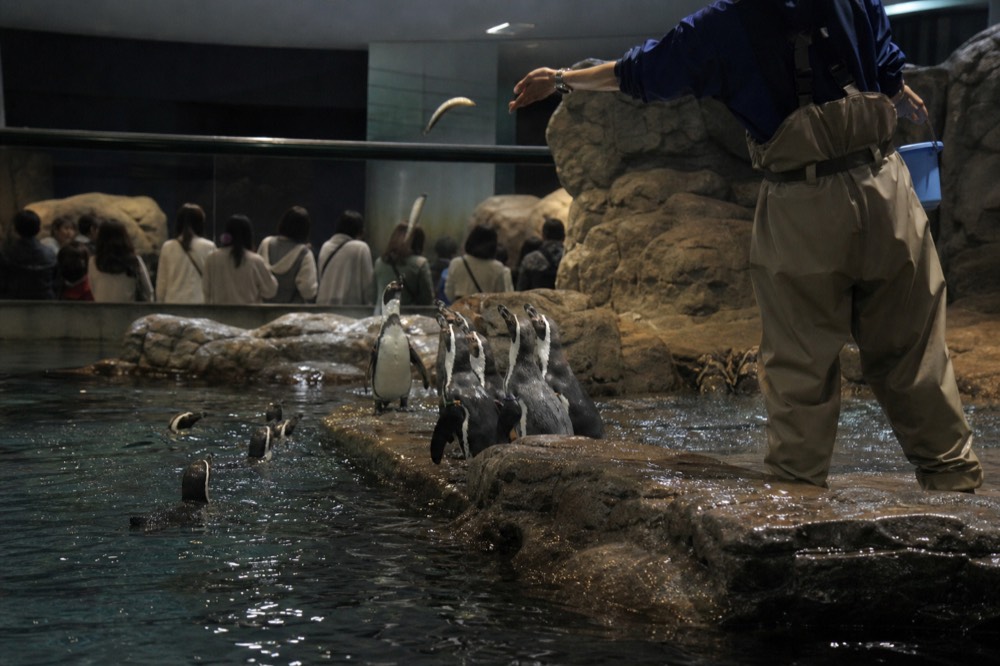
The published feeding timetable is the insider's tool. Otters feed in Japan Forest at 11:30, 13:30 and 15:30; penguins in Antarctica at 10:00 and 14:20; Pacific white-sided dolphins in the Tasman Sea at 11:40, 14:00 and 16:30; ringed seals in the Arctic at 10:50 and 15:35. The aquarium warns times can change without notice depending on the animals, but the timetable carries no weekday or weekend variants.
The single best viewing tip comes from the aquarium itself: the whale sharks are fed at the surface, so the upper floors give the better view when one upends into a vertical position to feed. Time your top floors right and you see behaviour most visitors walk straight past.
| Floor | Zone | Animal | Feeding times |
|---|---|---|---|
| 7F | Japan Forest | Otter | 11:30, 13:30, 15:30 |
| 7F | Monterey Bay | Sea lion and seal | 09:50, 13:20, 14:50 |
| 7F | Antarctica | Penguins | 10:00, 14:20 |
| 7F | Tasman Sea | Pacific white-sided dolphin | 11:40, 14:00, 16:30 |
| 6F | Pacific Ocean | Pacific fish | 10:30, 15:00 |
| 4F | Arctic Region | Ringed seal | 10:50, 15:35 |
| 4F | Falkland Islands | Rockhopper penguin | 10:50, 15:10 |
With no re-entry since June 2026, plan food around the visit, not during it. Naniwa Kuishinbo Yokocho, a retro food hall of roughly 20 stalls inside Tempozan Marketplace, sits a few steps away, and our where to eat near Kaiyukan guide covers the options in detail. If you want to fill a full day, the Ferris wheel, LEGOLAND Discovery Center and the Santa Maria cruise are all in the same complex.
How Kaiyukan compares with the alternatives
Kaiyukan is more expensive than every comparable aquarium in Japan, and none of the others use dynamic pricing: Kyoto charges a flat ¥2,600, Nagoya ¥2,030, NIFREL ¥2,400 and Tokyo Sea Life Park ¥700. What the extra money buys is scale, roughly 11,000 tons of water against Kyoto's roughly 500-ton main tank, and whale sharks, which no rival has.
The honest framing is that Kaiyukan competes on uniqueness, not value. Port of Nagoya's main pool is Japan's largest at 60 m long, 30 m wide and 12 m deep, and it costs ¥2,030. Tokyo Sea Life Park has over 500 species for ¥700. On pure yen-per-animal arithmetic, Kaiyukan loses.
| Venue | Adult admission | Scale | Whale sharks |
|---|---|---|---|
| Kaiyukan, Osaka | ¥2,800 to ¥3,500 by date | About 620 species, 30,000 animals, about 11,000 t water | Yes, two |
| Kyoto Aquarium | ¥2,600 flat | About 200 species, 10,000 animals | No |
| Port of Nagoya | ¥2,030 flat | About 500 species, 50,000 animals | No |
| NIFREL, Suita | ¥2,400 flat | 8 zones, other figures unpublished | No |
| Tokyo Sea Life Park | ¥700 flat | Over 500 species | No |
But aquariums are not bought by the kilo. The whale sharks, the spiral architecture and the 34-metre central tank are the reasons people remember Kaiyukan decades later, and 90 million visitors is not a marketing number, it is a turnstile count. If your Japan itinerary has no other whale shark stop, that comparison column is the whole argument.
Within Osaka itself, the closer comparison is NIFREL in Suita, which is produced by the same company and newly expanded with a venomous-creature zone in March 2026. Our NIFREL or Kaiyukan comparison works through that trade-off, and our broader Kyoto Aquarium vs Kaiyukan guide covers the Kansai decision.
The verdict
Kaiyukan is worth it if you want the biggest aquarium experience in Japan and can pick your date: a ¥2,800 weekday with a morning slot and the feedings timed is close to faultless. It is not worth it if you are squeezing it into a rushed peak-weekend itinerary, since you will pay ¥3,500 for the privilege of a crowd.
Between those poles sits most of Osaka's visitors, and for them the answer holds up. The building is one of a kind, the animals are actively refreshed rather than static, and the criticisms that exist, price, crowds, the closed zone, no re-entry, are all manageable with a little planning rather than fatal.
Pick a Tuesday. Book a morning slot. Park the big bag at your hotel or a locker. Spiral down eight floors with the feeding timetable in hand, and go eat in the food hall afterwards. Done that way, Osaka Aquarium justifies both the ticket and its reputation.
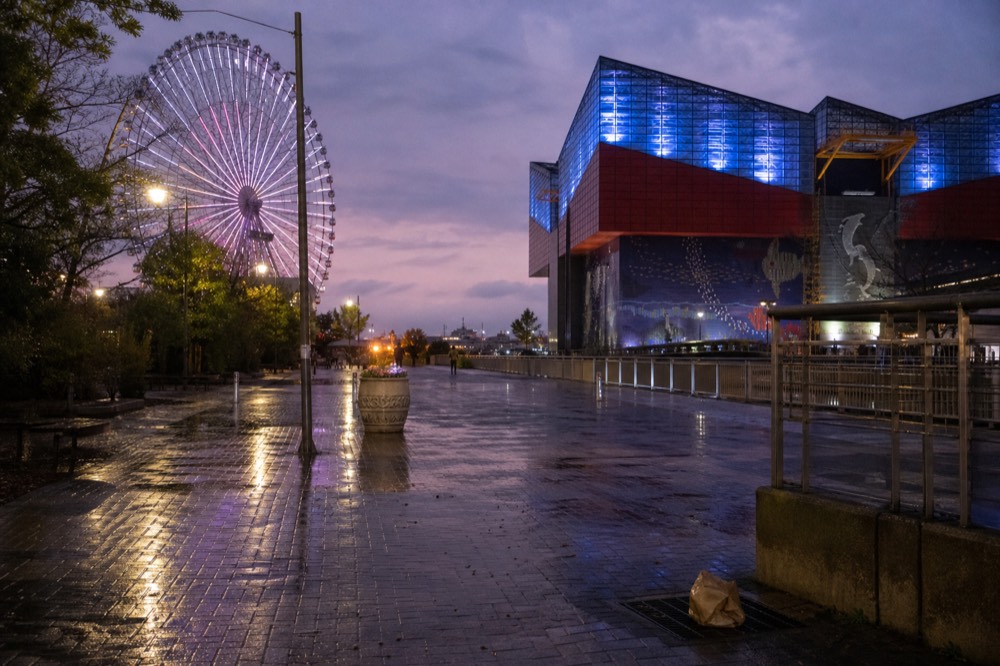
For everything else around the visit, our things to do near Kaiyukan guide covers the Tempozan complex, and how long to spend at Kaiyukan helps if you are building a full bay-area day.
These are the questions travellers most often ask before committing to a Kaiyukan ticket, answered from the aquarium's own published figures: what a visit costs on a given date, how long it takes, whether you can leave and return, how bad the crowds really get, and whether booking ahead is genuinely necessary. Each answer below uses the venue's first-party numbers rather than secondhand summaries, and none of them glosses over the awkward parts.
Common questions about whether Osaka's Kaiyukan is worth it
Is Osaka Aquarium worth it?
For most visitors, yes. It holds about 620 species and 30,000 animals, including two whale sharks at the last measurement, in a building designed as a top-down spiral around a 5,400-ton central tank. The caveats are the ¥2,800 to ¥3,500 adult price, peak crowds, one closed zone and the end of same-day re-entry.
How much does Kaiyukan cost?
Adult admission runs ¥2,800 to ¥3,500 depending on the date under Kaiyukan's dynamic pricing calendar. Children aged 7 to 15 pay ¥1,400 to ¥1,800, preschoolers aged 3 to 6 pay ¥700 to ¥900, and children under 3 enter free. On the dates currently bookable, more than three quarters charge the ¥2,800 adult floor.
How long should I spend at Kaiyukan?
Kaiyukan itself budgets 90 to 120 minutes for a visit. Two hours is a comfortable pace for the full spiral route, and longer if you time the feeding sessions, which run on a published timetable from 09:50 to 16:30.
Can you leave Kaiyukan and come back in?
No. Same-day re-entry ended on 15 June 2026, a change the aquarium announced in advance and attributes to its timed-entry and crowding measures. Once you exit the exhibition area, your ticket is spent, so plan meals and the surrounding Tempozan complex around your visit, not during it.
Is Kaiyukan crowded?
It depends heavily on the date. Weekday mornings at opening are the quietest periods and Tuesdays and Wednesdays are typically the least crowded days. Avoid Golden Week, Obon, the New Year holidays, weekends and Japanese school vacations if you have any flexibility.
Do you need to book Kaiyukan tickets in advance?
The aquarium itself recommends advance e-ticket purchase, and admission is sold in capped 15-minute time slots. Same-day tickets remain available at the counter from opening until last admission, one hour before close, but popular slots on peak dates can fill.