The Best Aquariums in Japan Compared: Where Kaiyukan Really Ranks
Japan has several world-class aquariums, and the one that tops most lists is not the one that wins on every number. This comparison sets out the criteria first, then checks six major venues against them using each operator's own published figures.
Short answer
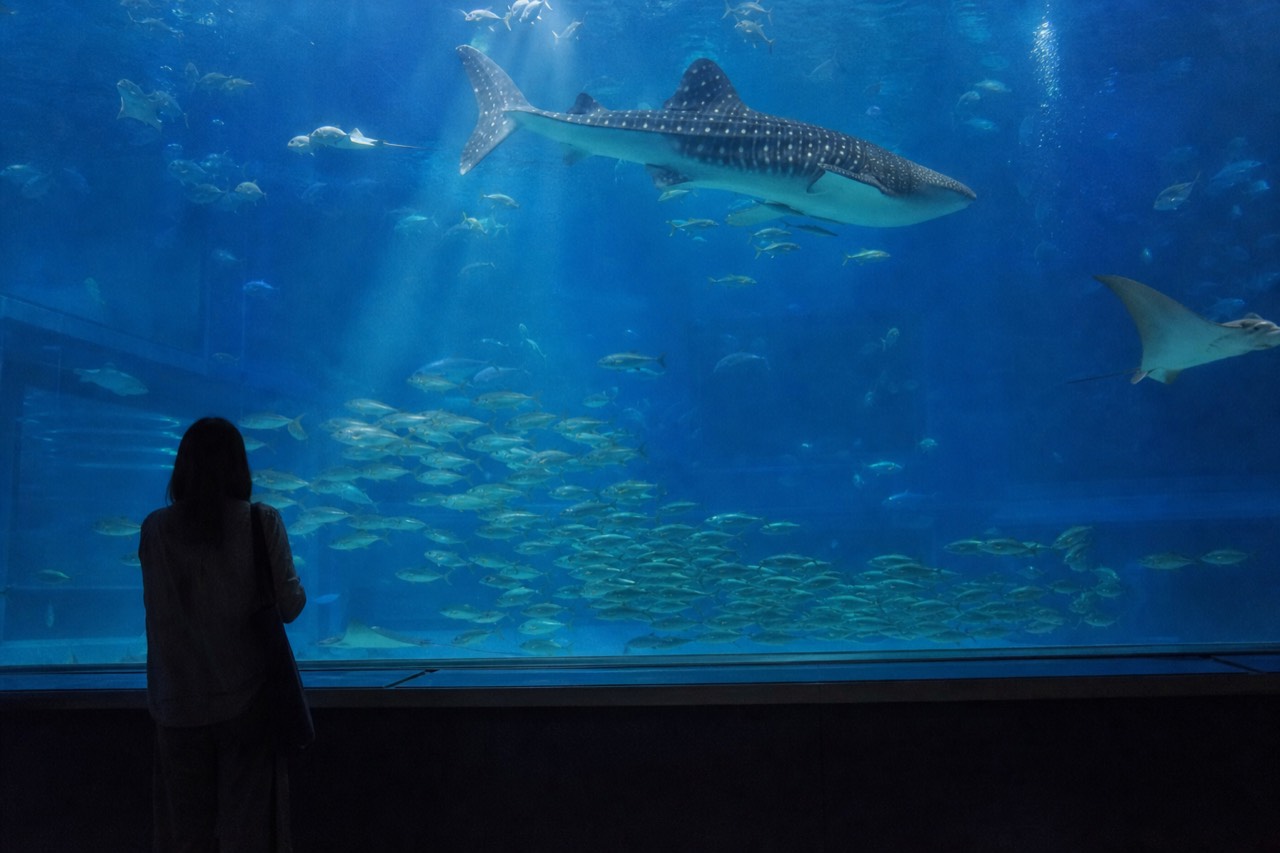
There is no single best aquarium in Japan. Kaiyukan leads on total water volume, about 11,000 tons, and whale sharks. Port of Nagoya beats it on species and animals at 2,030 yen. Tokyo Sea Life Park charges 700 yen with over 500 species. Sumida and Kyoto sit inside Kaiyukan's price band.
Every "best aquarium in Japan" list you will find online declares a winner on the first line, usually the biggest name, and works backwards from there. This comparison does the opposite. It states the criteria first, then checks Japan's six most-visited major aquariums against them, using figures each operator publishes on its own website. The result is less tidy and more useful, because the aquarium that wins on scale is not the one that wins on species, and neither is the one that wins on price.
The six venues compared here are Osaka Aquarium Kaiyukan, Port of Nagoya Public Aquarium, Tokyo Sea Life Park (Kasai), Sumida Aquarium, Kyoto Aquarium and NIFREL. All prices and scale figures below come from each venue's own pages. Where a venue does not publish a figure, we say so rather than padding with a guess.
How do you actually rank the best aquariums in Japan?
Four criteria decide it honestly: admission price, species and animal counts, the scale of the signature tank, and whether the venue offers something no rival can copy. Price is checkable to the yen, species counts are published by each operator, tank volume is engineering fact, and uniqueness, a whale shark, a doughnut-shaped tuna tank, a spiral route, is what turns a visit into a memory.
Price needs special care with Kaiyukan, because it is the only one of the six that uses demand-based variable pricing. Kaiyukan's adult admission runs ¥2,800 to ¥3,500 depending on the date, read from its own pricing calendar, and the older ¥2,700 level appears on no bookable date at all: more than three quarters of bookable dates sit at ¥2,800, with the rest climbing to ¥3,500. Every other venue in this comparison charges one flat adult price year-round. That contrast alone shapes the value question, and we return to it in the planning table later.
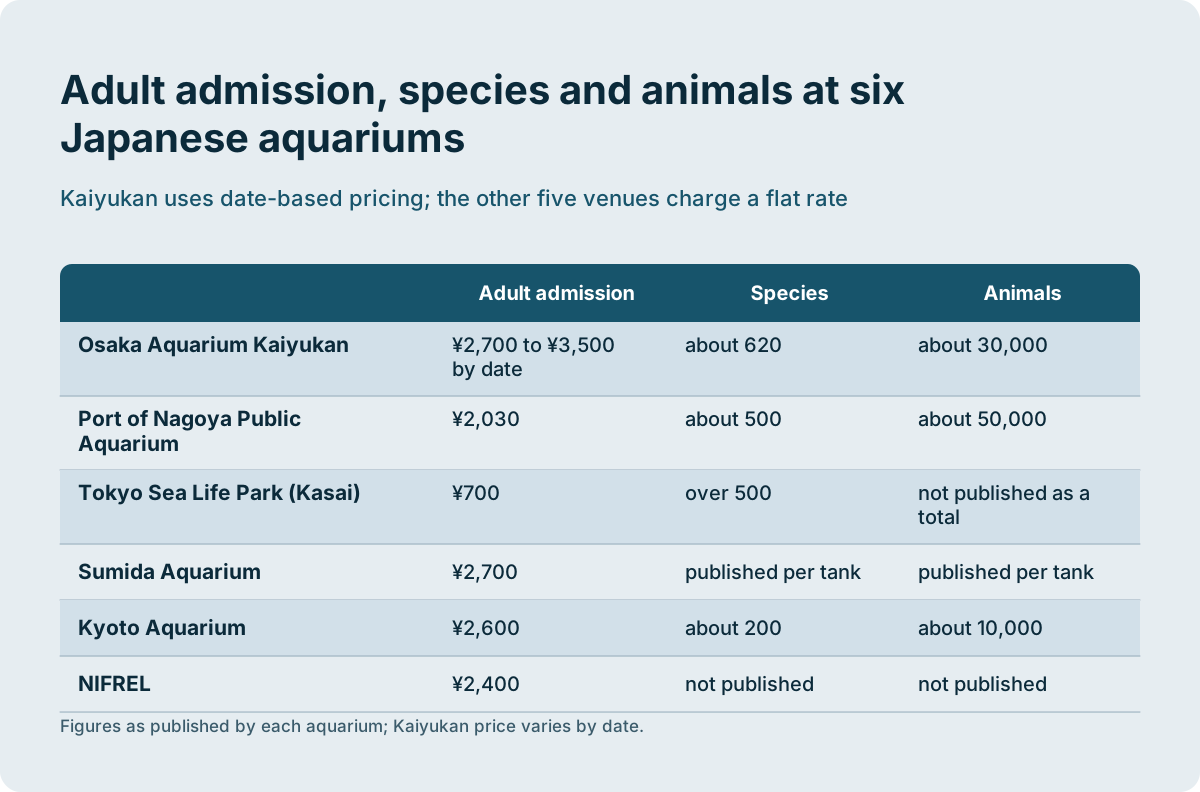
Species and animal counts are the crudest measure of richness. Kaiyukan publishes about 620 species and 30,000 animals. Port of Nagoya publishes about 500 species and 50,000 animals. Tokyo Sea Life Park publishes over 500 species. Kyoto Aquarium's current page states about 200 species and 10,000 animals. Sumida publishes animal counts per tank rather than a site total, and NIFREL does not publish a species count at all, so we say less about NIFREL rather than inventing a number.
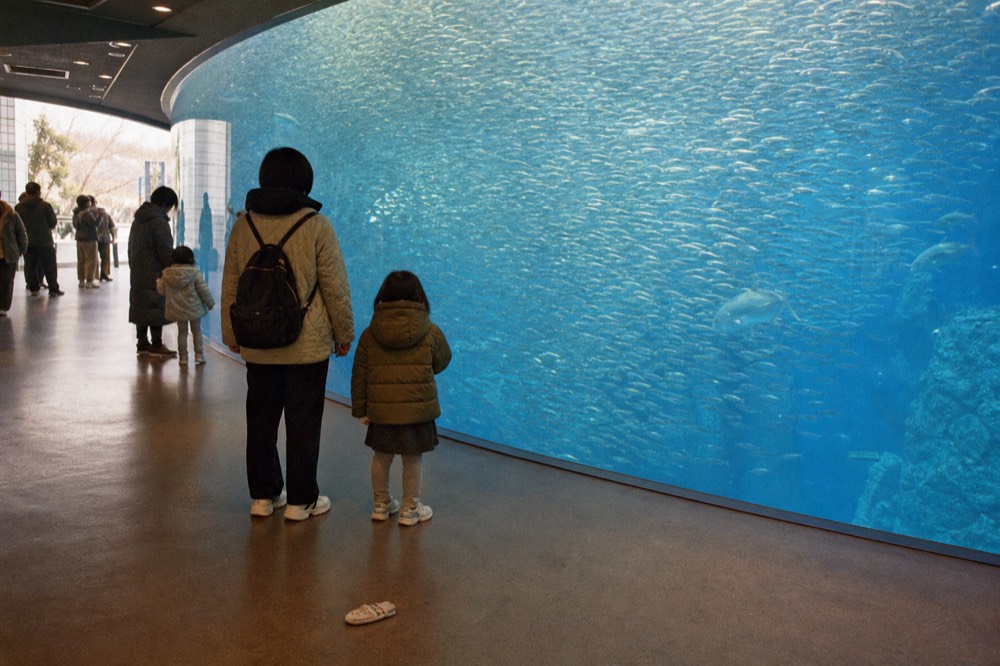
Signature-tank scale separates the engineering-led venues from the themed ones. Nagoya's main pool is Japan's largest at 60 metres long, 30 metres wide and 12 metres deep. Kaiyukan's Pacific Ocean tank holds 5,400 tons of water with a maximum length of 34 metres and a depth of 9 metres. Kasai's doughnut-shaped bluefin tuna tank holds 2,200 cubic metres. Sumida's penguin pool holds about 350 tons, and Kyoto's main tank about 500 tons. For more on how Kaiyukan's building shapes the experience, see our Kaiyukan floors and route guide.
Kaiyukan vs the field: what the scoreboard says
Kaiyukan ranks first of the six on total water volume, about 11,000 tons across 14 tanks, and first on singular animals, the two whale sharks. It ranks second on price, with adult admission of ¥2,800 to ¥3,500 by date against Nagoya's flat ¥2,030 and Kasai's ¥700. It ranks third on animals, about 30,000 against Nagoya's 50,000. On species it leads with about 620.
The scoreboard below pulls the verified numbers into one place. Each figure is the operator's own published number, and where the operator publishes nothing, the cell says so.
| Venue | Adult admission | Species | Animals | Signature scale | Opened |
|---|---|---|---|---|---|
| Osaka Aquarium Kaiyukan | ¥2,800 to ¥3,500 by date | about 620 | about 30,000 | 5,400 t Pacific tank; about 11,000 t total | 20 July 1990 |
| Port of Nagoya Public Aquarium | ¥2,030 | about 500 | about 50,000 | Main pool 60 m × 30 m × 12 m, Japan's largest | South Building 1992 |
| Tokyo Sea Life Park (Kasai) | ¥700 | over 500 | not published as a total | 2,200 m³ doughnut tuna tank | 10 October 1989 |
| Sumida Aquarium | ¥2,700 | published per tank | published per tank | Penguin pool about 350 t | 22 May 2012 |
| Kyoto Aquarium | ¥2,600 | about 200 | about 10,000 | Main tank about 500 t | 14 March 2012 |
| NIFREL | ¥2,400 | not published | not published | 8 exhibition zones | 19 November 2015 |
Read the table honestly and Kaiyukan's position is strong but not a default win. It leads on species and total water volume, and it is the only venue of the six with whale sharks. Nagoya beats it on animals for two thirds of Kaiyukan's price. Kasai beats everyone on price. Sumida undercuts Kaiyukan's cheapest bookable date by ¥100, at ¥2,700 flat, and wins on convenience for anyone already at Tokyo Skytree. Our deeper dive into what Kaiyukan is famous for covers the identity side of this question.
Kaiyukan's admission is also the least predictable of the six, which matters for budgeting. A weekday at ¥2,800 and a peak Sunday at ¥3,500 are the same aquarium at a meaningfully different price, while Nagoya, Kasai, Sumida, Kyoto and NIFREL charge the same every day.
Why Port of Nagoya is the surprise on paper
Port of Nagoya Public Aquarium beats Kaiyukan on raw animal count, about 50,000 animals against about 30,000, and its main pool is Japan's largest at 60 metres by 30 metres by 12 metres, yet its flat adult ticket is ¥2,030 against Kaiyukan's ¥2,800 to ¥3,500. On numbers alone Nagoya is arguably the better value of the two.
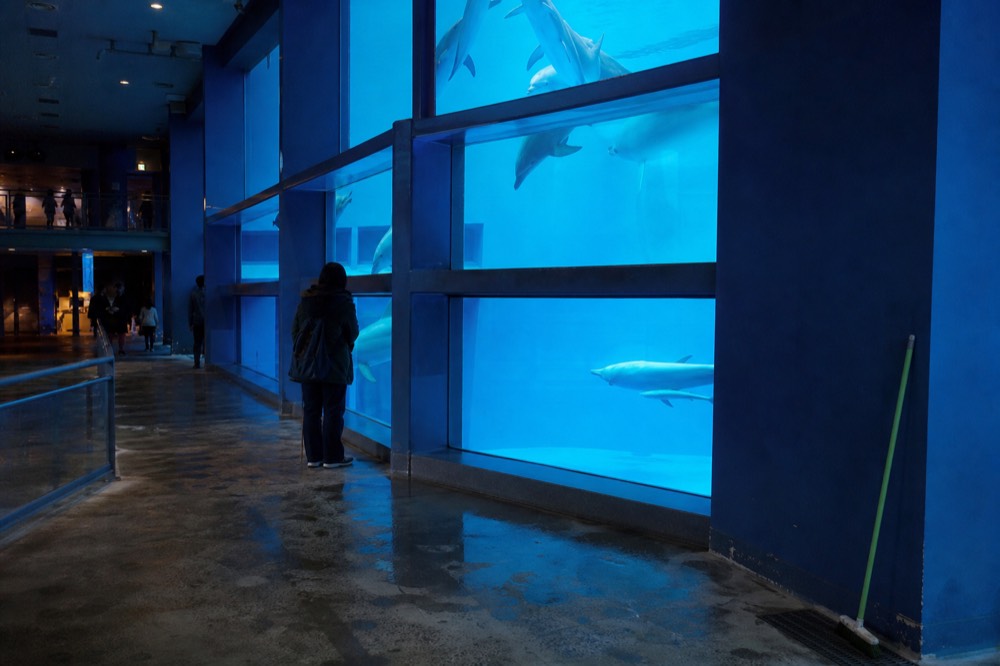
The main pool is the centrepiece: 60 metres long, 30 metres wide and 12 metres deep, the largest pool of any Japanese aquarium, per the aquarium's own English page at nagoyaaqua.jp. It hosts dolphin displays, and the venue keeps about 500 species and 50,000 animals in total, figures from its own FAQ page. Nagoya opened its South Building on 29 October 1992, with the North Building following in 2001.
Where Nagoya says less than you might expect: it publishes no total water volume for the complex, so no honest side-by-side with Kaiyukan's 11,000 tons is possible on that measure. Say less rather than pad, and the pool dimensions stand in.
What Kaiyukan holds over Nagoya, concretely: the whale sharks, two of them, Kai and Yu, at Kaiyukan's last published measurement, and roughly 120 more species. What Nagoya holds over Kaiyukan: a far larger animal count, 50,000 against 30,000, a bigger signature pool, a flat price, and a ticket that costs roughly what Kaiyukan charges on its cheapest dates. If your priority is seeing the greatest number of creatures for the least money, Nagoya wins that exchange. If it is the single most impressive animal in any Japanese aquarium, only Kaiyukan has it, and our whale sharks at Kaiyukan guide covers them in full.
Tokyo has two answers: Sea Life Park and Sumida
Tokyo Sea Life Park is the value pick: ¥700 flat, over 500 species, and a 2,200 cubic metre doughnut-shaped bluefin tuna tank. Sumida Aquarium is the trip-planning pick: ¥2,700 flat, a shade under Kaiyukan's cheapest bookable date, attached to Tokyo Skytree. Neither matches Kaiyukan on total water or whale sharks, so Tokyo wins on price or convenience, not on scale.
Kasai's ¥700 adult ticket is a metropolitan-government price, published at tokyo-zoo.net, and over 500 species make it the only Tokyo aquarium in Kaiyukan's size class. Its bluefin tuna tank, 2,200 cubic metres, lets tuna swim an endless circle past a glass ring, and it also runs one of Japan's largest penguin exhibits. Kasai opened on 10 October 1989, ten months before Kaiyukan.
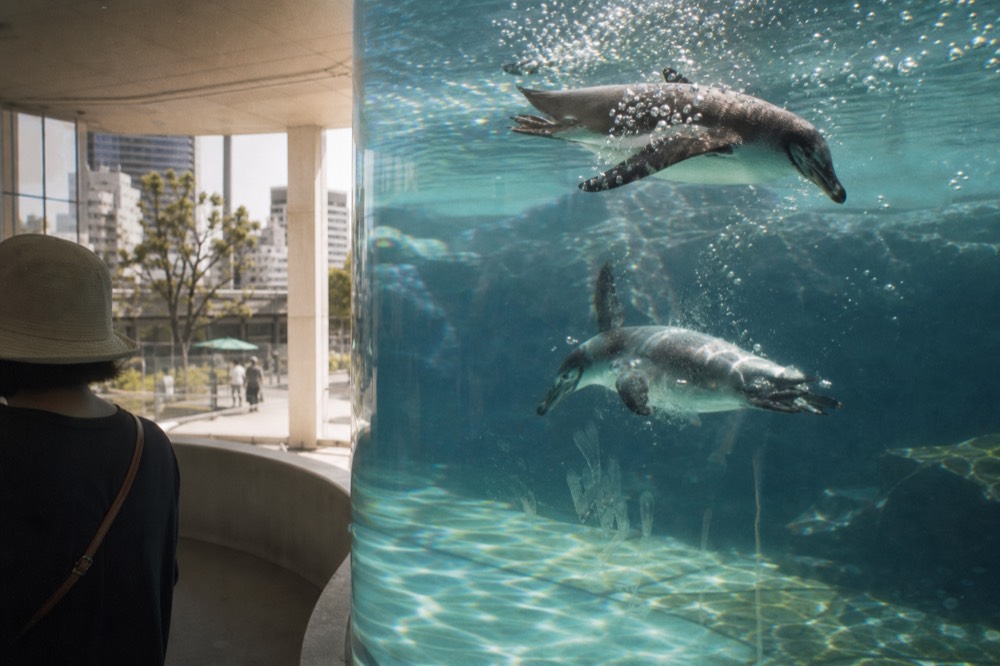
Sumida, at Tokyo Skytree's base, is the one travellers actually weigh against a Kaiyukan day, and its ¥2,700 adult price sits just below Kaiyukan's cheapest bookable date, published at sumida-aquarium.com. Its Ogasawara main tank holds about 45 species and 450 fish, its indoor penguin pool about 350 tons, and it keeps about 14 jellyfish species and 700 animals. Sumida opened 22 May 2012 and is compact, modern and indoors, a two-hour attraction rather than a half-day one. The head-to-head trade-offs are laid out in Osaka or Tokyo: which aquarium is better.
What does Kaiyukan actually lead on?
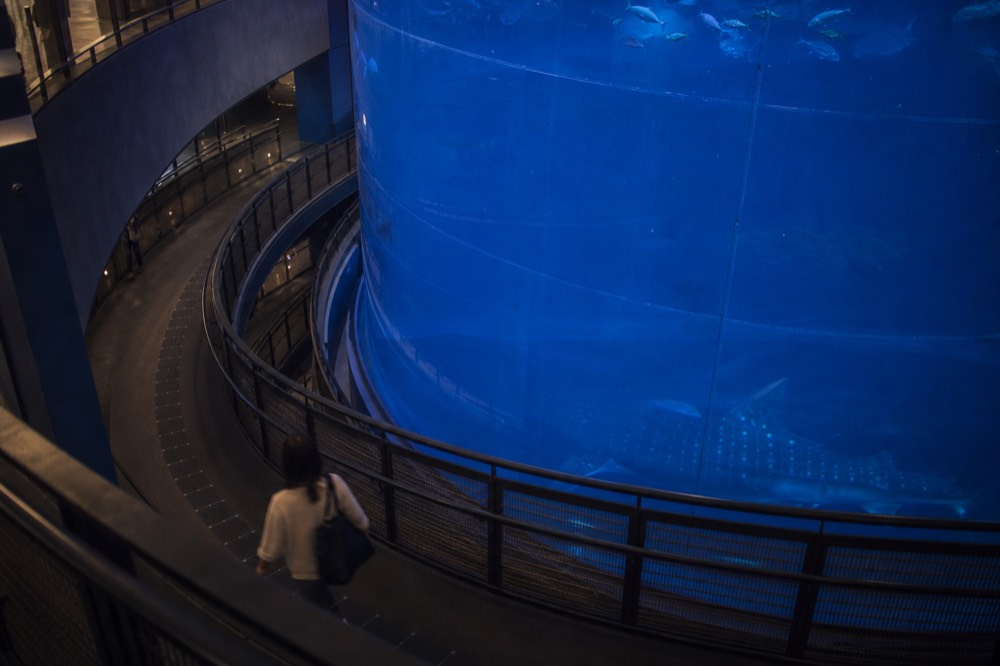
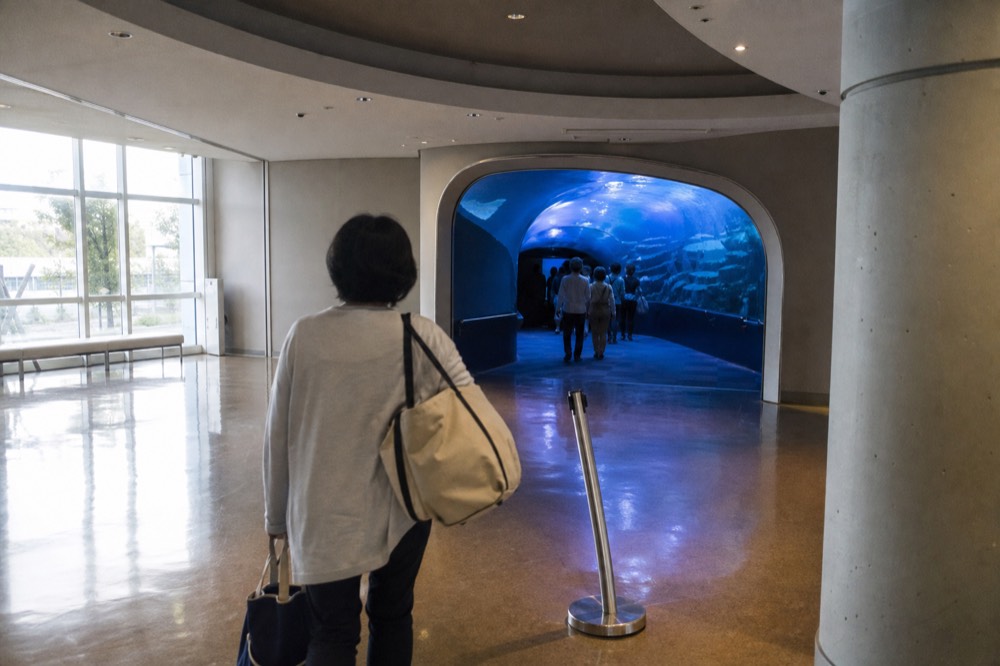
Three things, all verifiable: total water volume, about 11,000 tons across 14 tanks, the most of the six compared here; whale sharks, two individuals named Kai and Yu, which no other venue on this list exhibits; and the single-spiral route, one continuous descent from the 8th floor around the 5,400-ton Pacific Ocean tank, which no rival copies.
The 11,000-ton total comes from Kaiyukan's own school-visit pages, and the Pacific tank's 34-metre maximum length, 9-metre depth and 5,400-ton volume appear there too. About 620 species and 30,000 animals live across 14 tanks recreating 10 world regions. The whale sharks are the headline: Kai, a male at 5 m 30 cm and about 1,100 kg, and Yu, a female at 6 m 20 cm and about 1,800 kg, per the aquarium's 2025 measurement, Kaiyukan's most recent published statement. Kaiyukan rotates individuals over time, so the count is that measurement's, not a permanent promise.
The spiral route is the underrated lead. You enter through the Aqua Gate tunnel, ride an escalator to the 8th floor, then descend floor by floor around the central tank, seeing the same water at nine metres of depth from multiple angles. Other aquariums distribute their exhibits across halls; Kaiyukan's is one continuous helix. Kaiyukan itself budgets 90 to 120 minutes for a visit, published on its school-group FAQ, though many visitors stay longer.
What Kaiyukan does not lead on, said plainly: animal count, where Nagoya's 50,000 dominates; price, where Kasai's ¥700 and Nagoya's ¥2,030 both undercut it; and flat pricing, since it alone runs a demand calendar. Placing Osaka Aquarium honestly means naming those losses rather than hiding them behind adjectives.
Kyoto Aquarium and NIFREL: the closer rivals
Kyoto Aquarium, opened 14 March 2012, charges ¥2,600 flat with about 200 species and 10,000 animals, and is the natural inland alternative for anyone based in Kyoto. NIFREL, Kaiyukan's own sibling venue in Suita, charges ¥2,400 with 8 exhibition zones but publishes no species or animal count, so it cannot be ranked on richness, only on concept.
Kyoto's scale figures come from its own about page: about 200 species, 10,000 animals, and a main "Kyoto Sea" tank holding about 500 tons of artificial seawater with about 50 species. It is the smallest of the six on published numbers, but it is a genuine inland aquarium, reachable without a trip to the coast, and an annual pass at ¥5,800 covers locals. The full two-way breakdown is in our Kyoto Aquarium vs Kaiyukan guide.
NIFREL, opened 19 November 2015, is produced and operated by the same company as Kaiyukan, and it behaves more like a hybrid gallery of aquarium, zoo and art installation than a traditional aquarium. Its 8 exhibition zones include a walk-through bird space and a white tiger zone. Its species count, animal count and water volume are not published anywhere official, so this comparison says less about NIFREL and only what is checkable: the ¥2,400 adult price and the 8 zones. In March 2026 NIFREL opened a new "doku ni fureru" zone themed around venomous creatures. If you are weighing the sibling venues against each other, see NIFREL or Kaiyukan.
So which aquarium in Japan should you actually visit?
Choose Kaiyukan if the whale sharks or the spiral route are the point, and book a ¥2,800 weekday date to get it at the floor price. Choose Nagoya for the most animals and Japan's largest pool at ¥2,030. Choose Kasai for the best value ticket in the country at ¥700. Choose Sumida for convenience at Skytree, Kyoto for an inland day, NIFREL for something closer to art.
The honest answer is that the best aquarium in Japan depends on which criterion you weight most. There is no venue that wins price, species, animals and uniqueness simultaneously, and any listicle telling you otherwise has not checked the operators' own numbers. Kaiyukan is the strongest all-rounder and the only one with whale sharks, but a Nagoya visitor pays less and sees more animals, and a Tokyo visitor can see over 500 species for far less money.
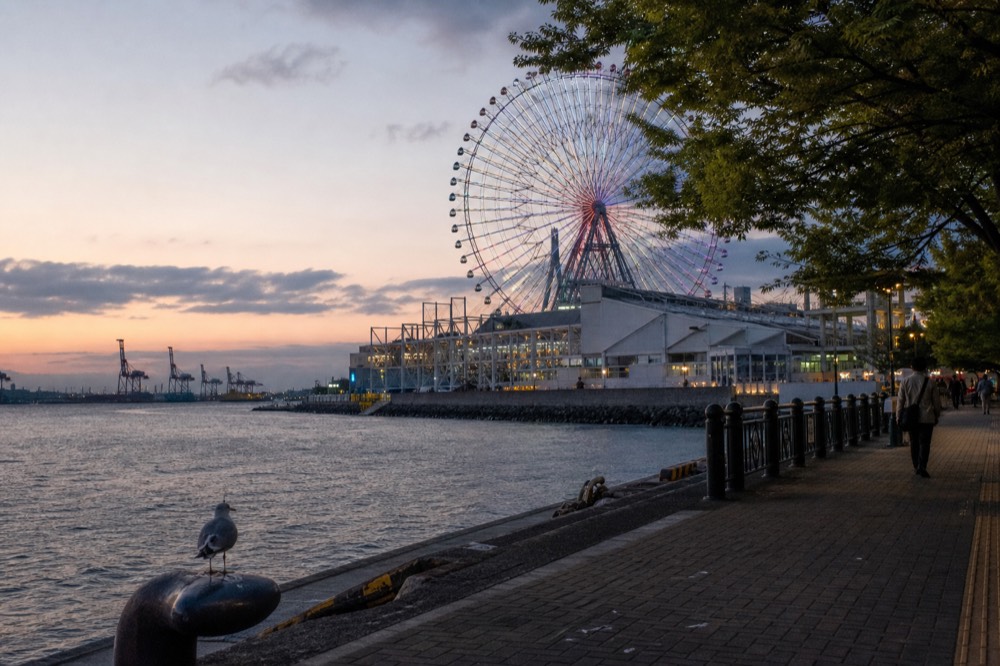
For overseas visitors on a Kansai itinerary, the practical calculus usually lands on Kaiyukan, because Tempozan Harbor Village wraps a full day around it: the Giant Ferris Wheel, the Santa Maria cruise, Naniwa Kuishinbo Yokocho food alley and the LEGOLAND Discovery Center are all next door. The Osaka Amazing Pass does not include Kaiyukan admission at all, though it does cover the Ferris Wheel and the metro ride to Osakako Station, a nuance most pass guides miss. Getting there is simple: Osaka Metro Chuo Line to Osakako Station, then about five minutes from Exit 1 per the aquarium, closer to ten from other exits.
The uniqueness angle is worth one more table, because it is the criterion listicles skip entirely: what each venue has that the others do not.
| Venue | What only it offers |
|---|---|
| Osaka Aquarium Kaiyukan | Whale sharks (Kai and Yu); the single-spiral descent around one central tank |
| Port of Nagoya | Japan's largest main pool, 60 m × 30 m × 12 m |
| Tokyo Sea Life Park | Doughnut-shaped 2,200 m³ bluefin tuna tank; ¥700 metropolitan ticket |
| Sumida Aquarium | Skytree-attached indoor penguin pool of about 350 tons |
| Kyoto Aquarium | Inland location; dolphin display in a landlocked city |
| NIFREL | 8-zone aquarium-zoo-art hybrid, plus a white tiger zone |
Planning figures that decide the trip
Budget ¥2,800 to ¥3,500 per adult for Kaiyukan depending on date, ¥2,030 for Nagoya, ¥700 for Kasai, ¥2,700 for Sumida, ¥2,600 for Kyoto and ¥2,400 for NIFREL. Only Kaiyukan varies by date; the other five are flat year-round. Child tiers exist at every venue, and Kaiyukan admits children under 3 free.
The table below is the full planning sheet, with each venue's own published prices and the child tier where the operator states one.
| Venue | Adult | Child tier | Pricing model | Free entry |
|---|---|---|---|---|
| Osaka Aquarium Kaiyukan | ¥2,800–¥3,500 bookable | ¥1,400–¥1,800 (7–15); ¥700–¥900 (3–6) | Dynamic, by date | under 3 |
| Port of Nagoya | ¥2,030 | varies by school stage | Flat | varies by age |
| Tokyo Sea Life Park | ¥700 | ¥250 junior high; primary and younger free | Flat | primary school and younger |
| Sumida Aquarium | ¥2,700 | published on operator page | Flat | varies by age |
| Kyoto Aquarium | ¥2,600 | published on operator page | Flat | varies by age |
| NIFREL | ¥2,400 | ¥1,200; ¥700 age 3+ | Flat | varies by age |
Kaiyukan's own price calendar currently publishes only about two months ahead, so dates beyond that window have no published price yet, a limit no competitor states. Booking in advance matters most at Kaiyukan for a second reason: since 15 June 2026 it has sold timed-entry tickets in 15-minute slots with a cap per slot and ended same-day re-entry, so a peak-day walk-up can mean a long wait or a missed slot. Our do you have to book Kaiyukan in advance piece covers the mechanics. For a sense of what a visit actually feels like hour by hour, the best time of day to visit Kaiyukan guide walks the crowding patterns.
One more Kaiyukan planning note that falls out of the comparison: its 4.8 rating across about 14,894 reviews on the operator's live listing is the largest review base of the venues here, which says something about how many international visitors it draws, though ratings measure satisfaction, not scale. Whatever you choose, buy from a legitimate channel. Kaiyukan itself warns that tickets from unauthorised resellers will not admit you, and its own news page names only a handful of official routes.
The six questions below cover the picks most readers debate: whether one venue beats all the others, which is biggest, which has whale sharks, which is cheapest, how Kaiyukan's tickets price out against the rest, and whether NIFREL is the better buy. Each answer uses only the operators' own published figures.
Common questions about the best aquariums in Japan
What is the best aquarium in Japan?
There is no single winner. Kaiyukan leads on total water volume, about 11,000 tons, species, about 620, and whale sharks. Port of Nagoya has more animals, about 50,000, and Japan's largest main pool for ¥2,030. Tokyo Sea Life Park offers over 500 species for ¥700. Pick by the criterion you weight most.
Is Kaiyukan the biggest aquarium in Japan?
It depends on the measure. Kaiyukan's about 11,000 tons of total water is the largest of the six venues compared here. Port of Nagoya's main pool, 60 by 30 by 12 metres, is Japan's largest single pool, and Nagoya keeps about 50,000 animals against Kaiyukan's about 30,000.
Which Japanese aquarium has whale sharks?
Kaiyukan does, two of them at its last published measurement: Kai, a male of 5 m 30 cm, and Yu, a female of 6 m 20 cm. None of the other five venues compared here, Nagoya, Kasai, Sumida, Kyoto or NIFREL, exhibits whale sharks.
Which aquarium in Japan is the cheapest?
Tokyo Sea Life Park at ¥700 flat for an adult, a metropolitan-government price, with over 500 species. Port of Nagoya follows at ¥2,030. Kaiyukan's cheapest bookable dates run ¥2,800, rising to ¥3,500 on peak dates.
How much are Kaiyukan tickets compared to other aquariums?
Kaiyukan adults pay ¥2,800 to ¥3,500 depending on date, the only demand-based calendar among the six. Children aged 7 to 15 pay ¥1,400 to ¥1,800, ages 3 to 6 pay ¥700 to ¥900, and under 3 enters free. Prices appear on the live listing for any specific date.
Is NIFREL better than Kaiyukan?
They are different formats. NIFREL, ¥2,400, is a compact 8-zone hybrid of aquarium, zoo and art installation run by the same company. Kaiyukan is far larger, about 11,000 tons of water and about 620 species, with the whale sharks. NIFREL publishes no species count, so the two cannot be ranked on richness.