Is Kaiyukan good for toddlers and young kids?
A parent-focused guide to Osaka Aquarium Kaiyukan with toddlers and young children: ticket tiers, the stroller-friendly spiral route, baby facilities, feeding times and how long a visit really takes.
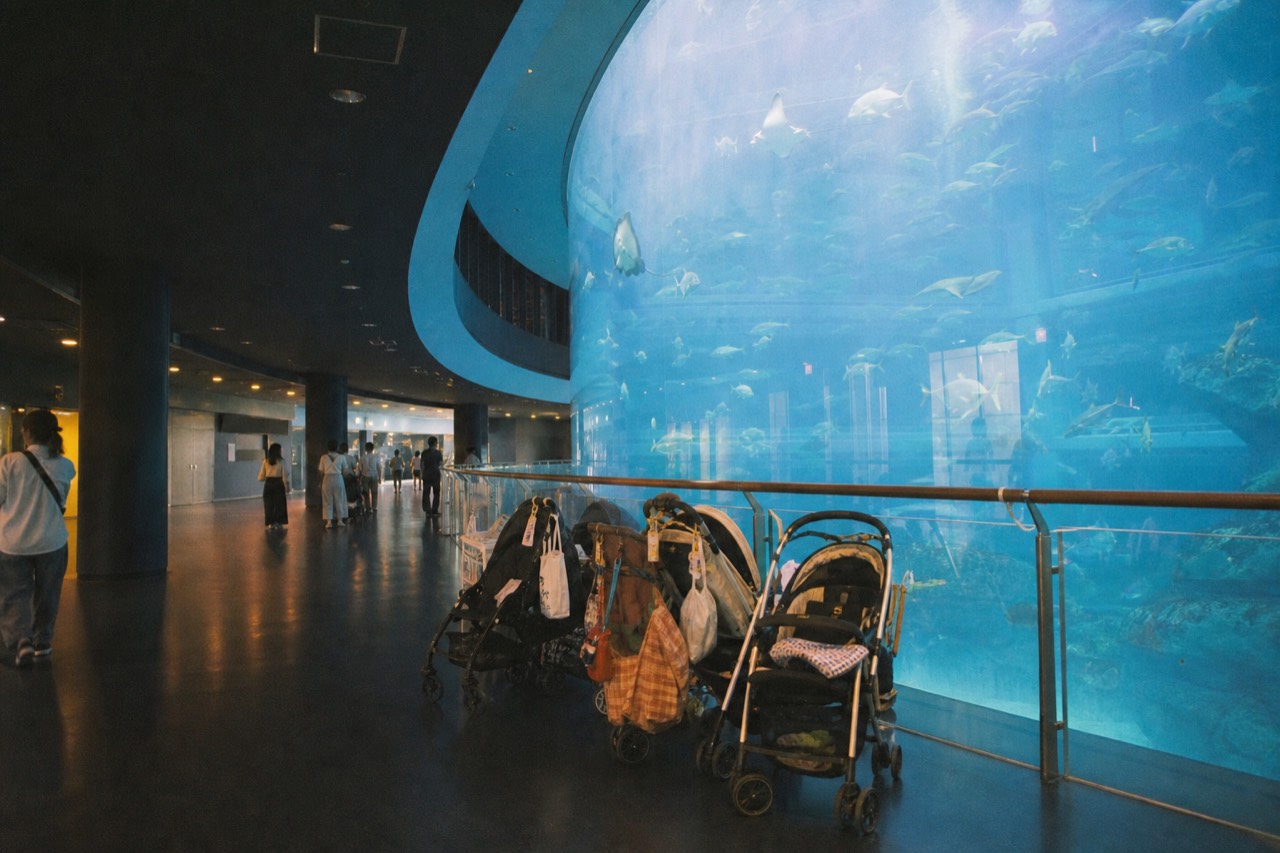
Kaiyukan was built in 1990 around a single idea: one enormous tank at the centre and a spiral route that walks you down around it, floor by floor. For a parent with a two-year-old, that idea is quietly the best thing about the place. There are no crossings against the crowd, no lifts to hunt for, no decision points where a tired child can bolt in three directions at once. There is one way down, and it ends at the exit.
That is the structural reason the answer to the question in the title is yes. The practical reasons, the free-under-2 admission, the low preschool ticket price, the baby care room on the second floor of the entrance building and the feeding timetable you can plan a whole morning around, are what the rest of this article sets out, with figures taken from the aquarium's own published material rather than from crowd-sourced guesswork. Osaka Aquarium sites like this one exist precisely because those first-party details are scattered across ticket pages, nursing guides and news archives that a travelling parent will never find in time.
Is Kaiyukan good for toddlers and young kids?
Yes, and comfortably so: children under 2 enter free, the 3-to-6 preschool ticket is the cheapest paid tier at ¥700 to ¥900 by date, the whole exhibition route runs downhill on slopes rather than stairs, and the aquarium itself budgets 90 to 120 minutes for a visit, which sits inside most toddlers' attention span before the meltdown threshold.
Two caveats make the difference between a good visit and a hard one, and both come straight from the aquarium's own announcements rather than from reviews. First, same-day re-entry ended on 15 June 2026: once you walk out through the exit, you are done, so a mid-visit escape to Tempozan Marketplace for lunch and a second pass through the whale shark tank is no longer possible. Second, since 24 April 2026 there is a bag rule that bites hard if you are travelling with a child's paraphernalia: nothing whose three sides total 120 cm or more, or with any single side over 70 cm, may come inside.
Both of those rules reward planning, and planning is what this page is for. The aquarium's own page for families with infants is the primary source for the baby-facility details below, and it is worth a read in full before you go. For everything about tickets, hours and the route itself, the aquarium's official ticket page publishes the price calendar it actually charges from, and this site's figures throughout are taken from that calendar.
For a family, the cheapest structural decision is simply choosing the right date. Kaiyukan prices by demand, so a weekday adult ticket is ¥2,800 on more than three quarters of the currently bookable dates, while a handful of peak days run to ¥3,500, and the child tiers move in step. Booking the e-ticket in advance also locks a 15-minute admission slot, which matters with a toddler in tow because it removes the one queue you cannot fast-talk a two-year-old through.
How much does a child's ticket actually cost?
A child aged 7 to 15 pays ¥1,400 to ¥1,800 depending on the date, a preschooler aged 3 to 6 pays ¥700 to ¥900, and a child under 2 enters free; adults pay ¥2,800 to ¥3,500 on the dates currently published, with every tier moving together through the same demand-based calendar.
The full ladder, read from the aquarium's own pricing data, looks like this:
| Tier | Age | Price range by date | Notes |
|---|---|---|---|
| Adult | 16 and over | ¥2,800 to ¥3,500 | ¥2,800 on 83% of currently bookable dates |
| Child | 7 to 15 | ¥1,400 to ¥1,800 | Applies through junior high age |
| Young child | 3 to 6 | ¥700 to ¥900 | The cheapest paid tier |
| Infant | Under 2 | Free | Not a purchasable ticket |
Two details in that table catch families out. The child rate runs to 15, not to 11 as at many Japanese attractions, because Kaiyukan groups junior high students with elementary students; a 14-year-old is still on the ¥1,400-to-¥1,800 tier. And the free tier is an age, not a height: the aquarium's own age table states free for children aged 0 to 2, with no measurement at the gate.
The date-dependence is the part nobody warns you about. Across the 59 dates in the bookable window right now, an adult ticket is ¥2,800 on 83% of them, with ¥2,900, ¥3,200 and ¥3,500 sharing the rest. For a family of two adults, one seven-year-old and one four-year-old, the spread between a cheap date and a dear one is roughly ¥1,600 across the group, real money for a savings of nothing but calendar position. If your dates flex, the official price calendar shows each day's price before you commit, and our Kaiyukan tickets guide walks through how the levels work in more depth.
A disability discount also applies: holders of the relevant Japanese disability booklets, or the Mirairo ID app or a MynaPortal record, pay half price along with one accompanying carer. Screenshots and printouts are not accepted, which matters if you are visiting with a child who has a Japanese booklet and a grandparent holding it on their phone.
Can you take a stroller around the route?
Yes, with one adjustment: you park the stroller near the ticket counter outside and collect it after, because the aquarium asks families to view on foot, though it confirms most of the spiral route uses slopes rather than stairs and staff will help with elevators where steps exist.
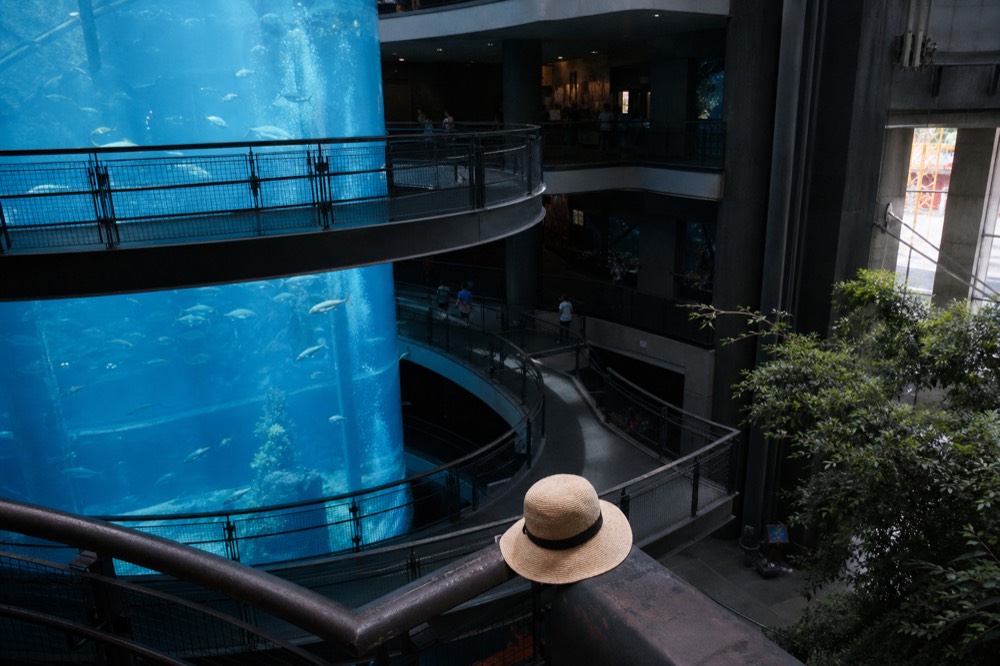
The route itself is the reason this works. You enter on the 3rd floor of the entrance building, pass through the Aqua Gate tunnel tank, ride an escalator up to the 8th floor, and then walk one continuous descending path around the central Pacific Ocean tank from the 8th floor down to the 3rd, exiting where you came in. The aquarium's own description of the structure is a spiral descent, and its family page notes that most of the route is slopes. For a parent carrying a child, or steering a freshly walking toddler by the hand, a one-way downhill slope with a tank always in view is about as good as a big building gets.
There is no stroller rental at the aquarium itself, so if your child will not tolerate a long walk, bring a carrier rather than assuming you can borrow wheels. The outdoor stroller parking sits to the left of the entrance, near the ticket counter. Inside, elevators exist where the escalators are, and staff provide guidance; the baby care room on the entrance building's 2nd floor is the natural regrouping point if a carry, a feed or a nudge toward the toilet is needed mid-visit.
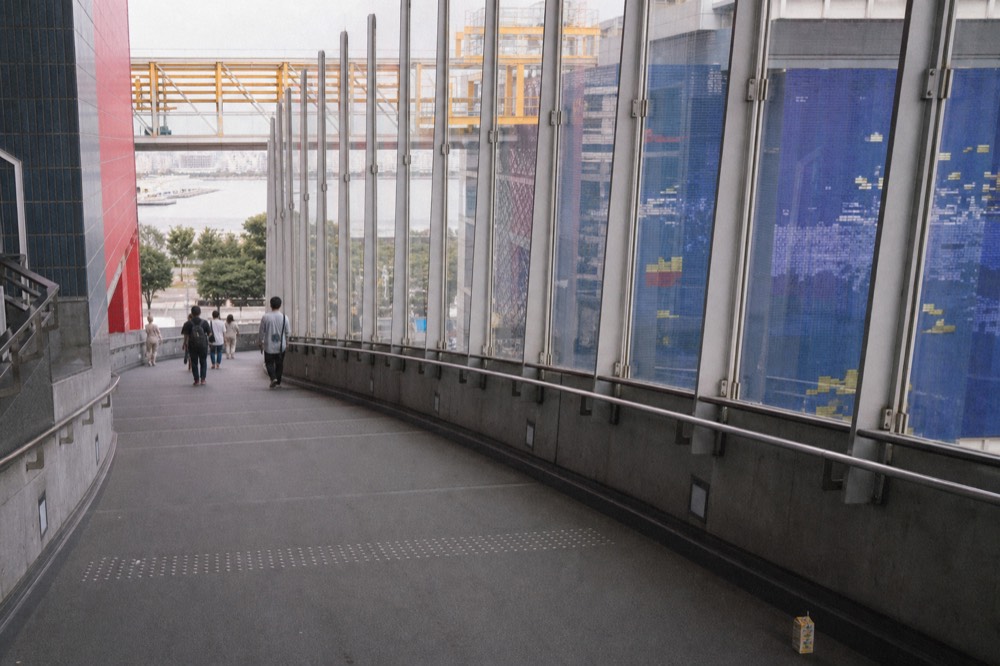
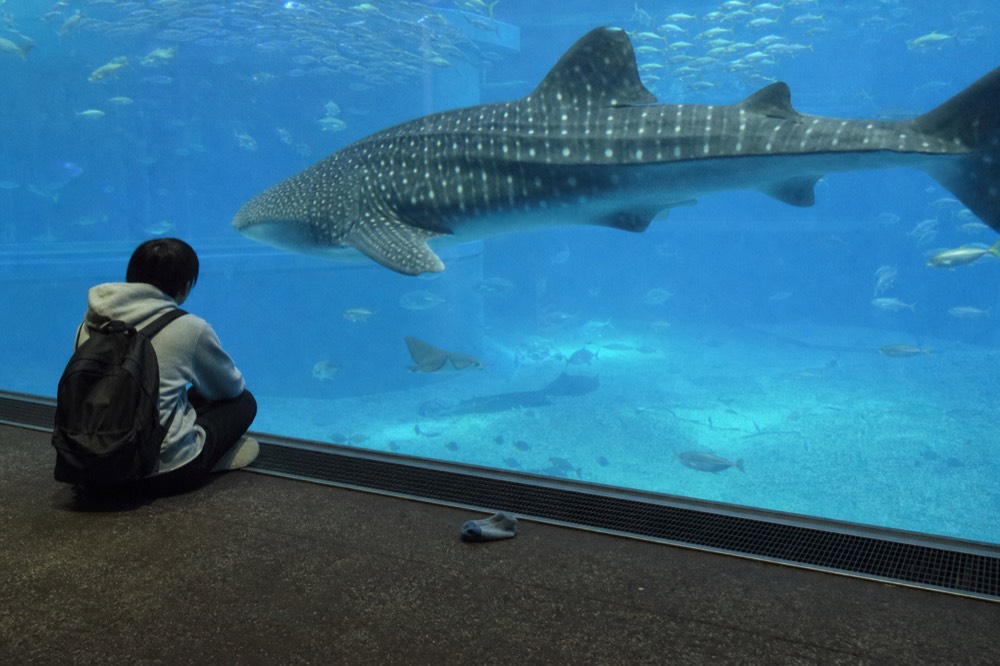
Two gallery conditions are worth flagging for the under-three crowd. Several zones, notably the Japan Deep tank and the Jellyfish gallery, are kept dim, and the Aqua Gate tunnel is a long enclosed passage of moving shadows that some toddlers adore and a few find overwhelming. The counterweight is that the animals are big, close and slow-moving: the Pacific Ocean tank holds 5,400 tons of water and reaches 9 metres deep, and its residents, two whale sharks named Kai and Yu at the aquarium's last published measurement, a male at 5 m 30 cm and a female at 6 m 20 cm, cruise past the glass at toddler eye-level on the lower floors. Very little at Kaiyukan requires a child to look up for long, which is rarer in aquariums than it sounds.
For preschoolers who want to touch something, the Maldives Zone in the newer area has one of Japan's larger touch pools, where visitors can gently touch small sharks and rays, with hand-washing stations alongside. The aquarium also offers an Expedition Team stamp notebook as an optional add-on, which turns the one-way route into a scavenger hunt and is well matched to a four-to-six-year-old's idea of a mission.
Where can you feed or change a baby inside?
The main baby care room is on the 2nd floor of the entrance building, with a kids' toilet, a nursing room, a diaper-changing bed and a formula preparation device; a second nursing-only room sits behind the Aqua Gate tank inside the paid area, and a third baby care room with a nursing booth and family zone is up on the 3rd floor of Tempozan Marketplace.
That spread is genuinely well designed for the building's flow. The entrance-building room is where you land before going in, the Aqua Gate nursing room is the in-visit option once you are committed to the one-way route, and the Marketplace room covers the after-visit slump when everyone is hungry and someone needs a change before the walk to the station. The in-visit room is nursing only, no hot water and no changing facilities, so the working pattern is: last full change and feed at the 2nd floor room, then the Aqua Gate room for a top-up if needed.
| Facility | Location | What it has |
|---|---|---|
| Baby care room | Entrance Building 2F | Kids' toilet, nursing room, diaper-changing bed, formula preparation device |
| Nursing room | Behind the Aqua Gate tank, inside the paid area | Private nursing space only, no hot water or changing facilities |
| Baby care room | Tempozan Marketplace 3F | Nursing booth, diaper-changing sheet, formula preparation device, family zone |
| Coin lockers | Entrance Building paid zone, plus Marketplace locations | For bags over the size limit, near escalators and under the Ferris wheel |
The bag rule from April 2026 deserves its own paragraph because it is the single most common way a family trip goes wrong at the door. Suitcases and cart-type luggage are banned outright, along with anything whose three sides total 120 cm or more or with any single side over 70 cm, and anything wider than 85 cm may be refused because some corridors will not take it. A single large diaper bag is fine; a wheeled travel crib or a stacked luggage trolley is not. The aquarium's own advice is to leave oversized items at your hotel or in the coin lockers at the entrance, in Kaiyukan Hall, near the museum shop, in Tempozan Marketplace or under the Ferris wheel. Build five minutes for that into your arrival time, especially if you are coming straight from a hotel checkout.
The end of same-day re-entry on 15 June 2026, announced by the aquarium to support the capped 15-minute admission slots, changes the rhythm of a visit with small children. There is no longer a mid-day exit for lunch at Naniwa Kuishinbo Yokocho and a return, so plan snacks inside your bag, eat before you enter, or accept that lunch follows the visit rather than splitting it. A practical pattern that fits the 90-to-120-minute official visit length: feed everyone first, enter at a slot just before a feeding time you want to catch, and let the Marketplace meal be the reward at the end.
Which feeding times are worth timing a visit around?
The published timetable puts otter feeds at 11:30, 13:30 and 15:30 on the 7th floor, penguins at 10:00 and 14:20 in Antarctica, dolphins at 11:40, 14:00 and 16:30 in the Tasman Sea, and ringed seals at 10:50 and 15:35 in the Arctic zone, with the aquarium warning that times can be cancelled without notice depending on the animals.
The full schedule, from the aquarium's own feeding-time data:
| Floor | Zone | Animal | Times |
|---|---|---|---|
| 7F | Japan Forest | Otter | 11:30, 13:30, 15:30 |
| 7F | Monterey Bay | Sea lion and seal | 09:50, 13:20, 14:50 |
| 7F | Gulf of Panama | Coati | 11:15, 15:30 |
| 7F | Antarctica | Penguins | 10:00, 14:20 |
| 7F | Tasman Sea | Pacific white-sided dolphin | 11:40, 14:00, 16:30 |
| 6F | Pacific Ocean | Pacific fish | 10:30, 15:00 |
| 4F | Arctic Region | Ringed seal | 10:50, 15:35 |
| 4F | Falkland Islands | Rockhopper penguin | 10:50, 15:10 |
For a toddler, the feeding times that consistently land best are the otters, which are on the 7th floor early in the route when legs are still fresh, and the ringed seals on the 4th floor, where the aquarium's most famous resident, Yuki the roly-poly ringed seal, lives with tankmates Arare and Moya. Yuki was alive and well and on exhibit when the aquarium's keepers last wrote about her, in a June 2026 blog post describing her eating well and curling her hind flippers; she is the animal most likely to be doing something crowd-pleasing at any given minute.
The whale shark view has a specific trick the aquarium states itself: the whale sharks feed at the surface, and when one upends into its vertical feeding posture it is best seen from the upper floors of the spiral. So if you want the feeding posture, linger on 8F or 7F around the Pacific tank's 10:30 or 15:00 feed rather than rushing downhill; if you want the animals gliding past at a small child's eye level, the lower floors win.
A note on arithmetic: last admission is exactly one hour before closing, on every day the aquarium publishes, and closing is 20:00 on most days. A 15:00 slot therefore gives a full two hours inside, enough for the official 90-to-120-minute visit plus a slow jellyfish detour, and the light-dimming shift of the late afternoon makes the galleries calmer. The trade-offs of morning versus late afternoon, crowd levels and the Night Kaiyukan lighting change, are covered in the best time of day to visit Kaiyukan, and the slot-picking logic is the same with children as without: a capped slot means the crowd inside is throttled, but the queue at a popular slot is not.
Booking the timed e-ticket in advance is what the aquarium itself recommends, and with a toddler it earns its keep twice over: no counter queue on arrival, and a locked slot you can build a nap and a train journey around. The date and time can be changed later from My Page on the official site, which is the flexibility a young family actually uses.
How long does a visit with small children really take?
Kaiyukan's own published answer is 90 to 120 minutes, and that holds with toddlers provided you arrive fed and skip the temptation to double back; plan closer to two and a half hours if you want feeding times at both ends, and remember that the one-way route and the end of re-entry make a mid-visit break impossible.
The honest planning range for a family is therefore about two to three hours from Aqua Gate to exit, plus whatever you spend in Tempozan Marketplace afterwards. The building has 19 listed exhibition areas, of which one, the Aleutian Islands tank, is closed for renovation, and about 620 species and 30,000 animals across 14 tanks and roughly 11,000 tons of water in total. No toddler sees all of it, and none needs to; the spiral structure means you pass the central Pacific tank at eight different depths, so the star attraction renews itself all the way down.
Two scheduling facts round out the plan. Opening times vary day by day, with seven distinct patterns in the aquarium's published calendar, from 10:30 starts on typical September weekdays to 08:00 on the peak late-September days that close at 21:00, so check your specific date rather than assuming 10:00. And the aquarium is closed on just two days in the twelve months its calendar covers, 13 and 14 January 2027, so a midweek winter visit with a small child, outside the New Year holidays, is among the calmest ways to see it.
Pulling everything on this page into one arrival checklist, here is the shape of a visit that works with a toddler, hour by hour:
| When | What | Why it matters with a small child |
|---|---|---|
| Before arrival | Check the day's opening pattern and price on the official calendar | Opening varies from 08:00 to 10:30; the same family ticket differs by up to ¥1,600 between dates |
| 30 minutes before the slot | Feed everyone, last diaper change at the Entrance Building 2F baby care room | No re-entry and an in-visit nursing room with no changing facilities |
| Entering | Park the stroller left of the ticket counter, carry the child | No rental inside; the route is one-way downhill on slopes |
| First hour | 8F downward through Japan Forest, catching the 11:30 or 13:30 otter feed | Otters land best with toddlers, and legs are freshest on 7F |
| Second hour | Lower floors for eye-level whale sharks, ringed seals at 10:50 or 15:35 | Yuki the seal and the touch pool are the toddler highlights |
| After the exit | Tempozan Marketplace 3F baby care room, then the food alley | Re-entry is over, so lunch follows the visit, not splits it |
Getting there is the last piece, and it is short: the aquarium sits about a five-minute walk from Exit 1 of Osakako Station on the Osaka Metro Chuo Line by the aquarium's own figure, though the mapped foot route is closer to ten minutes if you come out of a different exit, so pad the walk for short legs. The station is signed "Kaiyukan-mae", and the Tempozan Giant Ferris Wheel above the building is visible the whole way, which does useful work as a walking incentive.
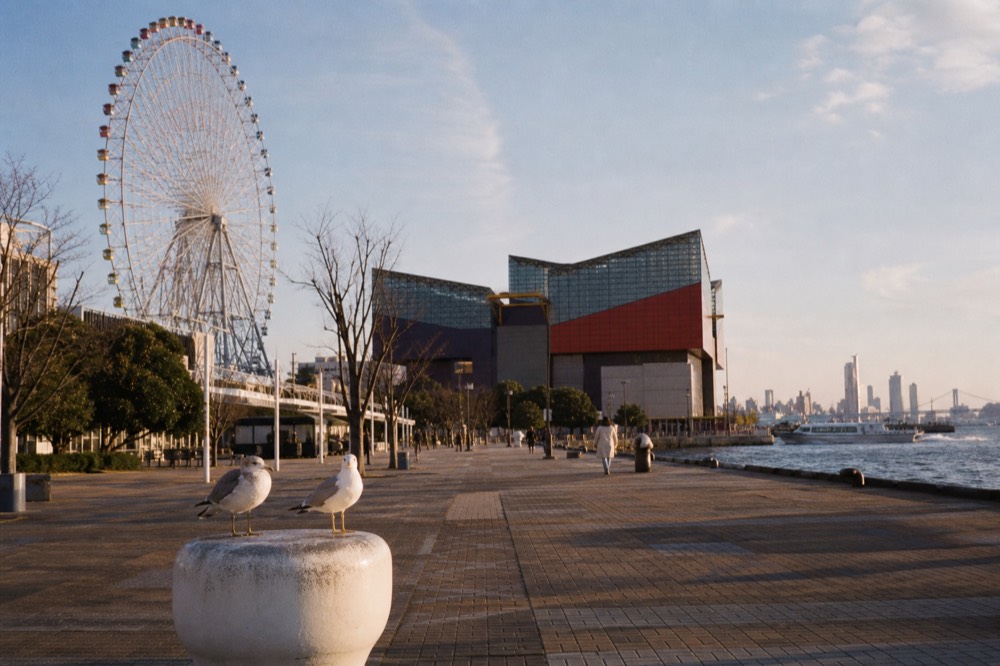
The wider Tempozan Harbor Village makes the after-visit hours easy: the food alley inside Tempozan Marketplace, the Ferris Wheel (¥1,000 from age 3, and included free on the Osaka Amazing Pass, though the pass gives nothing at Kaiyukan itself), and the LEGOLAND Discovery Center are all within a few flat minutes' walk. For the under-stroller set, the guide to spending time at Kaiyukan breaks the route down floor by floor if you want to cherry-pick.
The short answers are: yes it suits toddlers, under-2s enter free and 3-to-6s pay ¥700 to ¥900, strollers are parked outside and the route is walked on foot, re-entry ended in June 2026 so a visit is one continuous pass, baby care rooms sit on the entrance building's 2nd floor and in Tempozan Marketplace, and a family should budget two to three hours including a feeding-time stop.
Common questions about Kaiyukan with toddlers and young kids
Is Kaiyukan good for toddlers and young kids?
Yes. Under-2s enter free, the 3-to-6 ticket is the cheapest tier at ¥700 to ¥900 by date, the route is a one-way downhill spiral on slopes, and the aquarium itself budgets 90 to 120 minutes for a visit. The main constraints are the end of same-day re-entry and the April 2026 bag-size rule.
Do toddlers pay to enter Kaiyukan?
Children under 2 enter free. Ages 3 to 6 pay the young child tier, ¥700 to ¥900 depending on the date under Kaiyukan's demand-based calendar. Ages 7 to 15 pay ¥1,400 to ¥1,800.
Can we leave and come back in with a small child?
No. Same-day re-entry ended on 15 June 2026. Once you exit, the visit is over, so bring snacks in an allowed-size bag or plan to eat after the visit in Tempozan Marketplace.
Are strollers allowed inside?
There is no rental, and the aquarium asks visitors to park strollers outside near the ticket counter and view on foot. Most of the route uses slopes, and staff assist with elevators where stairs or escalators are the only option.
Where are the baby care facilities?
A baby care room with nursing room, kids' toilet, diaper-changing bed and formula preparation device is on the entrance building's 2nd floor; a nursing-only room sits behind the Aqua Gate tank inside the paid area; and another baby care room with a family zone is on Tempozan Marketplace's 3rd floor.
What size bag can we bring with a child's things?
Since 24 April 2026, suitcases and cart-type luggage are banned, and anything with three sides totalling 120 cm or more, or any single side over 70 cm, cannot come inside. A normal diaper bag is fine; oversized items go in the coin lockers at the entrance or around Tempozan.