Which is better, Nagoya's aquarium or Kaiyukan?
An honest comparison of Port of Nagoya Public Aquarium and Osaka Aquarium Kaiyukan on price, animals, tank size and the overall visit, with verified figures from both operators.
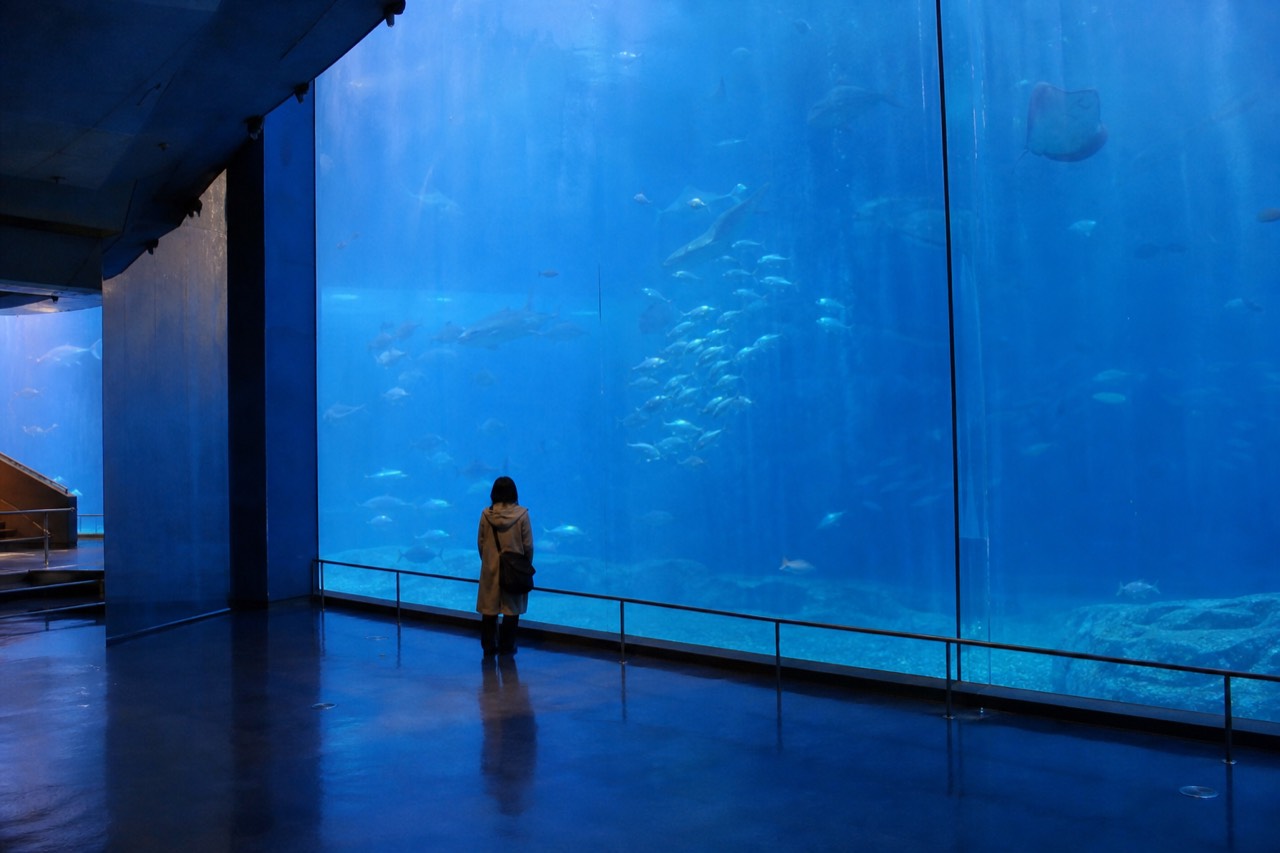
Comparing Japan's two big-city aquariums is a genuinely close call, and the honest answer depends on which axis you care about most. Port of Nagoya Public Aquarium keeps more animals, charges a flat 2,030 yen for adults and owns Japan's largest main pool, a tank measuring 60 meters long, 30 meters wide and 12 meters deep. Osaka Aquarium answers with about 11,000 tons of total water, two whale sharks named Kai and Yu, and a building you descend in a spiral from the 8th floor to the 3rd. Neither dominates the other, and this comparison lays out where each one clearly wins.
The figures below come from the two operators' own sites and from Kaiyukan's first-party pricing and hours data, not from aggregator roundups. Where an operator does not publish a number, we say so instead of estimating one.
Which is better, Nagoya's aquarium or Kaiyukan?
On raw counts and headline tank size, Nagoya's aquarium is the stronger claim: about 500 species and 50,000 animals against Kaiyukan's about 620 species and 30,000 animals, and a main pool that is Japan's largest at 60 by 30 by 12 meters. Kaiyukan is better on total water volume, roughly 11,000 tons against an unpublished Nagoya figure, and it is the only one of the two with whale sharks.
Nagoya's animal count advantage is real and large: 50,000 animals against Kaiyukan's 30,000, roughly a two-thirds edge in individual creatures, even though Kaiyukan lists more species, about 620 against Nagoya's roughly 500. Species and animal counts measure different things. A tank of 3,000 small sardines moves the animal count dramatically without telling you much about variety, and Kaiyukan's higher species number reflects its 14 large tanks recreating habitats from the Japan Forest to the Falkland Islands. Both numbers are the operators' own, printed on their official pages.
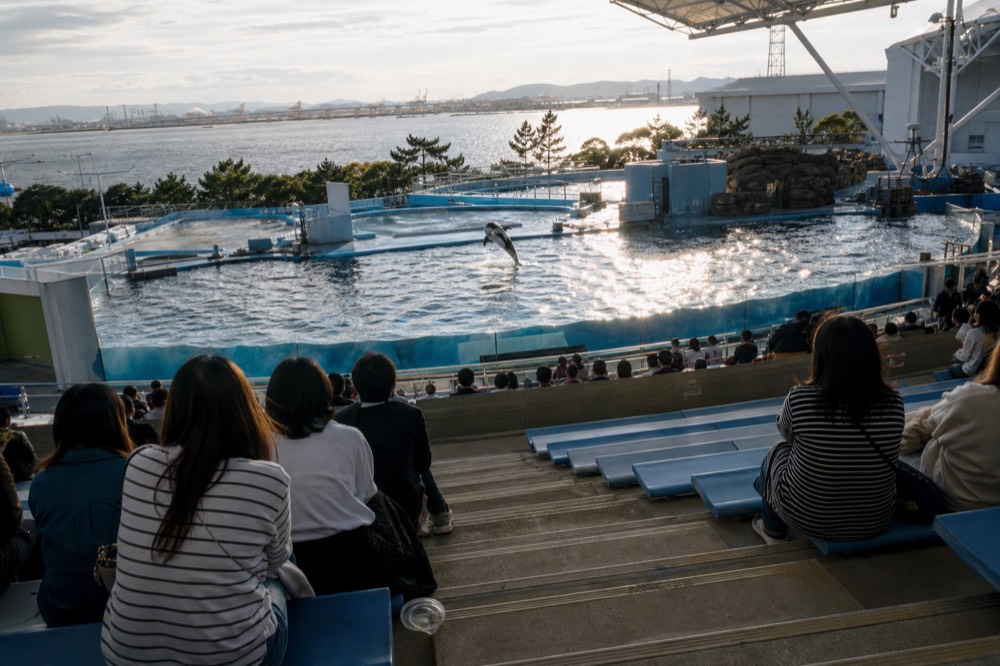
The headline tank comparison is where Nagoya flexes hardest. Its main pool is, in the aquarium's own English description, "the largest pool in Japan (60 meters long, 30 meters wide, and 12 meters deep)", and it stages dolphin shows on that scale. Kaiyukan's central Pacific Ocean tank is 9 meters at its deepest with a maximum length of 34 meters and holds 5,400 tons of water, but Kaiyukan's total across all tanks is about 11,000 tons, a figure the aquarium publishes on its own school-visit pages. Port of Nagoya publishes no total water volume at all, so an honest comparison has to use Nagoya's main-pool dimensions against Kaiyukan's building-wide total, and those two numbers are not directly comparable. That asymmetry is worth stating plainly: on the one number both publish, Nagoya's main stage is bigger than any single Kaiyukan tank, but no one outside the operator knows Nagoya's total.
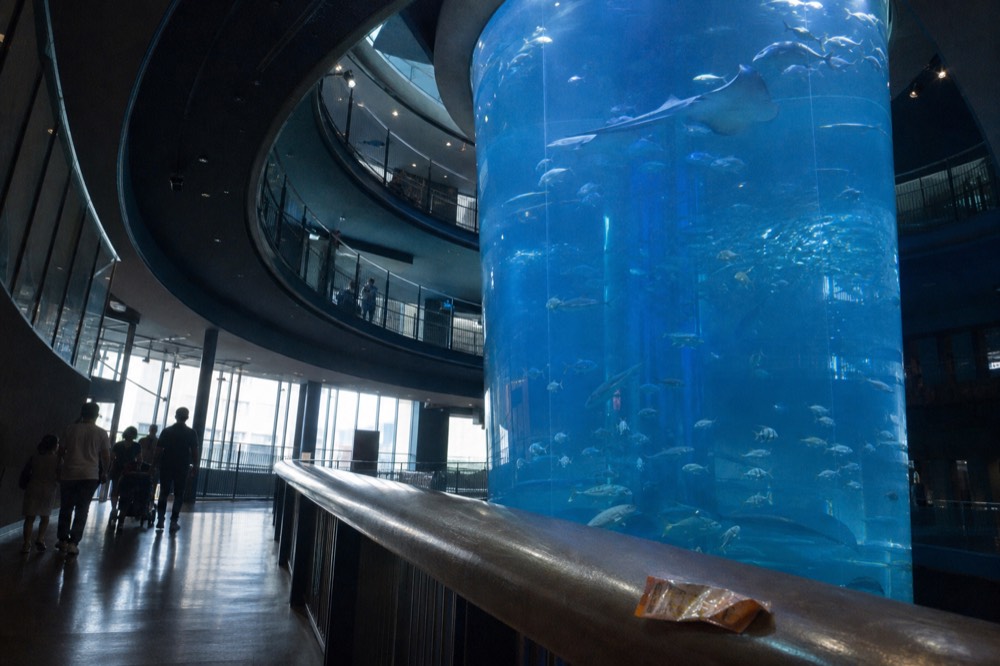
The choice also comes down to what kind of visit you want. Nagoya is a show aquarium: the south building's dolphin stadium and the vast pool are the emotional center, and the visit is organized around scheduled performances. Kaiyukan is a walk aquarium: you enter through the Aqua Gate tunnel tank, ride an escalator to the 8th floor, then spiral downward around the Pacific Ocean tank, seeing the same water at nine meters of depth from multiple levels. Visitors who love spectacle lean Nagoya; visitors who love immersion and architecture lean Kaiyukan.
How do the two admission prices actually compare?
Nagoya charges one flat adult price of 2,030 yen, while Kaiyukan runs demand-based pricing under which an adult pays 2,800 to 3,500 yen depending on the date, and more than three quarters of currently bookable dates sit at 2,800 yen with the rest up to 3,500. Nagoya's flat ticket is always the cheaper of the two on any date you can name.
The pricing structures are the sharpest practical difference between the two venues. Nagoya's official fee page lists a single adult price, 2,030 yen, with no date-based variation, and a seasonal 1,620 yen night ticket that exists only on night-opening days. Kaiyukan instead uses what it calls demand-based pricing, a date-by-date calendar in which the same adult ticket costs different amounts on different days; the official ticket page explains that the system exists to spread visitation more evenly.
Reading Kaiyukan's own pricing calendar, the bookable window currently covers 3 October 2026 to 30 November 2026, and across those 59 dated days an adult pays 2,800 yen on 83 percent of them, with 2,900, 3,200 and 3,500 yen making up the rest. The dearest dates are the public-holiday clusters; the pattern rewards weekday visits, though even a cheap Kaiyukan day sits above Nagoya's flat rate, and the gap widens further on the dearest dates. Child pricing follows the same logic: Nagoya's tiers are flat, while Kaiyukan's child ticket for ages 7 to 15 moves between 1,400 and 1,800 yen and the preschool ticket for ages 3 to 6 between 700 and 900 yen. Under 2 enters Kaiyukan free.
| What you pay | Port of Nagoya | Kaiyukan |
|---|---|---|
| Adult, cheapest day | 2,030 yen flat | 2,800 yen (bookable window) |
| Adult, dearest day | 2,030 yen flat | 3,500 yen |
| Pricing system | Single flat rate | Demand-based, moves by date |
| Night or off-peak option | 1,620 yen night ticket on night-opening days only | Cheaper weekday dates on the price calendar |
| Opened | 29 October 1992 (South Building) | 20 July 1990 |
There is a second, quieter cost difference: certainty. With Nagoya you know the price before you pick a date. With Kaiyukan the date you can travel dictates the price, and past the end of the published calendar nobody outside the aquarium knows what a given day will cost, because Kaiyukan publishes its prices only about two months ahead. A traveler locking in a November itinerary in September simply cannot know the Kaiyukan price yet, and the honest move is to check the calendar or the operator's live listing once the date goes on sale.
If Kaiyukan is your pick, the timed ticket matters as much as the price: entry runs in 15-minute admission slots with a cap on each slot, and same-day re-entry ended on 15 June 2026, so your slot is a one-way door. Booking ahead secures the slot you want rather than the slot that happens to be left.
Which one has the better star animals?
Kaiyukan's Pacific Ocean tank holds two whale sharks, Kai and Yu, measured in October 2025 at 5.30 and 6.20 meters, and no Nagoya exhibit matches that; Nagoya's stars are its dolphin program in Japan's largest main pool, plus orca and penguin exhibits that have run for decades. Whale sharks are the single rarest animal between the two venues.
The whale shark point deserves its own weight, because it is the one axis on which there is no counterargument. At Kaiyukan's last published measurement, dated 31 October 2025, the Pacific Ocean tank held exactly two individuals: Kai, a male at 5 meters 30 centimeters and an estimated 1,100 kilograms, and Yu, a female at 6 meters 20 centimeters and an estimated 1,800 kilograms. Kai arrived on 2 October 2024 and grew 60 centimeters in his first year. Kaiyukan also added two sand tiger sharks in May 2025, the first time the species was exhibited there, and an ocean sunfish in July 2025. Our companion piece on the Kaiyukan whale sharks in detail covers the feeding schedule and the upper-floor viewing tip, since the sharks feed at the surface.
Nagoya's answer is scale of a different kind. The south building's dolphin pool, the largest in Japan at 60 by 30 by 12 meters, hosts the aquarium's signature dolphin program, and the venue has kept orcas among the largest collections in Japan. For many Japanese families, the Nagoya dolphin show is the memory they leave with, the same way the whale shark silhouette is the one Kaiyukan visitors photograph. If your trip is built around one specific animal, that animal should probably decide this comparison for you.
A practical note on viewing: Kaiyukan's whale sharks feed at the surface, so the aquarium's own advice is to watch from the upper floors of the spiral, where you can see a shark upend vertically to feed. In Nagoya, the show schedule dictates where you stand and when, so it is worth checking the day's program at the entrance and working the exhibits around it.
Which building is more interesting to walk through?
Kaiyukan's building is the more interesting piece of architecture: a 30-meter-tall structure with a top-down spiral route through 14 large tanks across 19 listed exhibition areas, versus Nagoya's more conventional two-building layout split between a south show hall and a north research wing. Kaiyukan itself budgets 90 to 120 minutes for the walk.
The two floor plans shape the whole visit. Kaiyukan opened on 20 July 1990 as the anchor of Tempozan Harbor Village, and its route is the building's own idea: enter at the 3rd floor, pass through the Aqua Gate tunnel tank, ride the escalator to the 8th floor, then descend floor by floor around the central Pacific Ocean tank, seeing the same water from surface to nine meters down. The building stands 30 meters tall, or 50 meters including the glass upper section, and the aquarium's own school-group FAQ budgets 90 to 120 minutes for the full circuit. Our floor-by-floor Kaiyukan map guide walks the route in order.
Nagoya, opened 29 October 1992 in the south building with a north building added in 2001, is organized as a more traditional pair of halls: the south building carries the large-pool marine mammals and the show stadium, and the north building handles fish, deep-sea and research-oriented exhibits, themed around a journey from Japan's coastal waters to the deep ocean. It is a comfortable, legible layout, but it does not do the one dramatic thing Kaiyukan's spiral does, which is to keep returning you to the same enormous body of water from new angles.
One current caveat on Kaiyukan's route: the Aleutian Islands tank is closed for renovation, and its animals have moved to Aquaworld Ibaraki Oarai Aquarium, so the 19 listed exhibition areas include one you cannot currently see. The renovation timeline has not been announced. A fair comparison today compares Nagoya's complete building against a Kaiyukan that is missing one mid-sized zone, which does not touch the whale sharks or the spiral but does trim a floor.
Which is better for families and practical planning?
Both aquariums are strong family outings, but the practical edges differ: Kaiyukan's baby-care facilities, free-under-2 entry and timed-slot system suit small children and crowd-avoidance, while Nagoya's flat price and dolphin shows make budgeting simpler and the day more event-driven. Neither requires advance booking, but Kaiyukan's 15-minute capped slots make advance booking genuinely worthwhile on peak dates.
For families with toddlers, Kaiyukan's facilities are unusually well documented: a baby care room on the 2nd floor of the entrance building with a nursing room, kids' toilet, diaper-changing bed and formula preparation device, plus a second nursing room inside the paid area behind the Aqua Gate tank, and a further care room in Tempozan Marketplace on the 3rd floor. Strollers are not rented but can be parked near the ticket counter, and most of the spiral route uses slopes rather than stairs. Children under 2 enter free, and the preschool ticket for ages 3 to 6 runs 700 to 900 yen depending on the date. Our piece on visiting Kaiyukan with toddlers and young kids covers the full checklist.
Nagoya's family case rests on simplicity. One flat price means no calendar-checking, the dolphin shows give children a scheduled highlight roughly every hour of the day, and the two-building layout gives you a natural mid-visit break point. On crowding, both venues get busy on Japanese school holidays, weekends and national holidays, but Kaiyukan's timed-entry system, in place since the aquarium moved to capped 15-minute slots, now meters the flow in a way Nagoya's general admission does not.
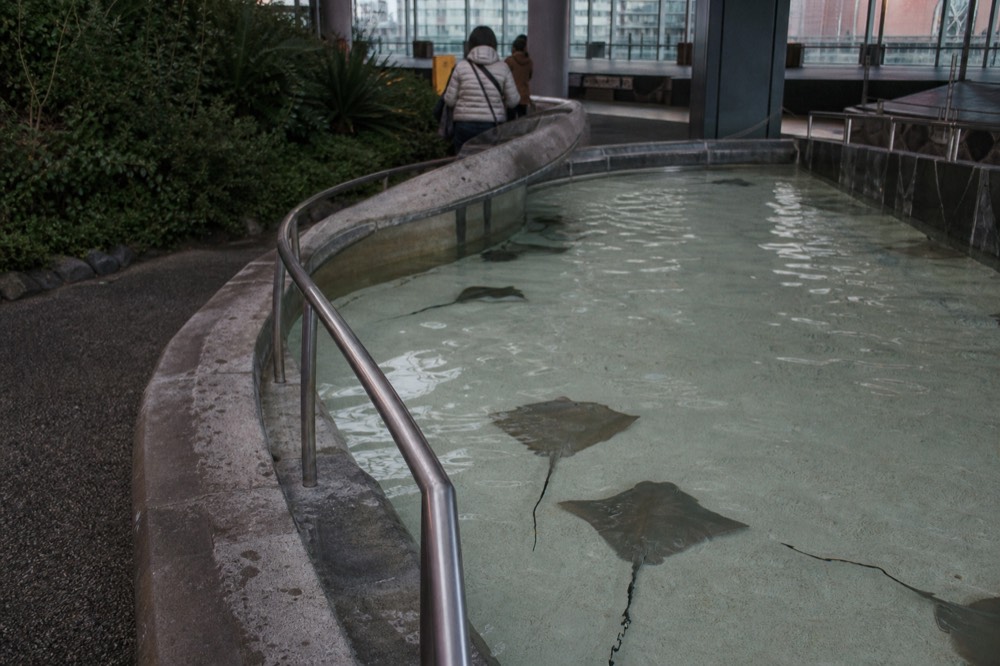
Kaiyukan also benefits from its surroundings in a way Nagoya cannot match inside a single comparison: Tempozan Harbor Village wraps the aquarium with a marketplace, a retro food alley, the Tempozan Giant Ferris Wheel and the Santa Maria replica cruise, so a family can spend a whole day at one train stop. Travelers weighing the wider day out rather than the aquarium alone should read our overview of things to do near Kaiyukan before deciding.
So which one should you actually choose?
Choose Nagoya if you want the cheaper, simpler, show-driven day: 2,030 yen flat, 50,000 animals, and Japan's largest main pool. Choose Kaiyukan if you want the deeper, more architectural visit: about 11,000 tons of water, two whale sharks, and a spiral descent built around one 5,400-ton tank. Travelers with time for only one and no strong preference should pick by city, not by aquarium.
The pattern across this whole comparison is that each aquarium wins the axes it was designed around. Nagoya, run by the city's port authority since 1992, was built around performance and volume, and its numbers show it: more animals, a bigger stage, a flat price that undercuts Kaiyukan on every day of the year. Kaiyukan, two years older and built around a single idea, one enormous tank you circle as you descend, wins on immersion, on total water, and on the one animal Nagoya cannot exhibit.
Kaiyukan's strong showing also carries the caveats its fans rarely mention: the price moves with the date, the published calendar ends about two months out, re-entry is no longer allowed, and one tank is currently closed for renovation. Nagoya's strong showing carries its own: it publishes no total water volume, so its scale claim rests on the main pool alone, and the experience leans on scheduled shows that set your itinerary for you.
For a Japan-wide view before you commit, our ranking of the best aquariums in Japan places both venues in context against Kyoto, Sumida, NIFREL and Tokyo Sea Life Park, each with its own verified admission figure.
If the comparison leaves you on the Kaiyukan side of the fence, the practical next step is the timed ticket: the Osaka Aquarium Kaiyukan Ticket is the officially authorized booking route, rated 4.8 across about 14,894 reviews, and it covers all three age tiers in 15-minute capped admission slots. Kaiyukan itself warns that tickets from unauthorized resellers will not admit you, and it names the official website plus a small set of authorized sellers as the only safe routes, so buying through the operator's live listing is the low-friction way to lock a slot.
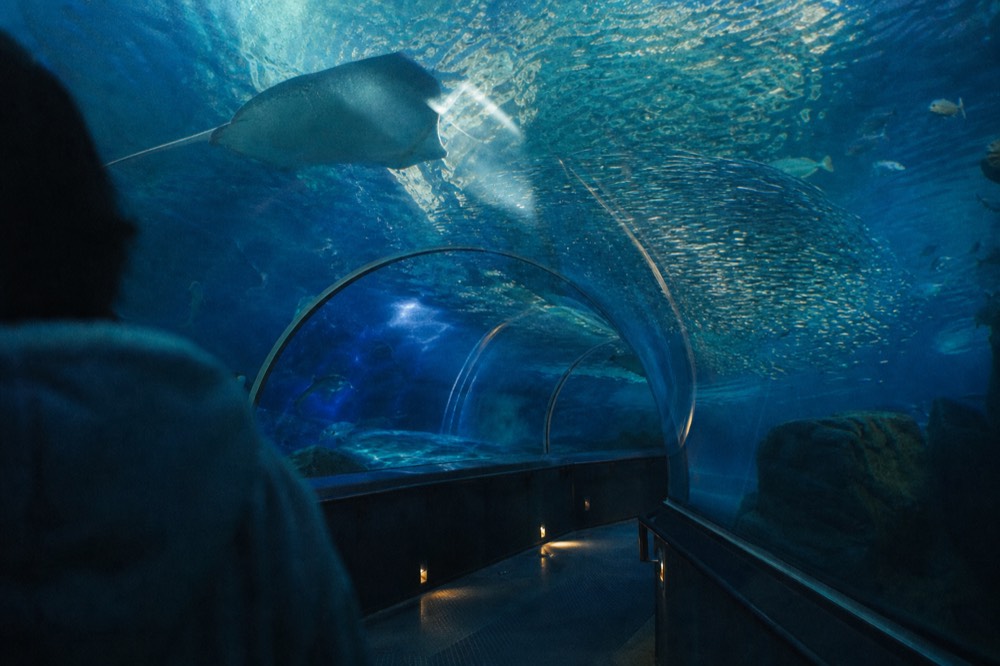
The short answers: Nagoya is cheaper on every date and holds more animals, while Kaiyukan holds the whale sharks, more total water and the more dramatic building. Nagoya's flat adult price is 2,030 yen against a Kaiyukan ticket that moves by date, 2,800 to 3,500 yen on a currently bookable one, and Nagoya keeps about 50,000 animals against Kaiyukan's 30,000 across about 620 species. The questions below cover each point in detail.
Common questions about Nagoya aquarium or Kaiyukan
Which is better, Nagoya's aquarium or Kaiyukan?
Nagoya wins on animal count (about 50,000 against 30,000), headline tank size (Japan's largest main pool at 60 by 30 by 12 meters) and price (2,030 yen flat against 2,800 to 3,500 yen by date across the bookable window). Kaiyukan wins on total water volume, roughly 11,000 tons, on whale sharks, and on the spiral top-down route. Pick Nagoya for shows and value, Kaiyukan for immersion.
Is Nagoya Aquarium cheaper than Kaiyukan?
Yes, on every date. Nagoya charges a flat 2,030 yen for adults with no date variation, while Kaiyukan's demand-based calendar charges 2,800 to 3,500 yen across the currently bookable dates, and more than three quarters of those days are 2,800 yen. Even Kaiyukan's cheapest bookable day costs more than Nagoya's flat rate.
Which aquarium has more animals, Nagoya or Kaiyukan?
Nagoya does on individual animals, about 50,000 against Kaiyukan's about 30,000. Kaiyukan lists more species, roughly 620 against Nagoya's roughly 500, so Nagoya has the bigger collection of creatures while Kaiyukan has the wider variety of species.
Does Nagoya Aquarium have whale sharks?
No. Kaiyukan is the only one of the two with whale sharks: two individuals, Kai and Yu, measured in October 2025 at 5.30 and 6.20 meters. Nagoya's signature animals are its dolphins, kept in Japan's largest main pool, along with its orca and penguin exhibits.
Which aquarium is older, Nagoya or Kaiyukan?
Kaiyukan, by about two years. Kaiyukan opened on 20 July 1990 as part of Tempozan Harbor Village. Port of Nagoya Public Aquarium's south building opened on 29 October 1992, with the north building added in 2001.
Does Kaiyukan's price change depending on the day?
Yes. Kaiyukan uses demand-based pricing with a date-by-date calendar, so the same adult ticket costs 2,800 to 3,500 yen depending on the date across the currently bookable window, and the older 2,700 yen level it once charged appears on no bookable date. Nagoya charges one flat price with no date variation.